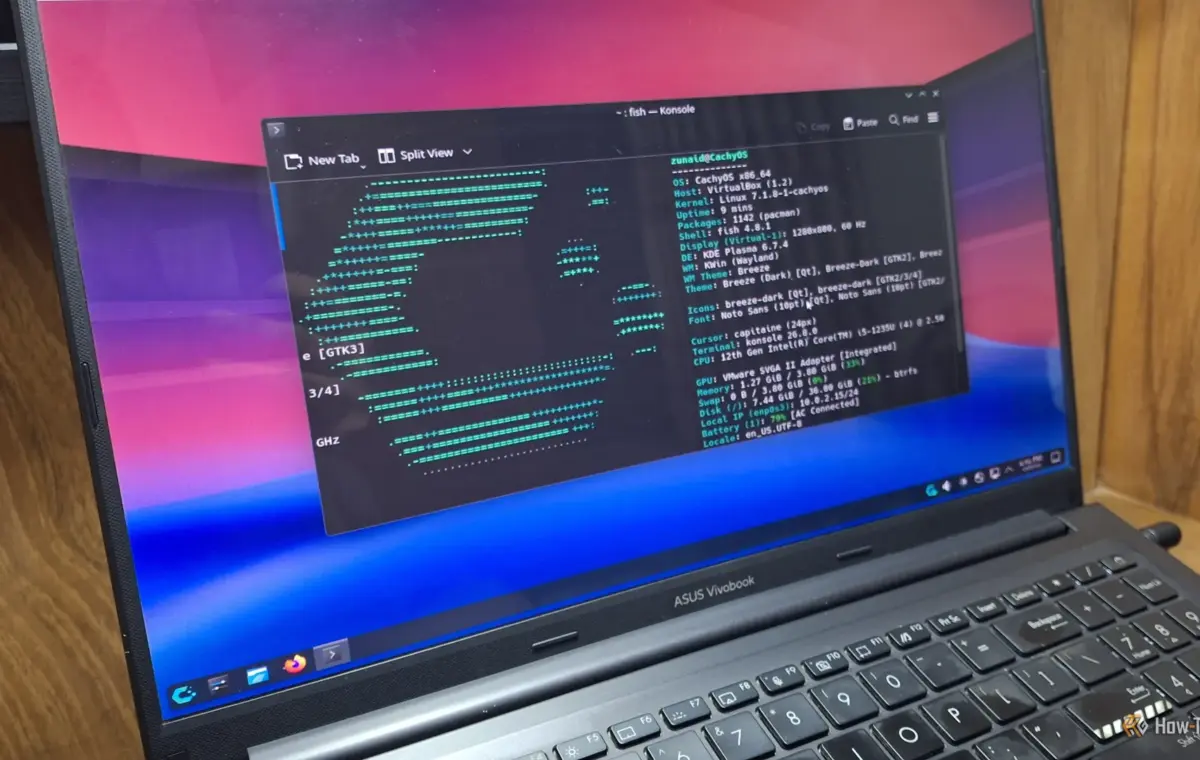
I've used both Windows and Linux for years now. To the disappointment of many of you, Windows mostly won the tie-breaker. It's not like I admire Windows a lot. Rather, fully switching means I have to give up a smooth desktop, a vast software collection, a no-headache gaming experience, and the comfort of "it just works."
When I first came across CachyOS, things looked different. I quickly downloaded the ISO file, spun up a machine in VirtualBox, and started poking around. Sure, it wasn't a Windows clone. However, it closed most of the gaps I found in other distros. As someone who daily drives both Linux and Windows, I was considering, for the first time, shifting to Linux fully.
CachyOS doesn't market itself as a beginner distro. And despite being based on Arch, it's not only for Linux veterans either. That's the fun part. CachyOS caters to everyone. The desktop experience is phenomenal.
KDE Plasma is the default desktop environment. However, CachyOS offers a lot more options. Earlier in 2026, the team added a feature to the installer that lets you see animated previews of Plasma, GNOME, Niri, COSMIC, and others before you ever hit install. I even got to pick a bootloader. I went with Limine, which was the default choice.
The CachyOS Hello application is a nice touch, welcoming you whenever you boot into the system. It has links to some useful resources and quick actions that I'm sure you'll go back to often.
CachyOS is highly optimized, featuring packages compiled with x86-64-v3/v4 and Zen4 instructions, as well as a custom kernel and the EEVDF scheduler. For those of you nerdy enough, it's some cool information to know.
Software was another consideration I used to keep at the back of my mind. I tried to switch to open-source alternatives and had some success to some extent. However, there was always that "one" pesky Windows-only app that I perhaps used once or twice every month, which didn't have any workaround.
CachyOS ships with WinBoat available in its repos, so installing it is straightforward. In fact, you can do so from the CachyOS Hello menu. WinBoat spins up a lightweight Windows VM inside a Docker or Podman container. It then streams the app back to your Linux desktop to make it feel native.
Your Linux home folder even mounts inside Windows, making file movement a breeze. This really was a game changer when I learned about it. This setup lets you run Windows without dual-booting at all. You get to keep the whole thing contained inside the Linux desktop you're already using.
Yes, it's not perfect. WinBoat doesn't do GPU passthrough yet. As a result, GPU-heavy apps will struggle. However, for me, that was not much of a concern.
I replaced Windows on my laptop and haven't missed it once.
Arch-based distros have a reputation, deserved or not, for demanding constant terminal use. But CachyOS boasts Octopi and pamac, two great graphical package managers. These allow you to install pacman packages, the AUR, Flatpaks, and AppImages from one window.
You can search for, install, and update applications the same way you would on the Microsoft Store on Windows. So, if the terminal scares you, you can mostly do without it. So, if you're coming from Windows and are nervous about typing sudo pacman -Syu on day one, that GUI layer removes a lot of the scare factor.
Setting up gaming on Linux used to mean solving a puzzle. CachyOS collapses all of that into one step. The cachyos-gaming-applications package installs Steam, Lutris, and Heroic together. This also comes in the CachyOS Hello menu.
Heroic even added an option to grab Proton-CachyOS, the distro's own tuned Proton build, directly from inside the launcher. That means no more jumping between three different apps to run that one game.