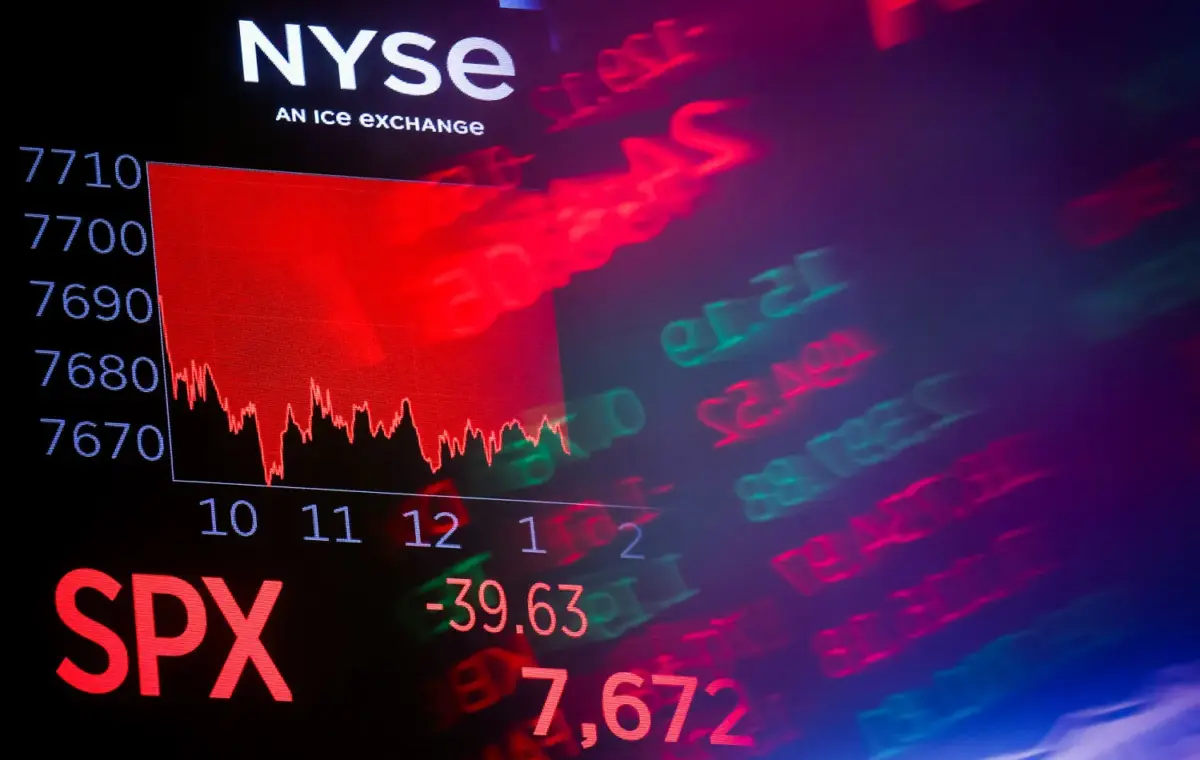
U.S. government borrowing costs surged Tuesday and stock markets opened sharply lower amid growing concerns that the Federal Reserve will raise interest rates at its next policy meeting to combat persistent inflation.
The yield on the 10-year Treasury note, which represents the return investors demand for lending money to the U.S. government for a decade, hit its highest level since January 2025, rising to about 4.79%.
On Wall Street, the benchmark S&P 500 opened 0.7% lower, nearing its one-month low, while the tech-heavy Nasdaq was down 1.3%.
The immediate cause for the move higher in the 10-year yield was renewed tensions with Iran and in the Strait of Hormuz, which sent the price of Brent crude up 2% Tuesday to more than $92, its highest level in about a week.
A British government agency said a tanker had been struck late Monday off the coast of Oman, while the U.S. and Iran traded tit-for-tat strikes on military installations in the Middle East.
Federal Reserve Chairman Kevin Warsh also indicated last week that the central bank is uncomfortable with the current rate of inflation, remarks investors interpreted to mean the central bank will likely raise its key interest rate in response. Warsh said business investment, led by AI spending and consumer demand, remain brisk.
The upshot of it all: Investors continue to demand a higher return in exchange for lending money to the government, to compensate for rising inflation risks. The 10-year yield also serves as the benchmark borrowing rate for most common consumer lending in the U.S. economy — mortgages, auto loans and credit card debt. That means average consumers are likely to face higher borrowing costs in the weeks and months ahead.
The rise in U.S. yields Tuesday paralleled similar moves around the world which were even more severe. Japanese benchmark bond yields hit a record high, while 30-year U.K. government bonds notched their highest level since 1998.
The tandem moves reflect similar issues across developed nations: widening deficits, and rising debt loads and tight global oil supplies that are all contributing to higher inflation.
At the same time, investors’ appetite for riskier assets, like stocks, continues to climb. That makes government bonds — which are seen as “safe haven” assets due to their guaranteed payout structure — relatively less appealing, putting further upward pressure on their yields.
Not all market observers believe yields are rising for “bad” reasons like rising inflation risks, however.
Matthew Klein, author of The Overshoot newsletter, argues In a new note that rising government bond yields are, on balance, a sign of reinvigorated economic health after more than a decade of sluggish growth.
Led by investments in artificial intelligence alongside increased government spending, the U.S. and developed economies writ large have entered a new stage of growth, he writes, one that makes government bonds relatively less attractive investments compared to stocks.
“Today’s rates are obviously too high only if inflation and growth are both poised to slow sharply from here,” he writes. “That is certainly possible, but it would (probably) only happen if the U.S. fell into a downturn.”
In other words, if yields started to fall again, it could signal an economic slowdown.