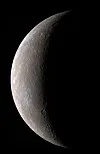
After nearly eight years, ESA and JAXA’s BepiColombo spacecraft is finally nearing Mercury, as engineers begin the arrival sequence by jettisoning the power module that got it this far. The spacecraft stack separated from the Mercury Transfer Module (MTM) on September 3 at around 1400 CEST. After a tense few minutes, controllers confirmed that a preliminary Doppler signal had been detected, indicating that the MTM had separated successfully; by 1552 CEST, it was confirmed that signals had been picked up, indicating that all had gone to plan. The solar panels of the Mercury Planetary Orbiter (MPO) were charging the spacecraft’s batteries. The next stage involves dropping into orbit around Mercury on November 21. Then the Mercury Magnetospheric Orbiter (MMO) – aka Mio – will be released between December 9 and 10, and a week later MPO will start moving to its final orbit over 480 x 1500 km, with science commencing in April 2027. The arrival is a year later than planned. BepiColombo was supposed to have been orbiting Mercury in December 2025, but problems with the spacecraft’s Solar Electric Power (SEP) system meant the trajectory had to be rethought, which extended the spacecraft’s cruise. BepiColombo is no stranger to Mercury and has performed six flybys of the planet since 2021. It has also conducted flybys of Venus and Earth following its 2018 launch. The spacecraft is an impressive example of international cooperation. The MPO and MTM are ESA contributions, while the MMO comes from JAXA. ESA also provided the sunshield to protect the MMO during transit. This sunshield will be ejected after the MMO is released. The MPO is the big brother of the BepiColombo partnership, with a main body measuring 2.4 x 2.2 x 1.7 m and a mass of 1,230 kg (including an 85 kg science payload). JAXA’s MMO is 1.8 m in diameter and 1.1 m high, and weighs 255 kg (45 kg of which is the science payload). While MPO is 3-axis stabilized and nadir-pointing, MMO will be spin-stabilized at 15 rpm, with its spin axis 90 degrees to the Sun. The goal of the mission is a study of Mercury, “from the structure and dynamics of its magnetosphere and how it interacts with the solar wind, to the properties of its large iron core and the origin of its magnetic field.” The initial mission at Mercury is planned for one Earth year (approximately four Mercury years), although it could be extended by another Earth year. ®
Commodities
BepiColombo sheds its ride and starts the final glide to Mercury
After nearly eight years, ESA and JAXA’s BepiColombo spacecraft is finally nearing Mercury, as engineers begin the arrival sequence by jettisoning the power module that got it this far. The spacecraft stack separated from the Mercury Transfer Module (MTM) on September 3 at around 1400 CEST. After a tense few minutes, controllers confirmed that a […]