Ambitious aims have given way to political anxiety over prices as many states’ 2030 emissions targets appear increasingly out of reach.
After President Trump pulled the United States out of the Paris climate agreement during his first term, many Democratic-led states passed their own laws to curtail carbon emissions.
But most states that set goals for 2030 are not on track to meet them. Now, with voters worried about inflation, and with the war in Iran raising energy prices, some states have begun to cut back or abandon those goals instead.
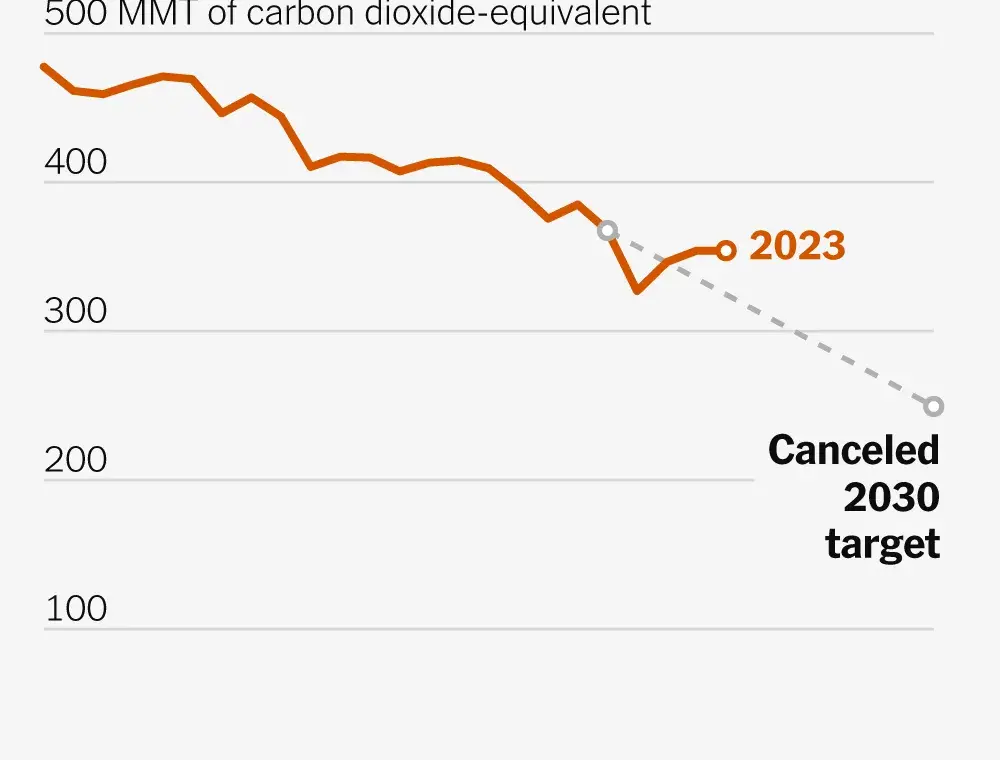
Between 2000 and 2019, New York State emissions fell about 20 percent.
In 2019, Gov. Andrew Cuomo signed a bill setting a legally binding emissions target for 2030.
Emissions dropped sharply in 2020 during the pandemic …
… but rebounded the following years, pushing the state off track for its goal.
Uses gross totals, with 20-year accounting. Source: New York State.
New York’s plan, like those in other states, was to meet the target by passing a series of individual climate regulations affecting transportation, home heating, industry and utilities. The law allowed citizens to sue if regulations to meet emissions targets were not enforced.
With the state behind on its goal, it had a choice: drastically push forward on its emissions target, or abandon it.
In May, New York scrapped the state’s 2030 emissions target. Gov. Kathy Hochul, a Democrat, said sticking to the plan would have imposed “additional crushing costs” on New Yorkers.
Uses individual state data and excludes Maryland, which has no available data. Recent decrease includes the last five years of available data, except for Hawaii, which uses four. Only states with statutory targets for 2030 are included. Sources: State reports.
Uses E.P.A. data (gross emissions, which excludes land use, land-use change and forestry), which differs from individual state accounting. Each state’s data accounts only for in-state electricity generation, not imports. Sources: E.P.A., Census Bureau (population).
Everything else includes agriculture and industry; E.P.A. data for New York, used here, has lower emissions than New York’s own accounting. Buildings and transportation include emissions categorized as residential, commercial and transportation by the E.P.A., which also include some other sources of emissions such as waste. Sources: E.P.A., Census Bureau (population).
Sources: E.P.A., Census Bureau (population).