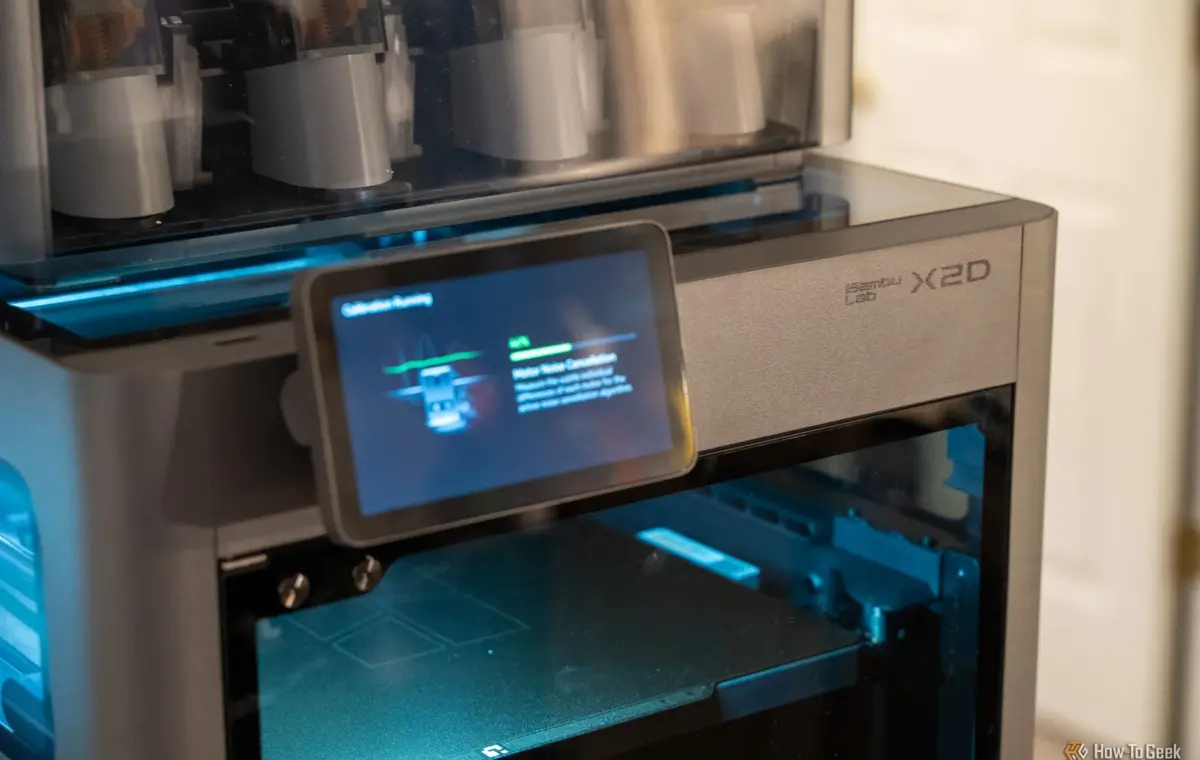
It's been nearly four years since Bambu Lab did a refresh of its X series of 3D printers, and the X2D definitely lives up to the hype. It improves on the X1 Carbon in every way, except for the one area where it lowers the bar—price. Here's why the X2D just became my go-to recommendation for anyone wanting to get into 3D printing.
The Bambu Lab X2D Combo is a mid-range 3D printer with dual-nozzle 3D printing for faster print speeds and better support printing. The nozzle reaches 300°C while the actively-heated chamber hits 65°C which is perfect for engineering-grade filaments. The printer comes with Bambu Lab's signature ease of use, AI fail detection, and has a maximum print volume of 256 × 256 × 260 mm. The combo package comes with the AMS2 multi-material system and filament dryer.
We go hands-on with every product to ensure it's worth your time and money.
The Bambu Lab X2D comes in two versions: the printer only for $649, or the Combo with the AMS 2 Pro for $899. It's available to purchase directly from Bambu Lab, MatterHackers, and Best Buy.
The Bambu Lab X1 and X1 Carbon were the brand's first 3D printers. Since the release in 2022, Bambu has launched many new printers, but the X series of printers saw barely any improvements or new additions.
The P series got the P1P, P1S, and then P2S. The A series got the A1, A1 mini, and A2L. The H series has the H2C, H2D, and H2S. The X2D is taking over as the successor to the X1 Carbon, but it fell short of the lofty heights of the X1C in one very good area—price.
I wasn't quite sure where the X2D would land on price when it was first announced. It has far better specs than the P2S, but it wouldn't make sense for it to be at the same price point as the H2C. Thankfully, Bambu knew this, and made it only a small upgrade charge over the P2S.
Some might think the X2D is a P2S Plus—and it kind of is, depending on how you look at it. The X2D is the P2S with extra features, whereas the P1S was not just an X1 Carbon with a few features removed, it was a very stripped down X1 Carbon with a lot of the core functionality that made the X1 Carbon special removed.
The X2D and P2S share a lot of the same features. They both use the same direct-drive PMSM servo extruder motor, ship with hardened steel nozzles from the factory, have a similar 5-inch touchscreen, reach 300°C on the nozzle, and can extrude plastic at 40mm³/s.
While there are even more similarities, the differences are what set these printers apart. The P2S just has "heat management" for the chamber, circulating the chamber's existing warm air to try and keep the chamber heated. The X2D has active chamber heating up to 65°C, which means that there is a dedicated heater keeping the chamber warm instead of using ambient heat. The bed can also get an additional 10°C hotter, hitting 120°C.
The X2D also ships with proper filtration from the factory, while it's an add-on for the P2S. The active chamber heating paired with active filtration makes the X2D much better suited for engineering-grade filaments like ABS, ASA, or PA-CF.
However, these differences are mainly for printing more challenging filaments. If all you print is PLA, PETG, and TPU, then the X2D only offers one main advantage over the P2S—dual nozzles.
The biggest change that the X2D brings to the table is dual-nozzle printing for under $1,000, which, until now, was unheard of in the Bambu lineup.
The X2D's second nozzle is what's called a Bowden drive extruder, which means the motor pushing the filament is back where the filament is fed in. This is actually a pretty big step down, all things considered. Material like normal TPU can't be fed through a Bowden extruder, and there are just more issues with Bowden extruders compared to direct drive.
This fits what Bambu is selling the X2D's auxiliary as, though. Bambu isn't saying that this is a second main nozzle, they're saying it's for support material and other things like that. For those jobs, it does great.