Account subscription benefits alongside Premium Stories, Editorials,
Opinions and more. Unlock these with Subscription
The View From India
Looking at World Affairs from the Indian perspective.
First Day First Show
News and reviews from the world of cinema and streaming.
Today's Cache
Your download of the top 5 technology stories of the day.
Science For All
The weekly newsletter from science writers takes the jargon out of science and puts the fun in!
Data Point
Decoding the headlines with facts, figures, and numbers
THEdge
At the cutting edge of education and careers
Health Matters
Ramya Kannan writes to you on getting to good health, and staying there
Gender Agenda
Stories from beyond the binary.
The Hindu On Books
Books of the week, reviews, excerpts, new titles and features.
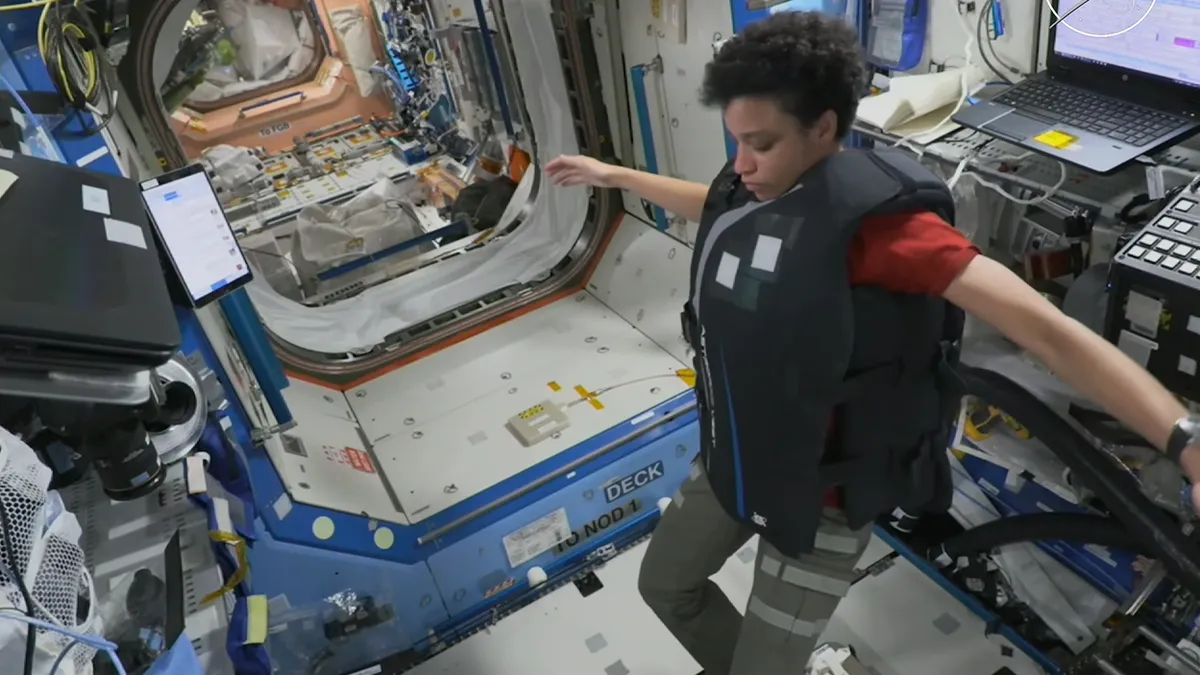
NASA astronaut Jessica Watkins evaluates the AstroRad vest onboard the International Space Station, July 17, 2022.
| Photo Credit: 2s0ckz (CC BY-SA)
Despite their best efforts to settle the moon and later Mars, humans may never become a spacefaring species, more than a few experts have said over the years. An important reason for this view is radiation. The earth has a magnetic field that keeps harmful radiation at bay, but astronauts who fly beyond this field are at risk of developing cancer and other serious health problems.
A common fix for this problem has been to add more shielding for astronauts. However, every additional kilogram increases the launch cost by a large amount, and it is often also impractical to add enough shielding to a crew capsule to cope with a major outburst of radiation from the sun.
To this end, an Israeli company named StemRad has, along with Lockheed Martin, developed a vest called ‘AstroRad’. StemRad had originally made the suit for emergency responders on the ground who may be exposed to nuclear radiation. The company adapted it for spaceflight, with a twist: AstroRad has more safeguards over the chest, abdomen, and pelvis, where there are large amounts of bone marrow, which make blood, and sensitive organs like the heart and the lungs. It also uses hydrogen-rich polymers to block radiation — materials rich in hydrogen slow energetic particles efficiently because hydrogen nuclei are similar in mass and so maximise energy transfer during collisions — rather than lead, which is more dense.
Overall, the vest is light, and made of panels pieced together to allow the astronaut sufficient freedom of movement.