Experts say better regulation is needed but that bad press about ‘motorized menaces’ puts the ebike revolution at risk
Beware, Americans: there’s a battery-powered threat cruising down beach paths, rolling up hiking trails and zipping along the streets of our cities.
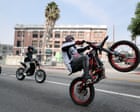
By now, you’ve probably seen footage on social media of teens racing along streets, popping wheelies and weaving around car traffic with reckless abandon. The Los Angeles Times recently dubbed them the “new Hells Angels”. Other news outlets have referred to them as “motorized menaces” terrorizing communities. Sounds scary.
In reality, these aren’t members of a federally designated violent criminal organization – they’re young adults riding electric two-wheeled vehicles: e-motorcycles, e-scooters and e-mopeds that have often been illegally built or modified to reach higher speeds than legal and regulated electric bicycles.
The proliferation of these vehicles is especially noticeable in fair-weather California, where mostly male riders have made headlines for dangerous antics and fatal crashes.
In May, Todd Spitzer, the Orange county district attorney, launched a specialized unit targeting “juveniles and adults, including parents who knowingly allow their children to ride illegal E-Motorcycles”.
That followed charges brought against parents earlier this year in the aftermath of crashes, including one in which a teen on an e-motorcycle fatally struck a pedestrian. In another case, a father was charged for modifying his 12-year-old son’s e-motorcycle to reach 60mph. The boy suffered serious injuries after he ran a red light and was hit by a motorist.
The media attention and government crackdowns extend beyond the Golden state. In New Jersey, the state legislature passed a law requiring registration, a license and, in some cases, insurance for anyone to ride an ebike. Similar laws are already on the books in a few other states, and comparable legislation has been proposed in others, including California and New York.
Look beyond some of the more hyperbolic headlines and you’ll see a familiar story about young people doing what they’ve always done: making dumb, dangerous decisions as they feel out the freedom of movement that grows with age.
That generational constant is happening as local and state authorities play catch-up with cheap, speedy vehicles that have flourished through mostly unchecked online retail sales. They are often marketed as ebikes, despite exceeding speed and power rules set for actual ebikes. Critics argue this makes it difficult for consumers to know the difference.
In this regulatory wild west, legal ebikes are caught in the crossfire. Experts, advocates and retailers say many officials are opting for scattershot over precise targeting to rein in illegal vehicles and invest in more education and infrastructure, putting the broader ebike revolution at risk.
The US and dozens of other nations experienced a surge in electric bike sales during the pandemic, as millions of people craved open space and movement in response to stay-at-home orders. People found an alternative travel mode for local errands, school drop-offs and work commutes, leaving behind the hassles that come with driving.
As components and batteries became cheaper to manufacture, new kinds of two-wheeled vehicles started to enter the market, many from China and often labeled as ebikes. Many of these vehicles had frames much more akin to motorcycles and dirt bikes than traditional bicycles. Another key difference: e-motos can go much faster, allowing riders to hit the same speeds as cars that many riders are too young to drive.
Ebikes are classified under federal law with specifics about their battery power – no more than 750 watts – plus rules about operable pedals to power the motor, and top speeds of 20mph for throttle bikes and 28mph with pedal assist only.
It’s these mis-marketed, cheaply made “junk” vehicles that have given real ebikes a bad rap, said Kendra Ramsey, director of the California Bicycle Coalition. Her organization advocates for policies that promote the benefits of riding bikes, including ebikes, and protect riders on the road.