Since Hurricane Sandy in 2012, a growing labor movement has addressed the climate crisis and economic inequality
Ryan McElroen had spent years repairing the New York City subway underground when he got the opportunity to work in the middle of the ocean.
“I had no views other than the darkness at work,” he said. “Then I went polar opposite.”
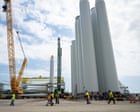
Two years ago, McElroen began being trained by his union, the International Brotherhood of Electrical Workers (IBEW) Local 3, for a job in the emerging offshore wind industry. Since then, he has completed six one-month-long rotations constructing New York’s first large-scale offshore wind projects: four on Sunrise Wind, roughly 30 miles (48km) east of Montauk Point, and two on Empire Wind in the New York Bight, 30 miles south of Long Island.
It was a “welcome change”, McElroen said. Instead of seeing rats, he has watched seals and dolphins swim past his Sunrise work vessel. And on the Empire project, his shifts would often end with sweeping sunsets over the open ocean.
“I would love to continue doing this for the rest of my career,” he said in an interview at his union’s Electrical Industry Training Center in Long Island City, Queens, days after his most recent Empire Wind stint.
Labor leaders convened by the Climate Jobs National Resource Center (CJNRC) have spent years working to ensure that workers like McElroen have the opportunity to develop lifelong, unionized careers in clean energy. Their goals received a major boost from Joe Biden’s Inflation Reduction Act, they say.
Now, the Trump administration is trying to dismantle some of those gains by slowing the clean energy transition, attacking offshore wind and attempting to revive the old idea that workers have to choose between good jobs and climate action. But the labor leaders say they are ready to fight back.
The CJNRC has origins in New York after Hurricane Sandy. The superstorm was a wake-up call for the labor movement, said Mike Fishman, president and executive director of the organization.
“We came to the realization, as you can imagine, that climate change is real and it’s only getting worse, and that workers are getting hit first and worst,” Fishman said. At the time, he was the secretary‑treasurer for the Service Employees International Union (SEIU).
In that moment in 2012, however, unions didn’t have much of a voice in climate policy discussions.
“The climate groups were really all about emissions,” said Fishman. “It was really about, we’re going to reduce emissions at any cost.”
Lara Skinner, founding executive director of Cornell’s Climate Jobs Institute, had seen a similar dynamic, where climate groups would tout potential jobs created by the green energy transition but not focus on whether they would be high-quality or unionized.
“If the answer was going to be yes, well, that was going to take work, that was going to require political power,” she said. She approached Fishman and leaders in the New York building trades and transit unions to begin talking about how to build that kind of power. Together, they developed a blueprint for a statewide clean energy transition that put workers at the center.
To try to make those plans a reality, Fishman, Skinner and members of the New York City Central Labor Council federation of unions formed a committee to launch Climate Jobs New York. They recruited New York organizations representing 2.6 million workers, including the local SEIU and several building trades chapters, to join their coalition and commit funds to advocating for unionized clean jobs.