Michael Zeiler is currently aboard the expedition ship Ocean Explorer, heading to the fjords of Greenland to view the upcoming total solar eclipse on Wednesday.
The veteran eclipse chaser has an ambitious goal: to make the first-ever observation of an aurora during solar eclipse totality. He also said he hoped to spot a few meteors flying by from the ongoing Perseid meteor shower.
Spotting these dazzling celestial displays together will take some luck. The good news? Seeing a total solar eclipse on its own does not. Thanks to powerful computer models and precise measurements, scientists can determine the path of an eclipse years, decades or even millennia in advance.
Zeiler, an eclipse cartographer and founder of the website EclipseAtlas.com, knows this most of all. He has created eclipse maps for over two decades, visualizing for the public the path of totality so that others get the chance to see and even chase eclipses. Zeiler has been chasing them since he saw his first total eclipse in 1991.
"My personal mission is to combine scientific accuracy with cartographic beauty. So, I think that for an eclipse map to really work, the first requirement is it has to be correct, has to be accurate, but it also has to effectively communicate the important information," Zeiler said.
The maps Zeiler creates are built on thousands of years of astronomical observations, mathematical calculations, and increasingly precise measurements of the Earth, moon and sun system that allows scientists to predict exactly where the moon's shadow will fall on our planet — and who will have a front-row seat to totality.
A total solar eclipse darkens the skies when the moon passes between the sun and Earth, casting a shadow onto the planet and blocking the sun's light from some areas of the world, according to NASA.
Because the moon — about 2,159 miles (3,475 kilometers) in diameter — is much smaller than Earth, its darkest central shadow, known as the umbra, is only a few hundred kilometers wide. As the moon moves in its orbit, that narrow shadow sweeps across Earth's surface, creating what's known as the path of totality.
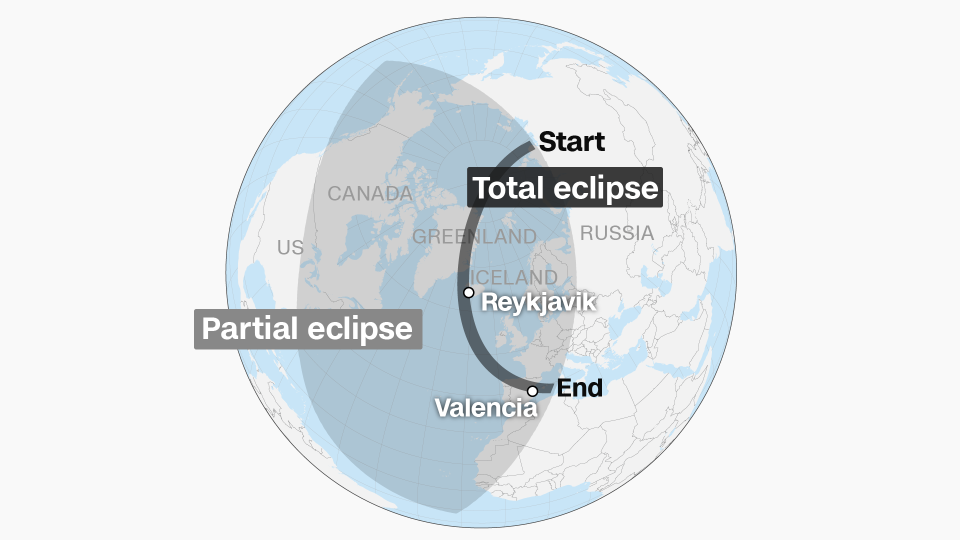
People within the path of totality experience a total solar eclipse, which unfolds when the skies go momentarily dark as the sun disappears behind the moon's shadow. During this year's eclipse, totality will be visible for observers in parts of Greenland, Iceland, northern Spain and northeastern Portugal.
Outside the path of totality, those viewers in the moon's lighter outer shadow, called the penumbra, will see a partial eclipse, in which only part of the sun's light is blocked from view. People in parts of Europe, Africa and North America will experience a partial solar eclipse this year.
The narrow path of totality will span a length of 5,157 miles (8,300 kilometers), starting over the Arctic coastline at around 1 p.m. ET and ending near the Balearic Islands at around 2:30 p.m. ET. Depending on where one is located, the duration of totality can vary. For example, in Reykjavík, Iceland, totality will begin at around 1:48 p.m. ET (5:48 p.m. local time) and last for about one minute, whereas in León, Spain, totality will begin around 2:28 p.m. ET (8:28 p.m. local time) and last for about two minutes. To check when the eclipse will occur in your area, and what it will look like, check Time and Date's website.
Eclipse maps also can help people determine where they want to be to observe an eclipse. Some eclipse chasers prefer to observe from the edge of totality to see certain phenomena that you can't see near the center, Zeiler said. One of these events is known as Baily's Beads, when flashes of light shine through gaps along the moon's uneven edge.
Totality maps are highly accurate for the most part, but there is always room for improvement.
"Right now, the most accurate is somewhere around a kilometer to maybe a kilometer and a half," said solar physicist Alex Young, associate director for science communication in the heliophysics science division at NASA's Goddard Space Flight Center in Greenbelt, Maryland. "We haven't gotten down to the meter scale yet. But I think that we perhaps will eventually get down to that scale."
Young pointed to calculations from the most recent total solar eclipse that was visible from Mexico, the United States and Canada in April 2024. They showed that the sun's radius was slightly different than previously estimated. That small difference shifted the predicted edges of the path of totality in some areas.