Tourism is only just taking hold in Vipava, but the locals are determined to do it right, by putting community first and preserving what makes it special
The drive to Pedrovo is vertiginous, and each hairpin bend has me sending a silent prayer that we won’t meet a tractor coming the other way. When we near it, we abandon the car and continue on foot to the hamlet, a scattering of red-roofed, whitewashed houses high on the steep karst hillside. The air is warm and dry, scented with wild sage.
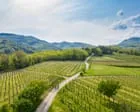
We follow a hand-painted sign to Čilčevi Farmstead. Descending stone steps to a lush garden, we find a shaded table set with fresh cheeses produced at the farm’s own dairy. Below, the valley stretches in both directions, a wide flat plain hemmed in by steep mountain slopes, with the Vipava River winding lazily through fields and vineyards.
If the Vipava valley gets a mention in a Slovenian guidebook, it’s usually as a wine region footnote. The area is an hour’s drive south-west of Ljubljana, meeting Italy at the cross-border city of Nova Gorica (called Gorizia on the Italian side). Most visitors skip it in favour of the Soča valley to the north, drawn to the turquoise river and opportunities for rafting on the rapids.
Vipava is a landscape shaped by a strong wind, the burja, which barrels down from the Alps, keeping the red earth arid, the trees bent low, and creating the perfect terrain for dry wines and dried meats. Tourism has traditionally been less of a focus, but I’m here with my family to meet local entrepreneurs and producers, to learn how this valley is building a genuine visitor experience that works for the community.
Part of the reason for the slow development of tourism has been the scarcity of accommodation, save a few nondescript business hotels and a handful of holiday cottages. One place that’s helping change that narrative is Wellba, a boutique guesthouse in the village of Planina, where an old abandoned farmstead has been converted into self-catering apartments and guest rooms by a local couple, working with traditional craftspeople and salvaged materials.
Marko and Tereza Kobal grew up on this hillside and then worked in Ljubljana before deciding to return to build a family business, striving to create the kind of place they seek out when travelling. “People who travel want to experience something that is just the way it is, without embellishment, pretence, exaggeration – somewhere authentic,” says Marko. We enter Wellba through a traditional “black kitchen”, its walls darkened by generations of wood smoke. “When we came here the building needed work but it had a real soul. We want the building to stand for another 300 years, so we took the renovation slowly and carefully.”
Our light, spacious accommodation wears its history lightly, with plenty of space for playing card games and reading books on the balcony, with views of the neighbouring farmyard and the valley beyond. Next door, another tumble-down farm building will be converted and opened in 2027. The couple are also working on a boutique hotel in Vipava town in the valley below. The dream is for their children to run Wellba one day, forging their futures in this valley.
Across Vipava, similar small projects are emerging: small, family-run and developing slowly and thoughtfully. Tom Ločniškar and Borut Kokalj began Čilčevi Farmstead during the pandemic, having moved to Pedrovo and become interested in farming. “We started to keep animals. Now we have 150, which is too many animals for just a hobby,” laughs Tom.
He recalls the mad panic to source equipment before the lockdowns began. The pandemic also brought him his first customers, people who were out walking and keen to support local businesses. Tom and Borut keep local Istrska sheep and Drežnica goats, which graze on dry karst grasslands, changing pastures across this hillside every four days. Having tasted fresh cheese straight from the chill of the dairy, including creamy goat’s cheese with fenugreek and buttery mature sheep’s cheese, we walk uphill to meet the goats.
Tom says that in the early 1900s around 1,000 people lived in Pedrovo, but by the 1970s the permanent population had fallen to just two, and remained that low until the 1990s. “The village was almost abandoned because people moved to the cities,” he says. “It was the same in a lot of hill villages: life was hard and tractors didn’t work on steep slopes.” Today the population has risen to 20, with second homeowners roughly doubling that number in the holidays.
Elsewhere in the village, I meet Alenka and Mark Smerajc, who were one of the first families to return, raising three children and running a business here. Today they have two small holiday cottages in what were farm outbuildings and run a relaxed courtyard restaurant for guests, opening to the public at weekends and for holidays. “People wanted food,” shrugs Alenka, as her teenage children help bring out beautiful plates of handmade pasta with local cheese and wild herbs from the kitchen.
“In Vipava valley there was no tourism, so we got to decide how to build it,” says Jani Peljhan. That means GPS-guided cycling tours along roads too small to merit signposts, and experimenting with “wine trains”, carrying visitors from Nova Gorica to the vineyards with local winemakers on board to lead tasting sessions.
Get travel inspiration, featured trips and local tips for your next break, as well as the latest deals from Guardian Holidays
Jani’s company, Wajdušna, also offers hiking and paragliding, both gaining in popularity here. He meets us at Wellba with some e-bikes and we pedal through Ajdovščina to spot Roman ruins, and up to Vipavski Križ, famed for being one of the smallest towns in Slovenia, before zigzagging back up the other side of the valley through vineyards. The warmth of the afternoon and the steep hillsides makes me appreciate the “sport” mode on the bikes.