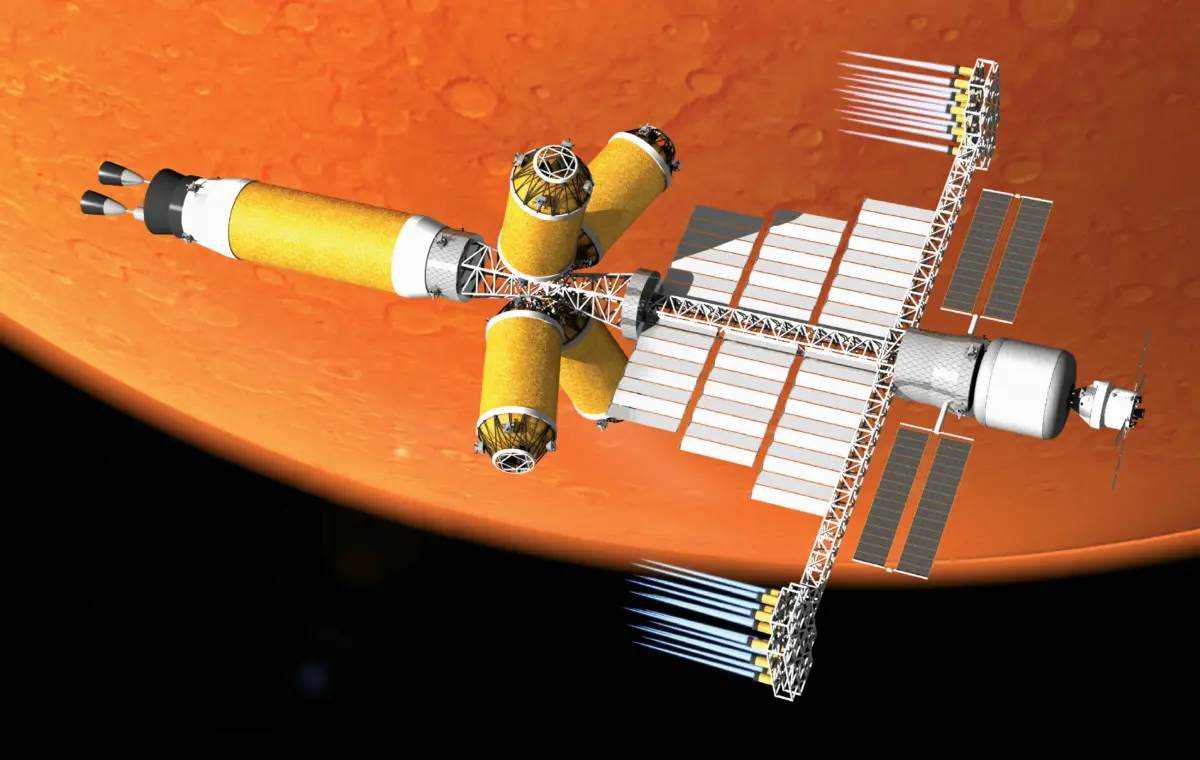
The synchronal bimodal nuclear rocket could slash travel time to Mars
This artist’s impression of a synchronal bimodal nuclear rocket shows a nuclear thermal engine for high-thrust maneuvers and an array of electric thrusters for highly efficient low-thrust propulsion.
The biggest threat to any crewed expedition to Mars is time. NASA’s shortest blueprint for sending people to the Red Planet and back requires spending 620 days in space and 30 days on Mars. Even setting aside the compounding challenges of building life-support systems that can operate without resupply for that long, or the fact that longer journeys leave more time for unlucky accidents, life in microgravity and solar and cosmic radiation will inexorably exact their cumulative toll on human bodies.
We want to make it possible to dramatically reduce the length of time crews must spend in space—down to just 335 days in transit or less. This will both simplify many engineering challenges and keep astronauts healthier and safer. We believe the key to this time reduction is a new approach to building a holy grail of space exploration, the bimodal nuclear rocket.
In the 1960s, U.S. open-air ground tests demonstrated much of the technology needed for nuclear thermal rockets as part of the NERVA and Rover projects.Nevada State Museum, Las Vegas
Technicians at NASA’s Lewis Research Center test a nozzle design for a nuclear thermal rocket in 1965. GRC/NASA
The prototype SNAP-10A, orbited in 1965, is to date still the only nuclear reactor launched into space by the United States. George Rinhart/Corbis/Getty Images
We are Kurt Polzin, chief engineer of NASA’s space nuclear propulsion project at the Marshall Space Flight Center, with over two decades of experience in advanced propulsion research, and Robert Schleicher, chief engineer for nuclear technologies and materials at General Atomics. And to explain just what a bimodal nuclear rocket is, and why the new version we have conceived together brings it closer to future reality, we first need to take a quick trip to the past.
As early as 1946, researchers realized that nuclear reactors had the potential to become extremely efficient thermal rocket engines. Most rockets are thermal rockets, and they work by expelling hot gases through a nozzle, thrusting the rocket forward. While there are other factors such as nozzle shape, generally speaking, the hotter and faster you make the rocket’s exhaust gases, the more acceleration the rocket will produce for a given mass of propellant. Because a smaller molecule will move faster than a larger one when heated to a given temperature, the smaller the molecular mass of your propellants, the better. By convention, the efficiency of a rocket engine is measured by how long the engine can exert a thrust equal to the initial weight of its propellant, a quantity known as specific impulse.
In a conventional thermal rocket, such as those used in every launch to orbit since Sputnik, the exhaust temperature and speed—and thus the specific impulse—is dictated by the energy released by a chemical reaction and the mass of the reaction’s by-product. The most efficient chemical rockets today combust hydrogen with oxygen, producing water and a specific impulse that tops out around 450 seconds.
But a nuclear rocket is not limited by chemistry. The heart of a nuclear thermal rocket is a nuclear fission reactor, in which chain reactions in uranium fuel release much more energy per kilogram than is possible with chemical combustion. A turbopump forces liquid hydrogen alone—with its very small molecular mass—through the reactor’s core, heating it to temperatures of at least 2,700 kelvin before expelling it, resulting in a specific impulse of 900 seconds or more.
In the 1950s and 1960s, the Rover and NERVA (Nuclear Engine for Rocket Vehicle Applications) programs ground-tested nuclear thermal rockets. By the early 1970s, the technology had matured to the point where flight tests were being planned. But changing political and budgetary winds led to nuclear thermal development being shut down in 1973.
Another prong of nuclear propulsion that has also demonstrated considerable promise is nuclear electric propulsion. In electric propulsion, instead of creating a stream of hot rocket exhaust through chemical reactions or exposure to the core of a nuclear reactor, electricity is generated and used to create electromagnetic fields that accelerate an ionized propellant such as xenon or lithium.
Various schemes to do this exist, including some that have already seen considerable time in space, such as the ion thrusters used on the Dawn asteroid mission launched in 2007. So far, these electric thrusters have only been powered by solar panels. But with a nuclear reactor as part of a power plant that supplies the juice, more thrust could be produced. And moving beyond solar power is particularly important in missions to the outer solar system where sparse solar photons would require enormous solar arrays.
With electric thrusters, specific impulses in the range of 2,200 to 4,600 seconds are possible, but currently with very low thrust. With the energy available to a nuclear-powered electric propulsion engine, you could have greater acceleration and reduced mission times. The nuclear reactor could also provide electrical power for all the spacecraft systems as well.