I bought my first cordless power tool over 20 years ago, and it was a shiny new Milwaukee V28 with a lithium-ion battery. Who remembers the V28 line? It was a big, expensive purchase, and over the years I've bought Milwaukee tools here and there, but eventually I got rid of them all and switched to Ryobi. Here's why.
Shortly after buying that expensive Milwaukee V28, I picked up a blue Ryobi cordless drill, followed by a more affordable Milwaukee, only this time it was yet another platform, the Milwaukee V18. None of the three worked together; I had three different battery systems and three different chargers.
At that point, I preferred Milwaukee, but a few years later, the company switched to its current M18 line of cordless power tools and slowly abandoned the V28 and V18 lines. None of those older tools were compatible with the new Milwaukee M18 tools or battery packs. How frustrating.
While all that was happening, Ryobi continued to release capable tools at more affordable prices, and the ecosystem and selection were rapidly growing. If I needed a tool, there was a good chance Ryobi made it. That still holds true today, perhaps more than ever, as it now has an expansive selection of over 350 tools that all run on the same 18V ONE+ battery system.
Fun fact: I still own that old Blue Ryobi drill, from before the company switched to the bright neon green used today. It still works and accepts any Ryobi 18V battery released over the last 20+ years—and that's key!
I have used Ryobi tools for 20 years now, and the ecosystem and backward compatibility are a huge part of what keeps me on Team Green. Throughout that entire time, Ryobi has maintained a strong selection of tools, released niche products, and offered combo deals that were too good to pass up. I ended up selling my V28 and buying a Ryobi 6-tool combo kit, and the rest is history.
The ecosystem and backward compatibility can't be understated. Now, Ryobi has a strong 18V, 40V, and even an 80V platform for all my needs. Ryobi makes a tool for just about any job.
Walk into any hardware store today, and you'll see a wide range of cordless power tools in a variety of colors from all the big brands. And while Ryobi and Milwaukee are both readily accessible at Home Depot now, it wasn't always that way. The same parent company now owns both brands, called Techtronic Industries (TTI) out of China, but that doesn't really matter to me. The easiest place to find both is now at Home Depot.
When it comes to buying new tools, there's no doubt Ryobi is one of the easiest brands to choose. They're all over every Home Depot store, available at select other retailers, and ship fast from online shops or Home Depot's website.
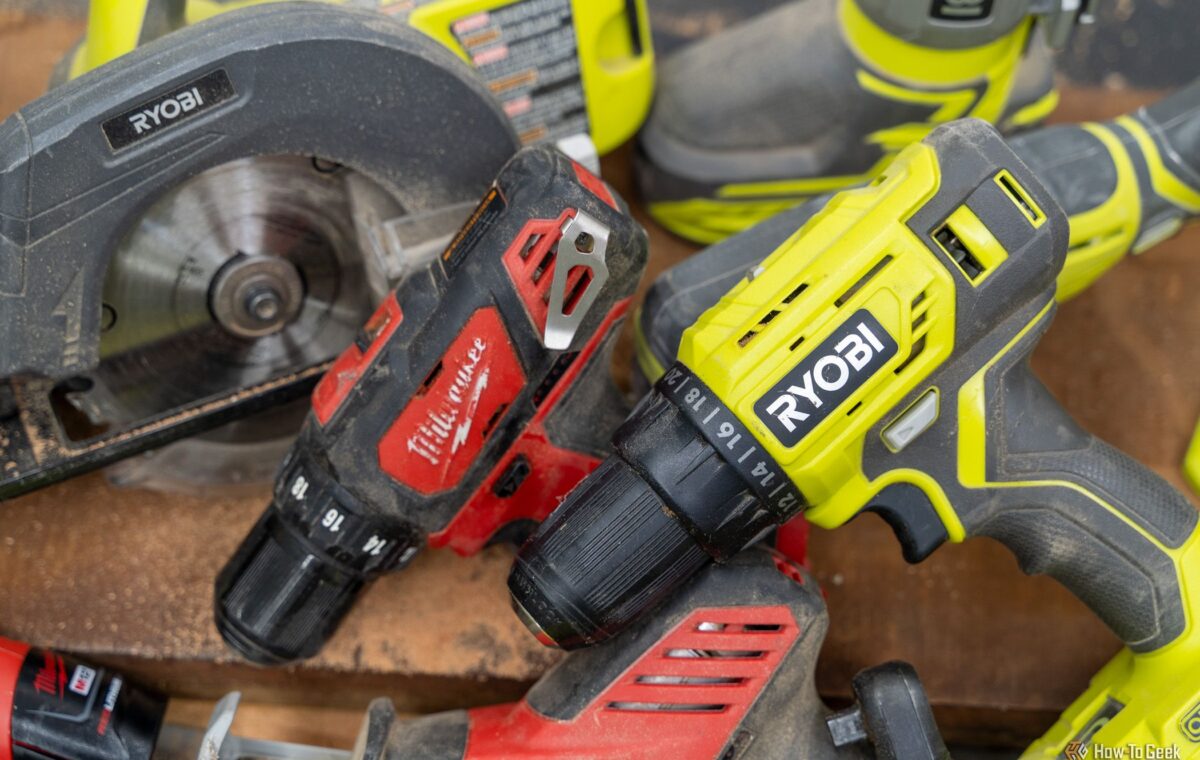
One brand feels more premium, but both have survived years of hard use.
A huge part of that availability isn't just finding a Ryobi tool in a store, but finding the right tool. Again, this goes back to the massive ecosystem that's constantly expanding with more options. Whenever I need a new tool, I can easily find a variety of Ryobi models at different price points.
Ryobi tools are incredibly affordable and perfect for the DIY crowd, and that's exactly who they are marketed to. More importantly, they are constantly on sale at Home Depot, not to mention places like Direct Tools Factory Outlet, which offer even deeper discounts. It's hard to argue with availability and affordability.
Don't get me wrong, I still own a few Milwaukee tools today for specific tasks and working on my truck, but those are few and far between. See, Milwaukee products are way more expensive and largely do the same thing as a more affordable Ryobi.
I'm not saying Ryobi is better than Milwaukee, but they're better for my needs. I'm not a professional who uses my tools every single day, and chances are, you aren't either. When it comes to common household tasks, repairs, or maintenance, all you need is a dependable tool that gets the job done. And for me, that's Ryobi.
A prime example is that scratched-up old blue Ryobi drill of mine in the photos above. That thing is 20 years old, runs off my newer 18V ONE+ HP battery pack, and it'll still drill a hole in a wall just as easily as a $200 Milwaukee drill. Milwaukee might be more premium and a hair faster, but that's not a priority for me.