From a 500-year-old inn in the Italian Dolomites to a log cabin in Finland’s lake district, these boltholes offer a tranquil and restorative getaway
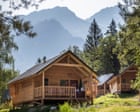
It’s not easy to get to Rifugio Val di Togno, at 1,317 meters (4,320ft). The dirt road from the nearest town winds for 4 miles through 27 hairpins and is best done in a four-wheel drive, or it’s a solid two-hour hike from the tiny hamlet of Carnale. But as managers Luna Lybeer and Wout Allegaert say: “We offer guests nothing so they can get away from everything.” Although you can hardly describe this beautifully renovated mountain hideout as “nothing”. Every room looks down the valley, whether through a porthole-like round window or huge floor-to-ceiling sliding doors. Breakfast, lunch (or a picnic to take on a hike), afternoon snack, aperitivo and a two-course dinner are included too – delicious vegetarian meals made using produce from the couple’s garden, or foraged nearby, along with homemade kombucha, sourdough and gnocchi.Doubles from £298 all-inclusive (three-night minimum), rifugiovalditogno.com
Built in 1910, the old station at Lermoos in Austria’s Tirol had stood empty for years before Johann Ehmann and his wife Cleo Weber bought it in 2019. “We were fascinated by it and contacted Austrian Railways regularly for more than five years asking if it was for sale,” says Ehmann. Now the couple have converted the classic Alpine building at the foot of Zugspitze (Germany’s highest peak) into Lermooser, a design B&B. The eight rooms range from a cosy bunk bed “cabin” to the “team XL” with three single beds and a double in a row. There’s a communal kitchen and a kiosk downstairs for coffee, pastries and homemade soups. The train still stops right outside, and hikes up to the Tuftl Alm viewpoint, and to Seebensee and Drachensee, start right from the door.Doubles from £106 B&B, lermooser.com
In summer, the sun doesn’t set until 11pm at Røisheim, which sits on the fringes of Jotunheimen national park in southern Norway. That means all the more time to go on blue ice glacier walks and swim in mountain lakes, cycle over the Sognefjellet pass or tackle Galdhøpiggen, Norway’s tallest mountain at 2,469 metres (8,100ft). The first recorded ascent of Galdhøpiggen in 1850 started from Røisheim and the trail still leads from the courtyard of the hotel, although most hikers now choose quicker routes starting from nearby Spiterstulen. Røisheim, a time capsule of a turf-roofed hotel, has been welcoming mountain-lovers since 1858 and many of the rooms are faithfully preserved with timber-clad walls, carved wooden beds and barrel-like tubs.Doubles from £243 B&B, roisheim.no
“We didn’t choose Mittenwald because we wanted to open a hotel, we chose it because we wanted to live somewhere that summer still feels like summer,” says Anne-Sophie Trinkgeld, who recently opened Karls Mittenwald in this pretty small town near the Austrian border with her husband Dario. Mittenwald came out top in their search for the best combination of climate, outdoor activities and accessibility in the Alps – it’s surrounded by mountains but just 40 minutes from Innsbruck. The couple turned the former bakery into 11 thoughtfully designed one- and two-bedroom apartments with a cafe downstairs serving breakfast spreads and homemade cakes. Just the fuel for days spent swimming in the clear waters of Lautersee, cycling to the source of the Isar River through the Karwendel nature park or hiking to Germany’s highest brewery, Karwendelbräu.Apartments from £145 a night, karls-mittenwald.de
Nearly 1,000 metres (3,280 ft) above sea level, the wide Mieming Sun Plateau is known for its mild microclimate and looping hikes through pine forests and Alpine meadows. Josef Volgger grew up on a farm here, Gerhardhof, which his parents also ran as a small guesthouse. Now Volgger, along with two business partners, has transformed Gerhardhof into a sustainability-minded campsite with grey water recycling, wood-chip heating and solar energy, as well as a naturally filtered swimming pond. You’ll still see Josef’s mother Edith in the bakery, turning out apple strudel, and there is a restaurant for dinners of wiener schnitzel and Käsespätzle (an Alpine mac and cheese).Pitches from £38 a night, gerhardhof.com
Over its five centuries in the South Tirolean town of Lana, the building that now houses 1477 Reichhalter has had many incarnations, including a butcher, bakery, sawmill, stable and tavern. Since 2018 it has been a restaurant with eight bedrooms dressed in mid-century furniture. Room number 4, Helmsdorf, has a balcony with views of the Vigiljoch mountain and Braunsberg Castle (you can borrow a bike to explore further), while Schönmüller is another favourite for its raw plaster walls and tiled stube stove. Downstairs, tables spill on to the pedestrianised street from the restaurant, which dishes up a delicious beef tartare and house salad made with homemade pickled vegetables and whatever’s in season from the kitchen garden at sister hotel Villa Arnica.Doubles from £170 B&B, 1477reichhalter.com
For 40 years, Johanna Fink ran her family’s Alpine hotel Briol with simple efficiency: sheets air-drying on the line, guests summoned to dinner by cowbell at precisely 7pm. Recently, her children Victoria and Valentin von Klebelsberg have taken over, but Briol remains charmingly the same. The main house was renovated in 1928 by artist Hubert Lanzinger in modernist Bauhaus style – the bedrooms have no heating (there is a hot-water bottle service), guests share a bathroom and there are no TVs, wifi or pictures on the walls. But with views like this, from a mountain meadow high above Barbiano and the Eisack valley, the lack of distraction is very welcome, and hiking trails fan out from the doorstep.Doubles from £255 half-board, briol.it
Stugbaat is a collection of five houseboats that bob around the huge Lake Lelång in Dalsland. Each floats on an aluminium or stainless steel pontoon, and comes with a little motorboat for towing the tiny house to a quiet corner or pootling ashore to explore. On dry land, there are mountains to climb (Egersknatten), berries and chanterelles to forage in the forest, a straw museum in Bengtsfors and a microbrewery in Torrskog. But, really, it’s all about the lake: fish from or dive off the wooden deck that surrounds the cabin or take out the paddleboard included with each booking. You can hire a kayak, check out the floating sauna, or simply drop anchor and do nothing.From £233 a night (two-night minimum), sleeps 4, stugbaat.se
Thomas Peterson started with just one log cabin, which he handbuilt on a section of pine and spruce forest on the shores of Lake Eldan in Värmland. Then he built another, and one up in the treetops, and one floating on the water. There are now seven at Naturbyn, all off-grid (no wifi or electricity, just wood-burning stoves and paraffin lamps), all with views of the lake and some with grass roofs dotted with tiny wild strawberries. This being Sweden, there’s a sauna on the lakeshore. Beyond that, borrow a canoe, forage in the forest, watch for elk among the trees, catch a pike for supper or count shooting stars across the inky sky.Cabins from £160 a night, sleeps 2, naturbyn.se
In the heart of the Danish Lake District on the Jutland peninsula, the 19th-century mill town of Silkeborg is known as Denmark’s outdoor capital. Just south of Silkeborg, the waterfront hotel Ny Hattenæs has sat on the forested shore of Brassø Lake since 1896 when it opened as a summer boarding house. It is now open year-round, but summer is still the loveliest time to stay, when days are long, the lake is filled with people swimming, paddleboarding and canoeing, and the terrace at Ny Hattenæs is the perfect place to catch the lingering twilight. Revamped in 2022 by the trio of siblings behind Danish design house Society of Lifestyle, the 14 bedrooms are filled with House Doctor furniture and the bathrooms stocked with Meraki natural products. Room number 7 is the plum pick, with a large balcony overlooking the water.Doubles from £205 B&B, nyhattenaes.com
Less than an hour’s drive south of Munich, Tegernsee is where city folk flock in the summer to drink in leafy beer gardens, tuck into knödel dumplings in farmhouse restaurants and boat on the lake. Lederhosen and dirndls are still a regular sight in some parts here, but the recently opened hotel Blyb, in the quiet village of Gmund am Tegernsee, is as far from the usual Bavarian cliches as you can get. The villa dates back to 1892, and while it still has original stucco paintings and ornate wooden balconies, they’ve been updated with crisp monochrome decor, a restaurant from the team behind the hip Munich spot Mural, an outdoor yoga deck and events that might include a doner kebab and DJ pop-up or intimate unplugged gigs in the library.Doubles from £112 room-only, blyb.co
Berlin school friends Julian Trautwein, Johann Ahlers and Christopher Eilers founded Raus in 2021 with the simple idea of getting city-dwellers like themselves out into nature. They started with a handful of sustainably built cabins near German cities and this year have added their 100th. Lodge am See takes the Raus concept and turns it into a little cabin resort, with 17 huts by a lake in the Unesco Elbe River Landscape Biosphere Reserve, between Berlin and Hamburg. The area is known for its quiet cycle paths, but the water is just as attractive, and there are free paddleboards to borrow, canoe hire nearby and sea eagles, storks and cranes to spot above the wetlands.Cabins from £126 a night, sleep 2, raus.life
Get travel inspiration, featured trips and local tips for your next break, as well as the latest deals from Guardian Holidays
Finnish Lakeland is Europe’s largest lake district, a watery labyrinth of thousands of lakes, rivers and channels. Its biggest body of water, Lake Saimaa, is like an inland archipelago of nearly 14,000 forest-covered islands. In summer, Finns flock here to lakeside log cabins (known as a mökki), which are an essential part of Finnish culture. On the site of a historic sawmill on Saimaa’s rippling shoreline, Sahanlahti Resort embodies mökki tradition old and new, with timeless red-painted wooden cabins (some with their own saunas) and sleek modern villas that come with wraparound terraces. You may even spot a Saimaa ringed seal, one of the world’s rarest.Cabins from £93 a night, sleep 4, sahanlahtiresort.fi