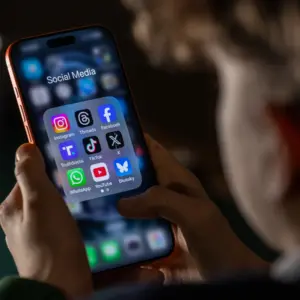
The settlement between states and Meta, the company behind Facebook and Instagram, means there will be new safeguards for young people on those platforms. What do psychologists think of the changes?
Meta has agreed to settle with the states that sued it.
Yeah. The states allege that the company knowingly designed social media platforms to be addictive to minors. Meta denies this. The proposed settlement requires Meta to pay up to 17 billion in penalties to states over 10 years. They also say they will make specific changes to Facebook and Instagram to make them safer for kids.
INSKEEP: NPR health correspondent Rhitu Chatterjee is here in Studio 31 to talk about this. Good morning.
RHITU CHATTERJEE, BYLINE: Good morning, Steve.
INSKEEP: OK. So this is personal for you and me. We're parents.
INSKEEP: We're thinking about our kids. What kinds of changes has Meta agreed to make?
CHATTERJEE: So the changes involve both restricting the kind of content kids can see and features that will make their social platforms a lot less addictive.
CHATTERJEE: So for example, they will have to give minors the option of having non-personalized feeds where Meta does not use an algorithm to throw specific content to keep them scrolling.
CHATTERJEE: There will be a default daily time limit of two hours for minors, and only parents can opt out of that.
INSKEEP: Oh, meaning that the kid would have to say, Mom, Dad, can I…
CHATTERJEE: And the parents will have to agree. And so Meta will have to have a default block on nighttime use from midnight to 6 a.m. And a block on notification to minors both overnight and during school hours when they are in classrooms. There will also be a ban on showing minors how many likes or reactions they have to their posts.
INSKEEP: All this sounds good. Does it actually make kids safer, though?
CHATTERJEE: In theory, yes. So psychologist Mitch Prinstein co-directs the Winston Center on Technology and Brain Development at the University of North Carolina Chapel Hill. And in fact, he was scheduled to testify at the trial on Monday. Doesn't have to do that, of course. He told me that these constant notifications and likes and dislikes on platforms are not well suited for the preteen and teenage brain.
MITCH PRINSTEIN: By the time a kid turns around 10 or 11, the part of their brain that makes them suddenly super interested in things like popularity and who sits at what lunch table are really showing a hypersensitivity to social signals.