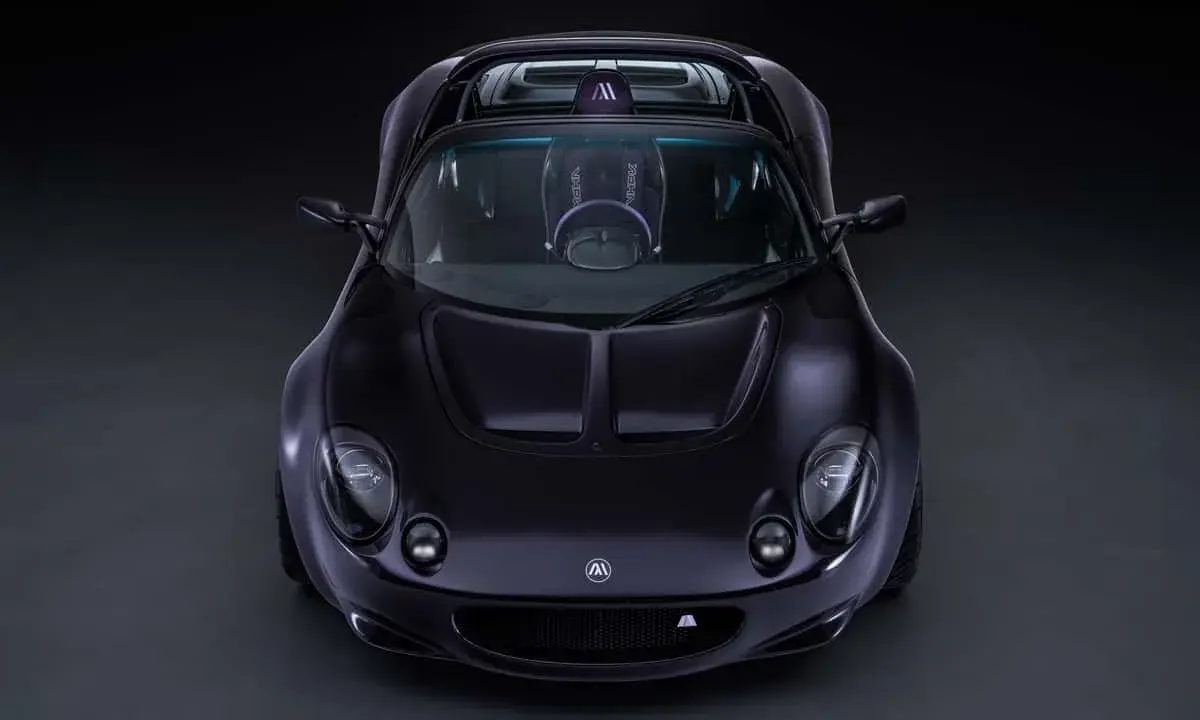
Analogue Automotive has just handed over the first Lotus Elise VHPK, a car that costs 17 times more than a clean Series 1 donor yet keeps the same aluminum chassis underneath. It weighs under 600 kilograms (1,323 pounds) and puts the driver dead center of the cabin.
Only 35 will exist, each starting at £350,000 (about $472,500) before tax, donor Elise included. That price tag has sparked plenty of arguments online, but the build itself explains most of it.
Steffen Dobke, the company's CEO, does not call it a restoration. "This isn't simply a restored Elise," he said. "It's a complete reimagining of what's possible with the original S1 recipe, the legendary combination of the Type 111 chassis with that high-revving, lightweight K-Series engine."
Every VHPK starts life as a Series 1 Elise, then gets torn down to the bonded aluminum tub before Analogue Automotive rebuilds it around a carbon-fiber body and a lightened fuel tank and wiring loom. That's the same extreme-lightweighting instinct that drove other British specialists, including the shop behind the Lotus Esprit V8 restomod.
Dobke's pitch is blunt: he calls the finished car "superior in every way to a brand new S1 Elise," a claim that only makes sense once you compare it against the original math. A stock Elise S1 weighed just over 700 kilograms (1,543 pounds) with 120 hp; even the hotter Sport 160 only reached about 770 kilograms (1,698 pounds) dry and roughly 158 hp. The VHPK undercuts both by well over 100 kilograms (220 pounds) while adding real power, which is the entire case for the price.
The numbers land where the original Elise engineers were aiming but never quite reached. Analogue Automotive's car produces 250 hp from a tuned 1.9-liter version of the old Rover K-Series, up from the donor's 1.8-liter unit, for a power-to-weight figure of 400 hp per tonne.
That's supercar territory on paper, and it comes paired with a close-ratio five-speed manual and a limited-slip differential, hardware aimed squarely at track days rather than daily comfort. Carbon-ceramic brakes with 300-millimeter (11.8-inch) front discs handle the stopping duties.
None of that explains the single carbon-fiber bucket seat sitting in the middle of the cabin, though. It's a layout borrowed from single-seat racers and the McLaren F1's road-car, and it forces a full redesign of the pedal box, steering column and bulkhead rather than a simple trim swap.
Whether that central position actually improves the driving experience or just adds novelty is the question buyers will only answer once they've lapped one. Analogue Automotive is betting that 35 people will pay to find out, the same wager other niche builders have made with projects like the electric Porsche 911 restomod from Kindred and the Gunther Werks GXR Evo.
Motor1's Take: This car targets specialists who prize purity and extreme lightness. Buyers will treat it as a track-day toy and a conversation piece. Its real test will be how it behaves on track. The other question is whether that uniqueness holds resale value.
Source:
Analogue Automotive
What would you like to see on Motor1.com?
Lotus Is Bringing Back Combustion With A New Hybrid Supercar
This Powerful Plug-In-Hybrid Setup Could Make Off-Roading Easier
Geely Completes Its Acquisition Of Lotus. What Does That Mean For The Emira?