With India aiming to join the ranks of developed economies by 2047, the country will need a workforce equipped for emerging jobs and technologies. Government think tank Niti Aayog has floated a skilling blueprint for the nation, proposing a fundamental shift from standalone training programmes to a new integrated system. This will involve linking schooling, higher education, skilling and employment, starting from middle school. Mint explains:
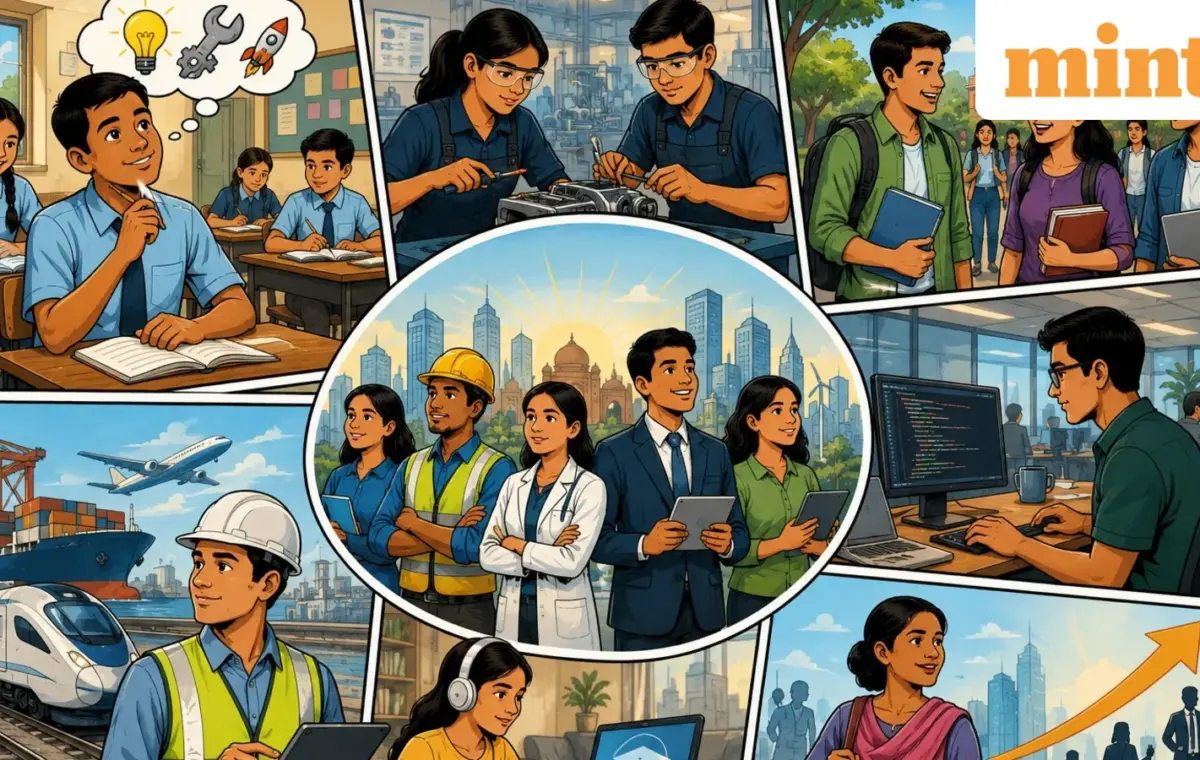
The report proposes general employability and entrepreneurship skills from grade 6, followed by structured vocational pathways from Grade 9. This is aimed at addressing the limited penetration of vocational education: the report says fewer than one in 12 secondary schools currently offer vocational subjects. For college students, it proposes greater industry involvement through apprenticeship-embedded degrees and diplomas, work-integrated programmes and flexible, modular courses. For people already working, particularly in informal jobs, it envisages shorter and more flexible courses that allow them to learn without completely giving up their income.
India has expanded its skilling programmes considerably. Niti Aayog says more than 76.7 million people have been trained since 2014-15, while the Union budget for 2025-26 allocated about ₹34,000 crore in skilling-related expenditure across ministries. Yet, the report says outcomes remain uneven. The report's answer is to integrate the system rather than keep adding individual schemes.
This approach is already reflected in the ₹600-crore Integrated Scheme in Skilling Architecture (ISSA) announced in the Union budget for 2026-27. The government said on Tuesday that ISSA was introduced even before the report as a precursor to the proposed reforms and is intended to bring education, skilling, employment and lifelong learning closer together.
“The problem isn’t that Indian students aren’t working hard enough. We’ve spent too much time preparing them to clear exams and too little preparing them for what comes after. We cannot build Viksit Bharat with a generation that is highly educated on paper but still figuring out how to enter the world of work,” said Ankit Aggarwal, founder and chief executive officer of Unstop, an online talent engagement and recruitment platform.
This is where the report has generated confusion. Niti Aayog estimates 87 million people aged 15-29 were not in education, employment or training (NEET), based on the National Sample Survey 78th Round for 2020-21. But this does not mean 87 million unemployed youth. The report separately identifies about 20 million unemployed people. The government clarified on Tuesday that the NEET category used in the report includes people engaged in domestic duties, voluntary work or household enterprises, those unable to work because of health conditions and others who are not seeking employment. Therefore, the figure cannot be added to India's unemployment rate.
The government has also said that the estimate comes from the pandemic period. That makes it more useful as part of the report's structural analysis than as a measure of India's current joblessness.
If implemented, the proposed system could change how people move from education to work. A school student could receive vocational exposure before leaving school. A college student could combine a degree with an apprenticeship. A worker could acquire a short-term credential without leaving employment. A woman returning to work could receive targeted training and career guidance. The report also proposes a Digital Skills Passport, which would provide digitally verified and portable records of skills and credentials. It suggests skill vouchers, scholarships, placement-linked financing and digital platforms for discovering courses and jobs.
The most important recommendation is arguably the move from enrolment to outcomes. Niti Aayog wants standalone skilling programmes to be linked more closely to labour-market demand and verified outcomes, with industry involved in designing courses, providing apprenticeships and ultimately helping deliver employment. That makes the report relevant beyond the skilling sector. If the proposed architecture works, the objective would no longer simply be to produce more certificates. It would be to make those certificates translate into jobs, higher earnings and career mobility.
The report emphasizes on-the-job training as an important bridge between education and employment, said said Saras Malik, chief people officer, Artemis Hospitals. "The healthcare sector continues to experience shortages and uneven distribution of trained doctors, nurses, specialists and allied health professionals. At the same time, there is increasing global demand for skilled healthcare workers. A future-ready skilling system can create stronger talent pipelines for healthcare and other sectors, enhance productivity, and prepare India’s workforce for domestic and global opportunities,” Malik said.
Dhirendra Kumar is a seasoned policy reporter with about 20 years of experience in deep, on-ground reporting across key economic and governance sectors. His work spans finance, public expenditure, disinvestment, public sector enterprises, textiles, trade, consumer affairs, and agriculture, with a strong focus on uncovering structural policy shifts and their real-world impact.<br><br>Kumar has been awarded the Chaudhary Charan Singh Award for Excellence in Journalism in Agricultural Research and Development, recognising his contribution to reporting on critical issues in the farm sector. He has also been a recipient of a fellowship in international trade from the National Press Foundation, which has further strengthened his coverage of global trade dynamics and their implications for India.<br><br>Kumar is known for breaking complex policy developments into clear, accessible stories. His reporting focuses on uncovering under-reported trends, explaining policy shifts, and helping readers stay informed about developments that shape India’s economic landscape.
Catch all the Business News , Economy news , Breaking News Events andLatest News Updates on Live Mint. Download TheMint News App to get Daily Market Updates.