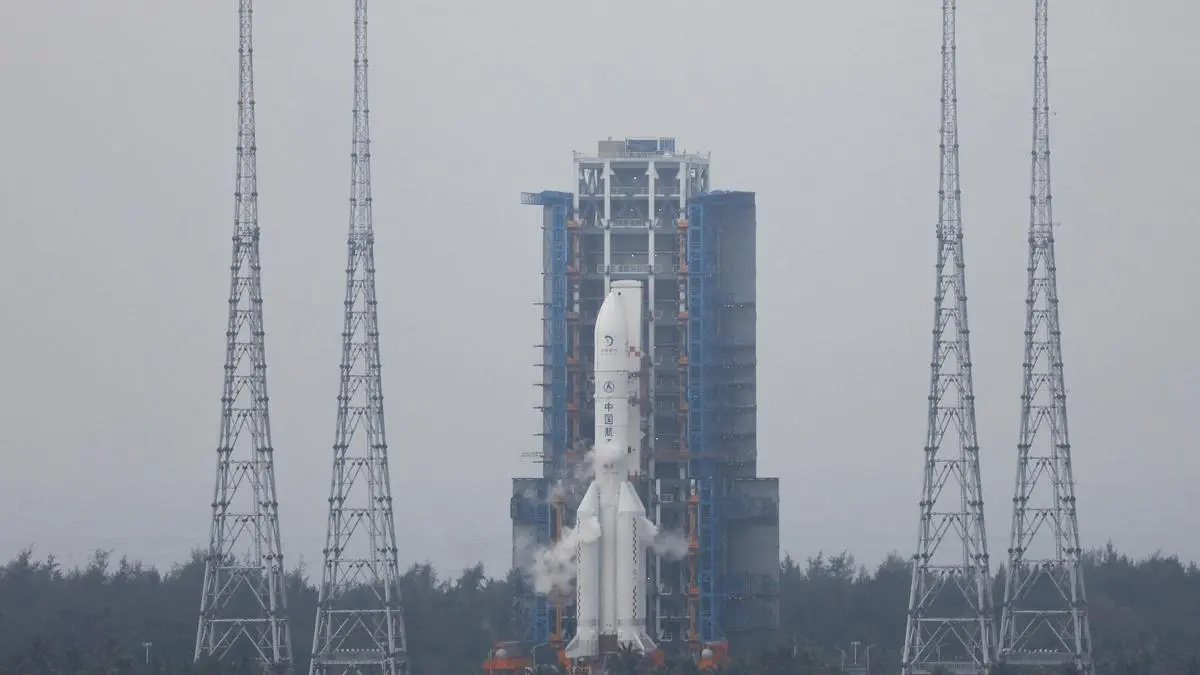
FILE PHOTO: The Chang'e 6 lunar probe and the Long March-5 Y8 carrier rocket combination sit atop the launch pad at the Wenchang Space Launch Site in Hainan province, China May 3, 2024.
| Photo Credit:
EDUARDO BAPTISTA
China is poised to launch
Chang'e-7, its most technologically complex lunar mission to
date, in its search for frozen stores of water in permanently
shadowed craters near the moon's south pole.
The uncrewed mission, named after a mythical Chinese goddess
of the moon, will feature the deployment of a robotic lander,
rover, and "hopping" probe to one of the coldest places in the
solar system.
It will represent a major step towards Beijing's long-term goal
of building a permanent human presence on the moon, with plans
underway for acrewed lunar landing before 2030 and the setting
up of a joint research station with Russia by 2035.
Next week, the Chang'e-7 spacecraft will lift off from the
Wenchang Space Launch Site in the southern island province of
Hainan atop a Long March 5 rocket with payloads that also
include an array of scientific instruments such as water
analysers, cameras and radars.
Once in orbit around the moon, the spacecraft will first
examine potential landing sites at the south pole before a
touchdown attempt.
One candidate location is near the rim of the Shackleton
crater, a permanently shadowed depression. The jagged rim of the
crater, however, is almost continually illuminated by sunlight.
China has not publicly disclosed a timeline for the Chang'e-7
mission, but space watchers estimate a landing attempt around
November.
After touchdown, the rover and hopper will start surveying
the surface.
Craters near the moon's south pole have not seen sunlight in
billions of years. As such, scientists think they could act as
deep freezers capable of preserving ancient water and volatile
organic compounds.
Temperatures can drop to as low as minus 203 degrees Celsius
(minus 334 Fahrenheit) in some of these shadowed terrain,
according to NASA.
Finding accessible water is crucial for future lunar bases
as it could provide drinking water, oxygen for astronauts, and
even serve as raw rocket propellant, reducing the need for
costly resupply missions from Earth.
Unlike most areas of the moon, where one lunar night is as
long as 14 Earth days, the high peaks and crater rims near the
south pole receive near-constant sunlight and would serve as an
ideal location for a lunar outpost with a relatively stable
thermal climate and continuous supply of solar power.
The United States, India and Russia have also set their targets
on the moon's south pole. Only India landed nearby with its
Chandrayaan-3 in 2023.
Over the coming years, NASA's VIPER rover, the European
Space Agency's PROSPECT drilling package, and the Japan-India
LUPEX rover are expected to arrive at the moon's south pole, as
the race to find water sources intensifies.
One challenge for traditional wheeled rovers is the
steepness of crater rims. To descend to the pitch-black floor of
a crater, Chang'e-7 will deploy a novel hopping probe.
The hopper, equipped with a water molecule analyzer, will use
its small thrusters to fly into shadowed craters. It will then
land on six articulated legs, before hopping back to sunlit rims
to recharge.
Technical details about the hopper's weight, engine
performance, or flight range remain unknown.
China's state news agency Xinhua has reported that the
vehicle is expected to conduct at least three hops during the
mission.
Source: Read the original article on www.thehindubusinessline.com