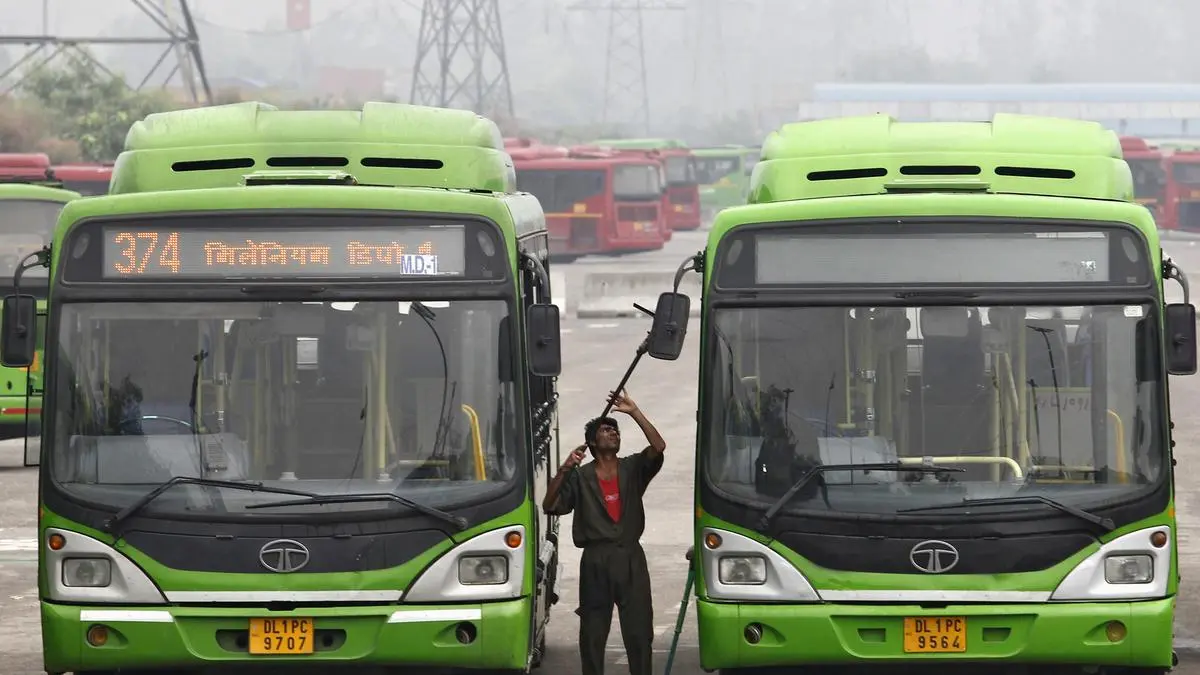
Heavy trucks and buses could see the richest incremental content at ₹75,000-1 lakh per vehicle.
| Photo Credit:
ANINDITO MUKHERJEE
India’s move towards Bharat Stage 7 emission norms opens up an estimated 10,000-crore annual opportunity for auto-component manufacturers as tighter pollution standards increase the value of catalysts, filters, sensors, electronic controls and exhaust-treatment systems fitted to combustion vehicles.
Industry experts told businessline that heavy trucks and buses could see the richest incremental content at ₹75,000-1 lakh per vehicle, followed by medium commercial vehicles at ₹30,000-40,000 and light commercial vehicles at ₹15,000-20,000, reflecting more complex dosing, after-treatment and electronic-control requirements.
Diesel cars and SUVs could add ₹12,000-16,000 through more sophisticated SCR after-treatment and NOx monitoring, while petrol, CNG and hybrid passenger vehicles could require ₹3,000-4,000 of additional content through components such as particulate filters and sensors. Two-wheelers sit at the other end at ₹750-1,130 per vehicle, but annual volumes exceeding two crore units make them a significant part of the opportunity.
The government is moving closer to putting the next emission regime on paper. Speaking at the SIAM Annual Convention in New Delhi on September 3, Road Transport and Highways Secretary V Umashankar said final consultations were nearing completion. “Consultations are going on. The draft should come in a couple of months,” he said.
Exhaust and after-treatment systems are estimated to capture the largest slice of the BS7 opportunity, about 40-45 per cent, or ₹3,000-4,500 crore—followed by sensors and monitoring controls at 25-30 per cent, or ₹2,000-3,000 crore. Fluid-dosing systems could represent another 15-20 per cent, or ₹1,200-2,000 crore, and precision engine and valve hardware 10-15 per cent, or ₹800-1,500 crore.
“The annual incremental opportunity for the component industry is directionally possible if BS7 requires the expected step-up in after-treatment, sensors, dosing and electronic controls across major vehicle categories,” said Randheer Singh of ForeSee Advisors. “The value addition will not be uniform: heavy commercial vehicles and diesel passenger vehicles could see the largest increase per vehicle, while two-wheelers could become significant because of their volumes.”
That puts Sharda Motor Industries and Tenneco Clean Air India among the more direct beneficiaries through exhaust and after-treatment assemblies, alongside Eberspächer and Cummins in heavy-duty applications. Bosch, Uno Minda, Continental and Sensata have exposure to the sensors and monitoring opportunity, while Bosch and Cummins also participate in dosing systems.
Diesels offer higher content because they already use particulate filters and selective catalytic reduction systems. That makes diesel-heavy portfolios such as Mahindra’s and Tata Motors’, alongside diesel offerings from Hyundai, Kia and Toyota, higher-value applications for suppliers. Singh said the final opportunity would depend particularly on real-driving emissions, onboard monitoring and the treatment of two-wheelers.
That makes two-wheelers a key swing factor in the final tally. SIAM, backed by Japanese industry body JAMA, wants the segment kept out of initial Real-Driving Emissions (RDE) testing. Their argument hinges on physical load: standard Portable Emissions Measurement Systems (PEMS), which include gas cylinders, power packs, and heavy analyzers, weigh over 100 kg. While four-wheelers absorb that weight easily, strapping 100 kg onto a lightweight commuter motorcycle essentially acts like a permanent heavy passenger, artificially spiking engine load and distorting tailpipe readings.
“Deferring RDE for two-wheelers could push back a sizable portion of the incremental sensor, monitoring, and control revenue linked to the segment,” experts noted, tracking the natural rollout of BS7.
BS7 will overlap with tighter CAFE III fuel-economy requirements and India’s shift to WLTP emissions testing from April 2027, creating parallel compliance programmes for automakers.
“India’s framework is expected to draw from Europe’s Euro 7 regime, but emission limits, testing and monitoring requirements, vehicle coverage and implementation dates remain undecided. Once that is clarified, a better analysis of the opportunity for the domestic component makers can be given” Singh of ForeSee indicated
Copyright© 2026, THG PUBLISHING PVT LTD. or its affiliated companies. All rights reserved.
Comments have to be in English, and in full sentences. They cannot be abusive or personal. Please abide by our community guidelines for posting your comments.
Source: Read the original article on www.thehindubusinessline.com