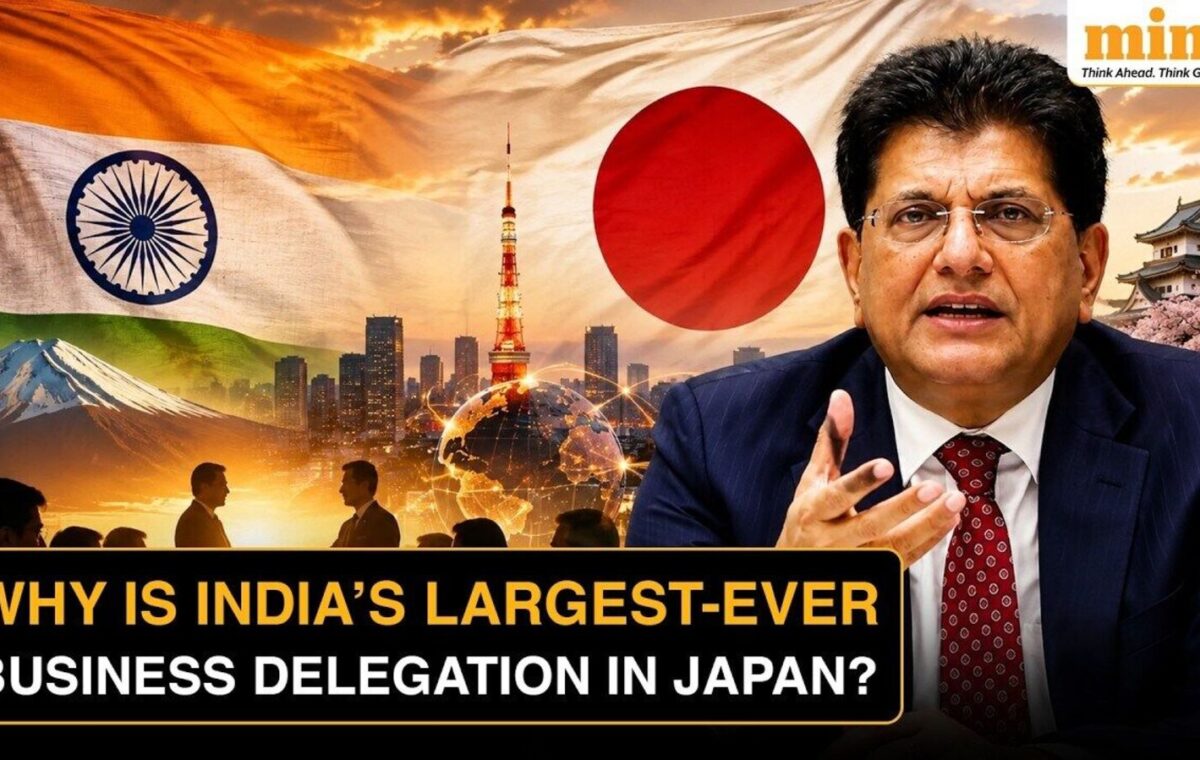
India is currently negotiating free trade agreements with at least eight to nine groups of countries and individual nations that together represent an additional $15 trillion in gross domestic product, Commerce and Industry Minister Piyush Goyal said on Monday.
Once these negotiations are concluded, India's network of free trade agreements could eventually cover nearly 75% of global trade, helping establish the country as a reliable partner in global value chains, Goyal said while addressing business representatives from India and Japan.
India, with its large domestic market, has increasingly opened its economy to global trade and investment. The country has signed nine free trade agreements over the past four years, Goyal said.
These agreements cover economies with a combined GDP of around $60 trillion and include 38 developed countries. India's earlier trade agreements with countries and regions such as Japan, South Korea and the ASEAN bloc have added another $10 trillion to the economic coverage.
"So today India opens up the doors to preferential market access to a USD 70 trillion economy. We are in negotiations with at least 8 or 9 other groups of countries or countries which will add another USD 15 trillion," he said. "Basically, 75 per cent of global trade will be covered through our free trade agreements, opening India to become a part of the global value chain as a trusted partner."
India has finalised trade agreements with the European Union, the EFTA bloc, the UAE, Mauritius, Australia, Oman, New Zealand, the US and the UK. The country is also pursuing similar agreements with nations, including Israel and Canada.
India has further signed terms of reference for trade negotiations with the South Africa-led Southern African Customs Union (SACU) and the six-member Gulf Cooperation Council.
Goyal is leading a business delegation comprising more than 200 representatives during his visit to Japan, aimed at strengthening bilateral trade and investment ties between the two countries.
The minister said India offers significant investment opportunities in sectors such as data centres, manufacturing and artificial intelligence. He added that closer economic cooperation between India and Japan should also help create a more balanced trade relationship.
Bilateral trade between India and Japan rose 9.18% to $27.47 billion in 2025-26 from $25.16 billion in the previous financial year. India's exports stood at $6.03 billion, while imports from Japan amounted to $21.43 billion.
As a result, India's trade deficit with Japan widened to $15.4 billion in 2025-26 from $12.66 billion in 2024-25. The deficit stood at $12.53 billion in 2023-24 and $11 billion in 2022-23.
Goyal also highlighted opportunities for collaboration in India's space sector, which has increasingly been opened to private-sector participation.
"India is also a compelling case to set up data centres," Goyal said, adding there are 1,580 Japanese firms operating in India.
"I am told that Suzuki India's market cap is higher than that of its parent company. We would like to see 1,580 Suzukis developed out of India."
He said India also offers substantial advantages for research and development, noting that the cost of innovation in the country is significantly lower than in many developed economies.