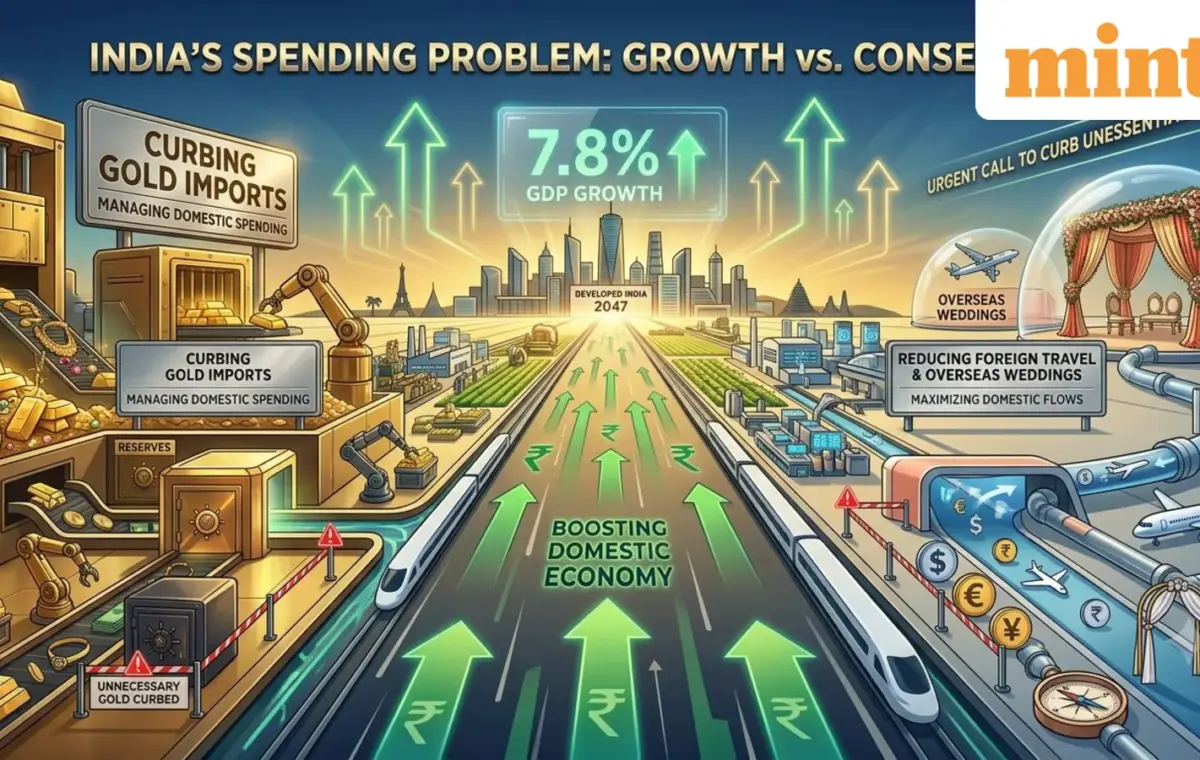
India's economy grew 7.8% in the first quarter of fiscal 2026-27, beating expectations despite higher oil prices and global supply-chain disruptions. At the same time, the government has renewed its call for Indians to curb non-essential foreign travel, overseas weddings and gold purchases, bringing attention to how household spending affects the wider economy.
Prime Minister Narendra Modi made the appeal on September 1 in a video posted on Instagram from the Shanghai Cooperation Organisation summit in Bishkek, linking domestic spending choices with India's goal of becoming a developed economy by 2047.
"Foreign trips, if you are going for leisure, you should not go. If you are getting married abroad, you should not do so. And if it is not necessary, you should not buy gold either."
Data from the Ministry of Statistics and Programme Implementation showed that real GDP stood at ₹81.36 lakh crore in Q1 FY27, compared with ₹75.46 lakh crore a year earlier.
The 7.8% expansion exceeded the Reserve Bank of India's projection of around 7% and followed revised growth of 8.6% in the previous quarter. The strong performance came despite external pressures, including oil price volatility and disruptions to global supply chains.
The latest figures have also brought renewed attention to the composition of India's economic activity and the way household spending contributes to growth.
Gold has a distinctive role in the Indian economy. It is widely held as jewellery, savings and an investment, making it an important component of household wealth.
At the same time, India imports most of the gold it consumes. Strong demand therefore results in an outflow of foreign exchange and can affect the country's external balance.
This is why policymakers have periodically encouraged households to avoid unnecessary gold purchases and instead consider domestic financial assets and other forms of investment.
But gold has another connection to GDP that makes the issue more complicated.
Gold does not simply represent money leaving the country. In national accounting, purchases of valuables such as gold can contribute to measured economic activity.
Economists have previously highlighted periods when a surge in gold buying contributed to headline GDP growth without necessarily generating productive investment.
In 2015, for instance, estimates suggested that India's growth rate would have been 6.34% rather than 7.4% if spending on valuables and discrepancies were excluded. Gold-related expenditure had risen 45% year on year during that quarter.
The distinction is important. A purchase can contribute to measured economic activity while doing little to expand the economy's productive capacity.
Overseas holidays and weddings present a different version of the same issue. Money spent on hotels, venues, travel and other services abroad represents consumption by Indian residents but does not directly generate demand for businesses operating within India.