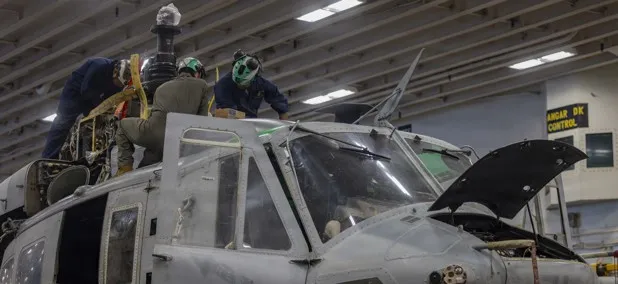
U.S. Marines conduct maintenance on a UH-1Y Venom helicopter aboard the Wasp-class amphibious assault ship USS Essex in the Pacific Ocean, Aug. 8, 2026.
U.S. Marine Corps / Lance Cpl. Maria Amaya
When a Marine planner is trying to determine whether a deployed unit has everything it needs, they must query several separate databases while cross-referencing supply levels, maintenance records, and more to create a spreadsheet. Marine Corps Forces, Pacific, is hoping an AI-powered logistics platform can make that process much faster and easier.
Defense tech company Tagup on Thursday announced a modification to its $2.1 million Small Business Innovation Research contract that will extend the use of its Manifest platform to certain theater sustainment cases in support of MARFORPAC. The platform is already being used by a handful of Marine units at the tactical and operational levels—and the company said its application in Marine medical logistics has resulted in a 25 percent reduction in purchasing costs and a 30 percent reduction in materiel handled, “with no compromise to readiness.”
Jon Garrity, CEO and co-founder of Tagup, said Manifest pulls from a variety of data sources to help Marines decide “what materiel, what resources do you posture where and when, and ultimately tying it back to measures of output or outcomes.”
On the supply side, it looks at the industrial base, he said. “We loaded over 4 million vendors in platform, we’ve got over 16 million parts represented. What are the lead times for each of those? How do we think about that? What are the locations of those vendors? What are the sources of supply?…and then the demand side is also, of course, critical.”
Historically, Garrity said, “at a theater level, a lot of this analysis was done at a headquarters level, not driven from the micro data. Imagine, for ground vehicles, you have every single maintenance action that’s ever been taken….That’s not used, generally speaking, to build theater-level [courses of action], and so that’s now the opportunities. Hey, we have technology and capability, AI capabilities that allow us to take the micro data, every single service request, every bit of inventory on the demand side, and then connect it to the supply side. What do we have? Where is it? Where’s the industrial base to be able to connect the two?”
Sustaining forces that are spread across the vast Indo-Pacific is a challenge, a MARFORPAC spokesperson told Defense One via email. “Marine units are highly dispersed, which intensifies standard logistics friction points.”
To overcome that challenge, the command “is testing how a unified logistics decision-support tool might automate” the data aggregation that could otherwise take several days of work, “to see if the software can ingest those disparate data streams and generate comparative courses of action—quantifying the impacts on readiness, cost, and operational risk—in near real-time or a matter of hours.”
Garrity said Manifest can also help Marines better use the materiel they send forward, “so as a result, you’re maintaining higher levels of readiness for the end items that that materiel supports, you’re… making better use of the space available on a [deployed ship], and you’re typing up less capital, less cash, in the materiel that’s not being used effectively.”
The platform, which the company calls “an AI-powered multidimensional logistics decision engine” has a conversational AI interface called Argus that allows users to ask questions “and explore scenarios in plain language.”
NEXT STORY:
Privacy-focused communication app aims for military customers and beyond