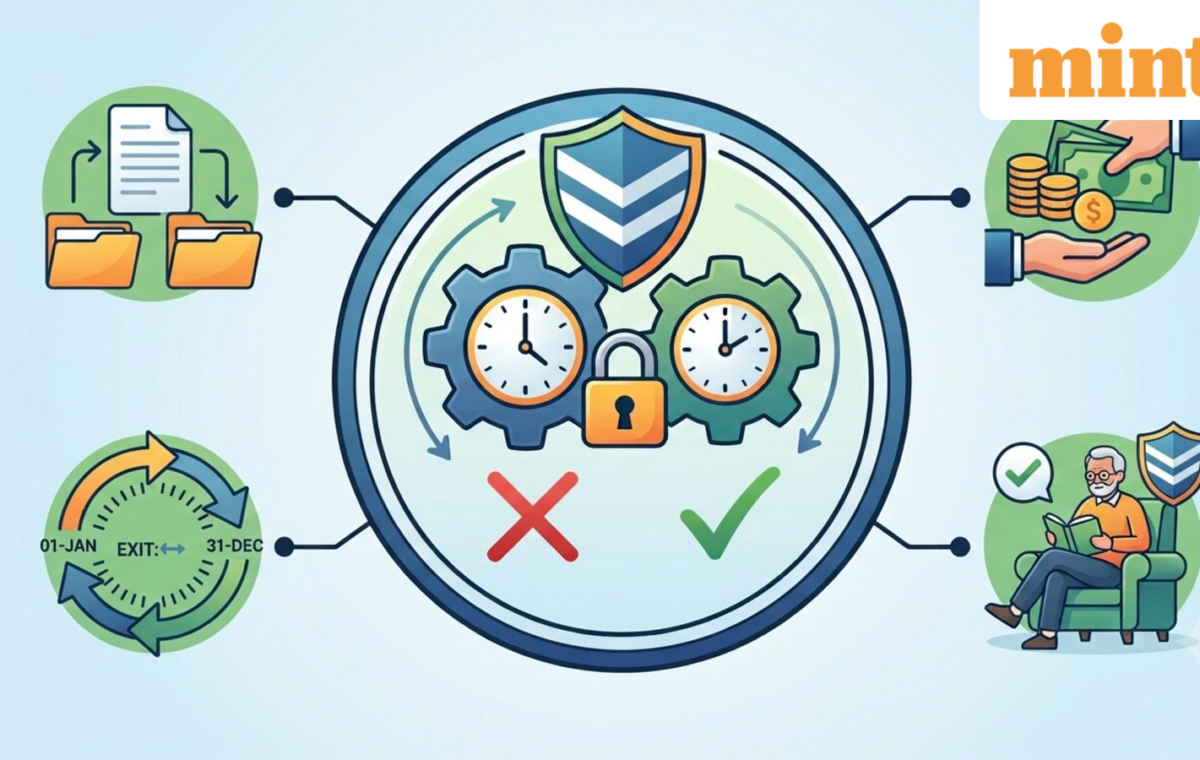
An incorrect date of joining or exit in your Employees’ Provident Fund (EPF) record may look like a routine clerical error, but it can create problems when you transfer your PF, withdraw the balance or establish your pensionable service.
The issue is particularly important for members covered by the Employees’ Pension Scheme (EPS), where the length of eligible service is a key factor in determining pension eligibility. EPFO’s pension manual states that a member generally needs 10 years of eligible service to qualify for a member pension.
Your date of joining (DoJ) and date of exit (DoE) form part of the employment history maintained against your Universal Account Number (UAN). If either date is recorded incorrectly, your service history may not accurately reflect the period for which you worked and contributed.
This matters most when you change jobs. EPFO says updating the date of exit from the previous employment is mandatory for an online PF transfer. If the previous employer has not recorded the exit date, the transfer process can therefore run into problems.
A wrong exit date can also affect subsequent contribution records. EPFO’s revamped electronic challan system states that contributions can be remitted only for the period between the valid date of joining and date of leaving. If a leaving date has been entered incorrectly, contributions for a period after that date require correction of the exit information.
The implications can be more significant for EPS. EPFO’s pension manual calculates actual service using the date of exit and date of joining, after accounting for factors such as non-contributory periods. Since 10 years of eligible service are generally required for member pension, an incorrect employment timeline could become important for someone close to that threshold.
However, an incorrect joining or exit date does not automatically mean that EPF interest stops or that the existing PF balance is erased. EPFO says interest is calculated on monthly running balances. The amount of interest depends on the balance and contributions credited to the account.
The responsibility for maintaining accurate employment records primarily lies with the employer, but EPFO has simplified the process for members.
In January 2025, EPFO announced that members with Aadhaar-validated UANs could update several profile details themselves, including their date of joining and date of leaving, without uploading documents in eligible cases. For older UANs issued before 1 October 2017, employer certification may still be required in certain cases.
For a missing exit date, EPFO’s FAQ says members can update it themselves after 60 days from leaving employment. The process involves logging into the member portal, going to Manage > Mark Exit, selecting the relevant PF account, entering the date and reason for exit, and authenticating through Aadhaar-linked OTP.
Employees should therefore check their EPF service history whenever they leave a job, rather than waiting until they need to transfer or withdraw their savings. A simple mismatch can become much harder to resolve if it remains unnoticed for years.
Checking the DoJ, DoE, employer details, contribution history and service records periodically can help ensure that the PF account reflects the employee’s actual employment history before a transfer, withdrawal or pension claim is made.
Kirti Jha is a Senior Content Producer at Mint, where she writes on mutual funds, taxation, personal finance and macroeconomic developments. Her reporting focuses on helping readers understand complex financial developments through data-driven, research-backed stories that explain how policy changes, market trends and regulatory decisions affect investors and households. <br><br> Before joining Mint, Kirti worked at ET Money, where she specialised in mutual fund research and investment analysis. She tracked portfolio disclosures, fund manager strategies, sectoral allocation shifts and investment trends, distilling large datasets into investor-focused insights. Her work combined quantitative analysis with consumer-centric storytelling, enabling readers to better understand fund positioning, portfolio changes and long-term investment opportunities.<br><br> Kirti holds a Bachelor's degree in Economics from Indraprastha College for Women, University of Delhi, and a Master's in Finance from the Jindal School of Banking & Finance at O.P. Jindal Global University. Her academic training emphasised analytical thinking, quantitative research and financial decision-making, providing a strong foundation in understanding capital markets, financial systems and economic policy. With a combined experience in investment research and financial journalism, she is committed to producing accurate, accessible and insightful journalism that empowers readers to make well-informed financial decisions.
Catch all the Instant Personal Loan, Business Loan, Business News, Money news, Breaking News Events and Latest News Updates on Live Mint. Download The Mint News App to get Daily Market Updates.
Log in to our website to save your bookmarks. It'll just take a moment.