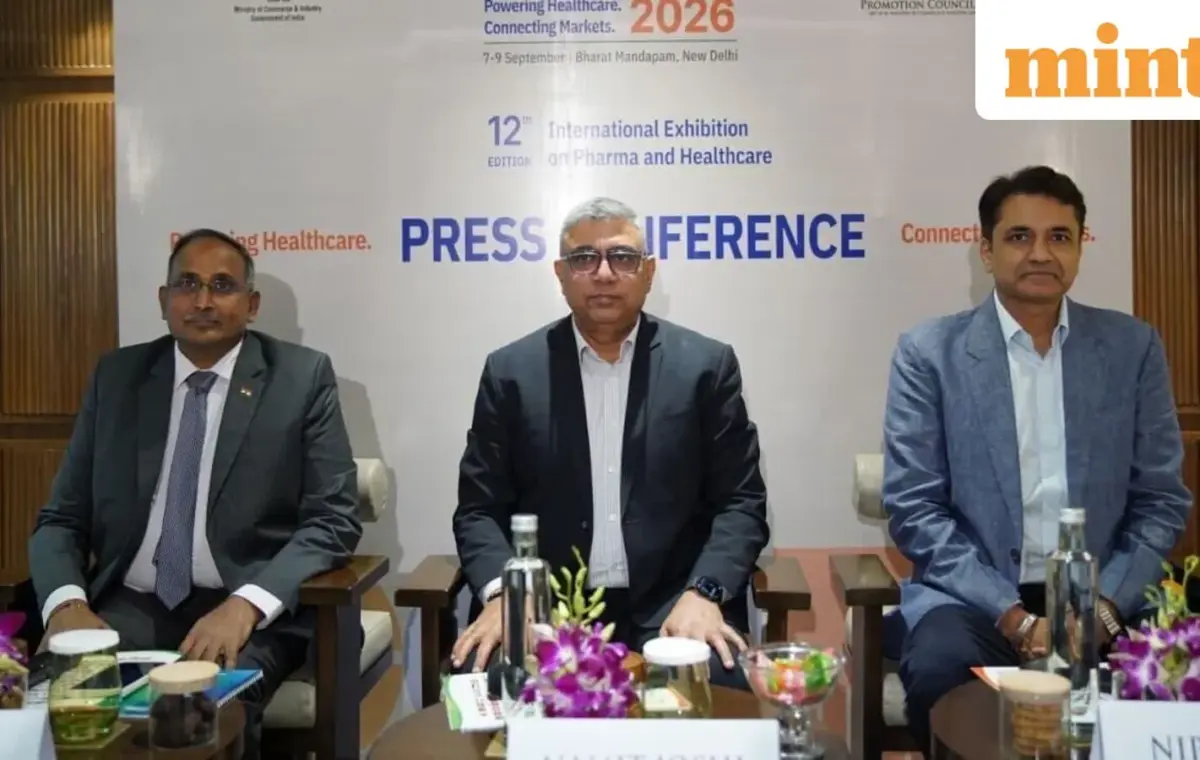
India’s pharmaceutical sector continues to show strong export resilience despite facing war-related supply chain shocks, which have become the ‘new normal’, Pharmexcil chairman Namit Joshi said on Thursday at an event in New Delhi.
Pharmaceutical Export Promotion Council of India (Pharmexcil) operates under the commerce ministry.
Valued at over $50 billion and projected to hit $130 billion by 2030, the pharma market relies heavily on MSMEs to sustain growth, he said.
Despite shipping route closures in the Strait of Hormuz and air-cargo collapses that stranded vaccines and vital raw materials, drug exports expanded 6.8% in the first quarter of fiscal year 2027 (FY27). Industry leaders now treat geopolitical instability in West Asia not as a temporary crisis, but as an operational baseline.
Yet sustained expansion depends on micro, small, and medium-sized enterprises (MSMEs), which operate roughly 60% of the country’s manufacturing facilities. Faced with mandatory regulatory overhauls that cost up to ₹12 crore per unit, small factory owners, many already leveraged against personal assets, risk being left behind without targeted financial support, he said.
MSMEs run over 6,000 of India's 10,300 pharma factories.
At the same time, regulators in India are attempting to salvage the country's global reputation following past high-profile overseas scandals involving contaminated cough syrups. Pharmexcil executives argue that while illegal operators must be jailed, compliant suppliers require urgent funding to secure their place in global supply chains.
Geopolitical challenges and disruptions in West Asia have become the new normal, yet Indian pharma exports have shown remarkable resilience. To capitalize on this momentum, the sector relies heavily on small and medium producers to sustain a long-term trajectory.
However, meeting new manufacturing quality rules requires ₹5 crore to ₹12 crore per unit—a huge hurdle for small owners who have already pledged personal assets for bank loans. While government schemes offer support, industry leaders are pushing for flexible financial solutions to help genuine units upgrade, alongside strict penalties for quality offenders.
“There is zero compromise on product quality. While rogue operators who risk human lives must face strict legal action, including imprisonment, legitimate MSME units striving to meet global standards urgently need financial hand-holding to upgrade,” Joshi said. International trust has since rebounded strongly, with Indian exports registering double-digit growth across key markets in Africa and Central Asia. To solidify these gains, Pharmexcil aims to secure $1.4 billion in trade opportunities at its upcoming iPHEX 2026 conference in New Delhi.
The conference is scheduled to be held from 7 to 9 September at Bharat Mandapam in New Delhi, with over 800 exhibitors and 600 overseas delegates expected to attend.
Priyanka Sharma is a journalist at Mint, where she covers the Union Ministry of Health and the pharmaceutical industry. Her work focuses on explaining government policies and how they impact healthcare and the medicine market in India. With 12 years of experience in journalism, she has built a reputation for providing clear and honest news on important health topics that affect the entire country.<br><br>Her educational background includes a journalism degree from the prestigious Indian Institute of Mass Communication (IIMC) and specialized training in public health from the Public Health Foundation of India. Before her current role at Mint, Priyanka worked with India Today, The Pioneer, and ANI. She also served as a lead consultant for the National Health Authority, which gave her firsthand knowledge of how the government manages large-scale health programmes.<br><br>Priyanka is based in New Delhi and is an avid traveller who loves visiting the mountains. She has a great interest in regional flavours, particularly South Indian food.
Catch all the Industry News, Banking News and Updates on Live Mint. Download The Mint News App to get Daily Market Updates.