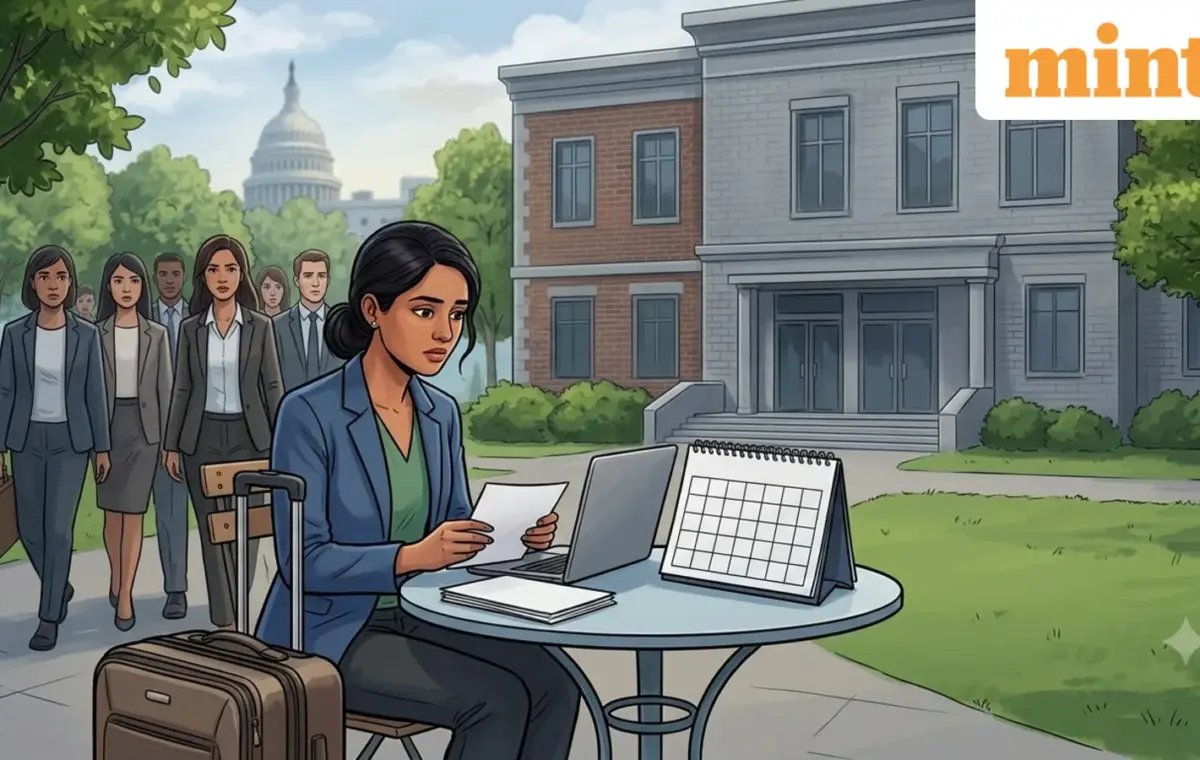
The White House has completed its review of a proposal that could eliminate the 60-day grace period available to certain foreign workers, including H-1B visa holders, after they lose their jobs in the United States.
The proposal was sent by the Department of Homeland Security (DHS) to the Office of Management and Budget (OMB) for review earlier this month. Details of the proposed regulation are not yet public. If the proposal moves forward, it will be published in the Federal Register, followed by a public comment period, typically lasting 30 to 60 days.
The rule would represent a significant change for foreign professionals who depend on employer-sponsored visas to remain legally in the US.
The 60-day grace period was introduced in 2017 to give certain nonimmigrant workers and their dependents time to remain in the US after employment ends.
During this period, an H-1B visa holder who is laid off or otherwise loses employment can look for another job and potentially change employers without immediately having to leave the country.
The provision applies to several visa categories, including H-1B, H-1B1, L-1, O-1, E-1, E-2, E-3 and TN, as well as eligible dependents.
DHS has the discretion to shorten or deny the grace period in individual cases, although immigration consultants say it has rarely done so.
If the proposed regulation is finalised and the 60-day protection is eliminated, foreign workers could face a much shorter window — or potentially no automatic grace period — after their employment ends.
They would generally be expected to leave the US when their employment ceases, unless another immigration option is available or USCIS exercises discretion to forgive a lapse in status.
This could make job loss particularly difficult for H-1B workers because their immigration status is generally tied to employment.
Under the current system, a worker who is laid off has time to search for another sponsoring employer. Removing that window could make it considerably harder to find a new job, complete the required immigration process and maintain lawful status while remaining in the US.
The proposed change could have a major impact on Indian professionals because Indians make up the largest group of H-1B visa beneficiaries.
Indian nationals accounted for 71% of successful H-1B applicants in fiscal 2024, according to the figures cited in the report.
That means a change affecting the post-employment grace period could disproportionately affect Indian technology professionals and other skilled workers employed in the US on H-1B visas.
The impact could be especially significant during periods of layoffs in sectors such as technology, consulting and financial services, where H-1B workers are heavily represented.