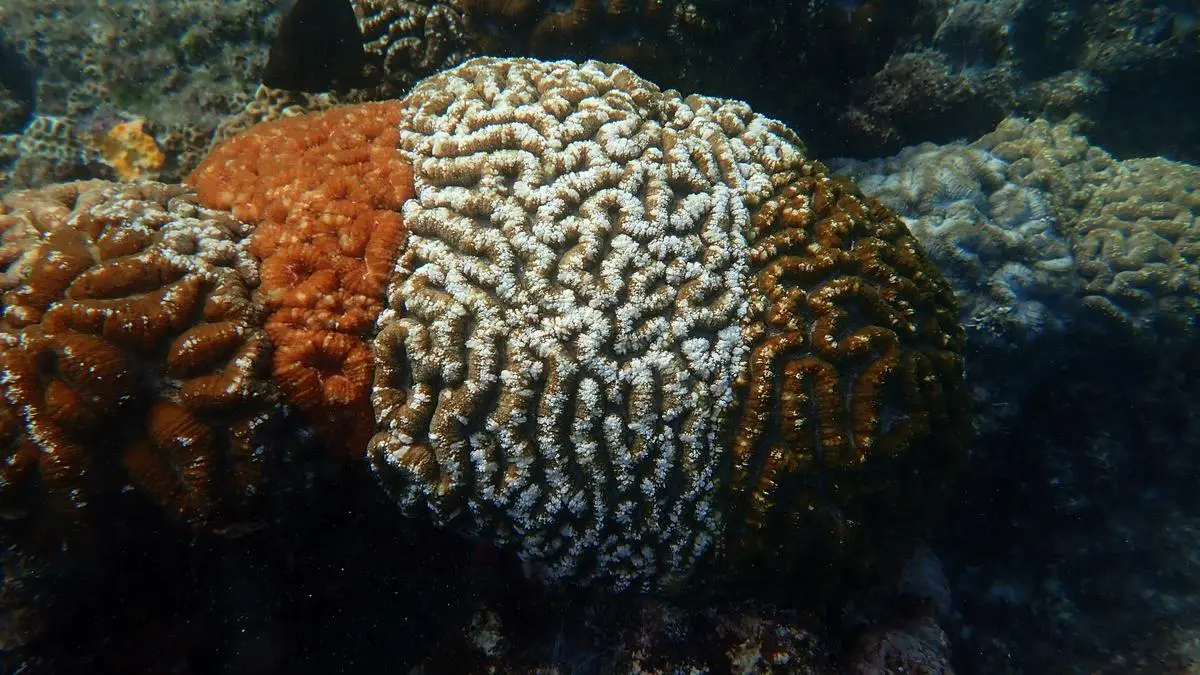
Captured by CMFRI research scholar Alvin Anto, the underwater image provides valuable insights on contrasting response of corals to environmental stress.
A natural coral assemblage beneath the sea offering an intriguing view of marine life with a striking resemblance to the Indian tricolour has sparked curiosity and offered critical insights on climate adaptation research.
The underwater image captured during a marine mammal survey by the ICAR-Central Marine Fisheries Research Institute (CMFRI) from Minicoy, Lakshadweep shows two coral colonies appearing in tricolour—orange, white and green— come together naturally, creating an underwater tableau reminiscent of the national flag. A scene that could easily be mistaken for an artist’s creation, this masterpiece belongs entirely to nature.
The species has been identified as Lobophyllia corymbose with its vibrant orange colour, and Lobophyllia radians in white and green colours.
Captured by CMFRI research scholar Alvin Anto, the underwater image provides valuable insights on contrasting response of corals to environmental stress. While one L. radians colony underwent bleaching after losing its symbiotic algae, its neighbouring colony remains healthy despite growing in close proximity.
Though this assemblage is a symbol of India’s rich marine biodiversity, it also carries an urgent message about ocean health. It tells the stark story of resilience and vulnerability to climate stress. While one colony of coral species bleached due to rising sea temperatures, while its direct neighbour of the same species remains healthy and green. This variation in thermal stress tolerance offers crucial insights for the ongoing reef restoration and climate adaptation research, said CMFRI Director Grinson George.
Emphasising the urgent need to tackle these climate impacts, he highlighted measures being taken up by the CMFRI towards coral reef restoration. With the support from the Union Government, CMFRI is on a mission to rapidly scaling up the deployment of Artificial Reefs along coastal waters to revive degraded habitats, enhance coastal biodiversity, and support the livelihoods of artisanal fishers”, he added.
Simultaneously, efforts are underway to replenish depleted wild stocks of ecologically and economically vital marine species through marine fish breeding, seed production, and sea ranching programmes, George said. Restoring natural habitats through artificial reefs is expected to support marine ecosystem and build a robust climate resilient marine ecosystem, he added.
Copyright© 2026, THG PUBLISHING PVT LTD. or its affiliated companies. All rights reserved.
Comments have to be in English, and in full sentences. They cannot be abusive or personal. Please abide by our community guidelines for posting your comments.
We have migrated to a new commenting platform. If you are already a registered user of TheHindu Businessline and logged in, you may continue to engage with our articles. If you do not have an account please register and login to post comments. Users can access their older comments by logging into their accounts on Vuukle.
Source: Read the original article on www.thehindubusinessline.com