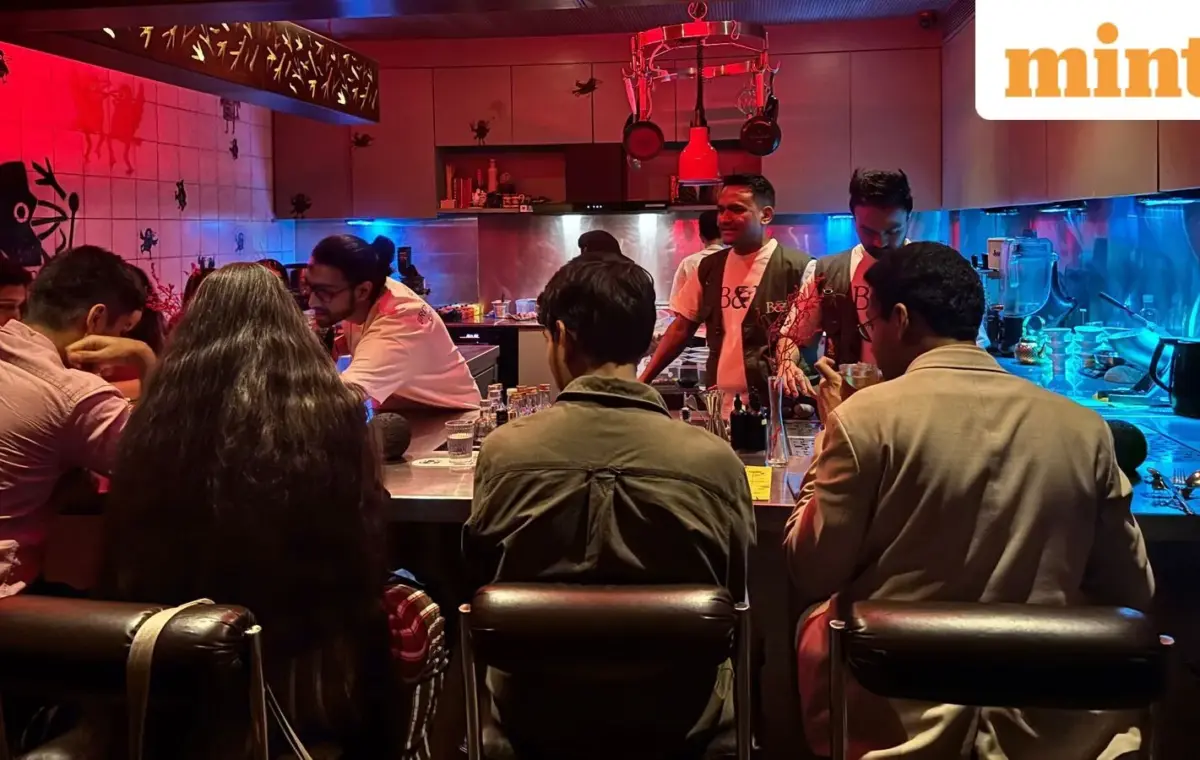
One recent Sunday evening, a group of nine diners gathered at Barbet & Pals, a popular Delhi cocktail bar. As soon as the clock struck 8, the staff whisked them past the buzzing crowd, escorted them through a door with no handle, and led them down a passageway, to a basement that transformed into an intimate living-room-cum-open-kitchen glowing in red and blue ambient light.
This is Cavity, a micro bar hidden inside a bar, that opened in February this year, part of a growing trend of small-format dining concepts coming up across the country. Cavity offers a nine-seater, nine-course innovative cocktail-tasting led meal that runs Friday to Sunday, with a focus on modern twists on regional, GI (geographical indication)-tagged ingredients.
For those with a coveted reservation made weeks in advance, the experience began with personalised welcome notes attached to the L shaped counter seats overlooking the open kitchen. Even among strangers, the mood was easygoing, humour-laced and mysterious: what might we be served next?
For the next two hours, Barbet & Pals founders and bartenders Jeet Rana and Chirag Pal regaled diners with a story for every course, talking about the provenance of the unique ingredients in the food designed by chef Amninder Sandhu, and the drinks they assembled and served in style—from a fizzy cherry-coloured Sundarban honey mead served with a liver pate hidden inside a mini cotton candy, to a warm Sikkimese black cardamom-flavoured cocktail paired with corn-shaped brioche and Nihari.
One of the diners at the table was 27-year-old Dhananjai Subramaniam, a beverage consultant and a foodie, who had come for the event with a childhood friend.
“Tasting menus are generally expensive and not that accessible. But at ₹5,500 plus taxes for nine cocktails and food pairings, Cavity offers great value for money,” he says. “The experience is intimate—the distance between you and the kitchen is almost zero. Watching the food move straight from the counter to your table turns into a conversation about techniques, culture, and flavour.”
Like Subramaniam, discerning and well-heeled diners across the country are enthusiastically seeking out micro-dining concepts, not just on occasions but as a regular activity.
According to Mordor Intelligence’s India Full-Service Restaurants Market Size and Share report for 2026-2031, restaurants are evolving into “lifestyle destinations as customers increasingly seek more than just food; they want a complete dining experience that includes ambiance, interaction, and entertainment.”
To meet these expectations, says the report, restaurant operators are introducing “unique features, including chef-interaction counters that encourage customers to spend more time at the restaurant but also allow businesses to charge premium prices.”
Priced between ₹5000 and ₹12,000, and seating just four to 16 guests, these spaces get sold out within minutes of the reservations being released, often months in advance, on restaurant websites or booking platforms like Airmenu and District.
So if Cavity is a bar within a bar, Olive’s brand new Hidden Club in Delhi, with just four seats on offer, can only be accessed through a backdoor entrance and is possibly the smallest bar in the country. Naru Noodle Bar in Bengaluru offers an over the counter ramen-centred interactive dining experience, with monthly specials. Naar is a remote, curated destination experience located near Kasauli. The year-old Rannaghor in Kolkata is an attempt to go beyond regular Bengali fare to spark conversations on forgotten food stories and the interplay of caste and class in food culture.
Rushina Munshaw Ghildiyal, a food consultant and editor of the Annual Godrej Food Trends Report, notes that the rise of small-format dining reflects a broader post-pandemic shift: intent is winning over opulence.
“In intimate dining spaces, there is no standardised menu. A lot of thought goes into the flavour profiling. It’s customised and nuanced,” she says.
And the chefs are the Shah Rukh Khans of that space, she adds.
Among the pioneers of this small-format wave is Naru Noodle Bar in Bengaluru. What started off as a delivery-only kitchen in 2020 transformed into an interactive, eight-seater ramen bar in Bengaluru’s culinary and cultural hub, The Courtyard, in 2022. It became so popular that scoring a table became the ultimate trophy, compelling founder and chef Kavan Kuttappa to update his Instagram handle: “Not the reservation desk for @eatnaru".