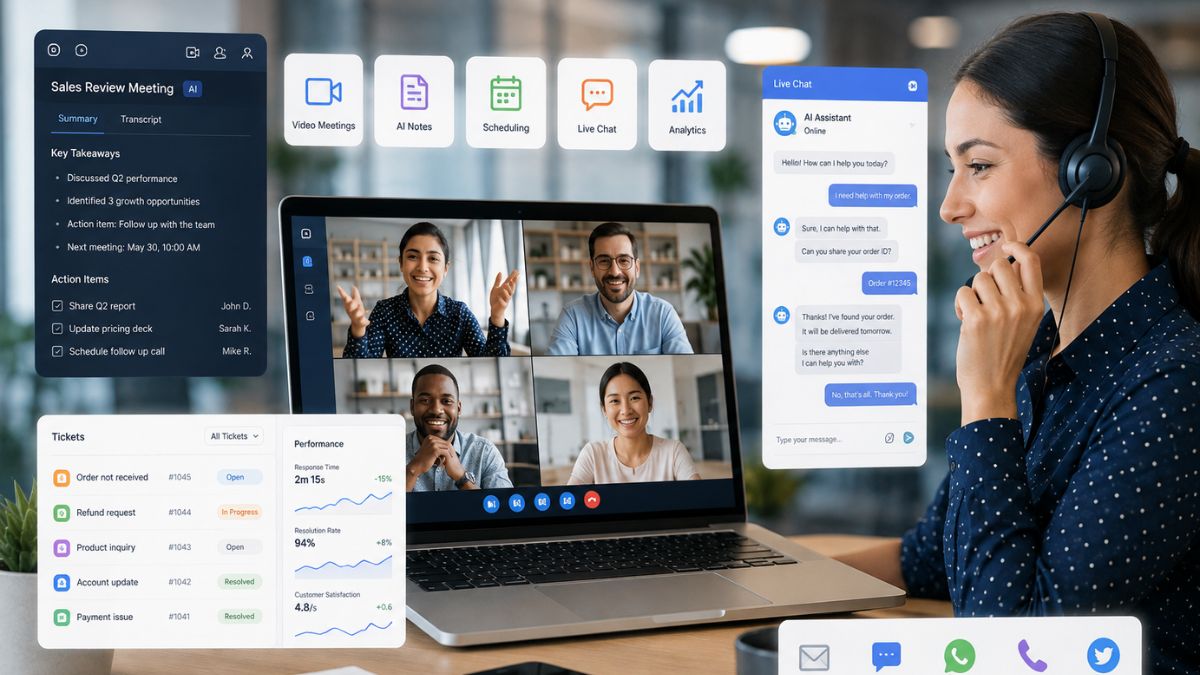
Two categories of business software, meetings and customer service, have undergone more structural change in the past two years than in the preceding decade combined, and the force driving both transformations is the same: AI that can do substantive communicative work rather than simply record or route it. In video conferencing, the contest has shifted from who can put faces in rectangles to who can turn those rectangles into structured, searchable organizational memory. In customer service, the contest has shifted from which ticketing system routes requests most efficiently to which AI agent can resolve those requests without a human agent ever being involved. These are fundamentally different competitive dynamics from the ones that shaped both markets through most of the previous decade.
The AI meeting assistant category illustrates how fast this change has moved. Fathom, now the highest-rated tool in the category, offers unlimited recording, transcription and storage at zero cost, with post-call summaries generated in approximately 30 seconds, a capability that competing platforms charged $20 or more per month for as recently as 2023. Granola has created an entirely new product architecture, bot-free local audio capture that is invisible to other meeting participants, specifically because the market recognized that the presence of a visible recording bot changes meeting behavior in ways that no summarization quality can compensate for. Gong, at the enterprise end, has evolved from a call recording tool into a revenue intelligence operating system analyzing pipeline health, deal risk and coaching opportunities across an entire organization’s customer conversation history. These are not the same product category despite sharing the meeting transcript as a raw input.
In customer service, the AI customer service agent has matured from a novelty to a primary operational category in 18 months. Decagon reached a $4.5 billion valuation in January 2026 after deploying at Notion, Rippling and other high-profile technology companies. Sierra AI introduced per-outcome pricing, charging customers only for resolutions confirmed by the end customer, the most commercially honest model in the category. Intercom’s Fin AI Agent consistently achieves the highest autonomous resolution rates of any independent benchmark evaluation. And the contact center market, historically one of the slowest enterprise software categories to change, is now running active competitive evaluations between Five9, Genesys, NICE and Talkdesk specifically on which AI orchestration and autonomous agent capability will reduce the human headcount required to service a given contact volume. The pace of change across both categories makes this one of the most consequential areas of enterprise software investment in 2026.
This guide reviews 55 tools across five categories: video conferencing and meeting platforms; AI meeting assistants, note-takers and revenue intelligence; meeting scheduling and booking; customer service and help desk platforms; and AI customer service agents and contact centers. Customer success platforms including Gainsight, ChurnZero, Planhat and Vitally are covered in our companion data analytics and revenue analytics episode rather than duplicated here.
These are the core platforms for conducting live video meetings, team calls, webinars and hybrid collaboration at any scale. Their differentiator has shifted from basic video quality, now effectively commoditized across all major players, to ecosystem depth, AI-generated meeting recaps and unified communication capabilities that reduce the need for separate tools. Buyers range from individuals seeking a free browser-based meeting link to enterprises requiring FedRAMP-authorized, HIPAA-compliant conferencing infrastructure for regulated environments.
Zoom remains the most widely used standalone video conferencing platform in the world and the reference choice for organizations that are not standardized on either Microsoft or Google, combining the most recognized meeting URL format with mature AI, webinar and team chat capabilities on a single platform. Its AI Companion is included at no additional cost on paid plans and delivers meeting summaries, action item extraction and in-meeting smart suggestions that have historically been premium features on competing platforms. Zoom’s Workspaces expansion now covers persistent team chat, an AI-powered whiteboard and a phone system, positioning the platform as a more complete collaboration suite rather than a meeting-only tool. Its standing as the most universally recognized video conferencing brand gives it a practical advantage for external client-facing meetings where asking a guest to join Zoom generates less friction than any alternative. Pricing starts at $16 per month per user for the Pro plan, and the free tier covers unlimited one-to-one meetings with a 40-minute group call limit.
Features: AI Companion included at no extra cost on paid plans for meeting summaries, action items and smart suggestions, support for up to 1,000 participants on Business and Enterprise plans, integrated webinar capability on the same platform, Zoom Phone system as a unified calling add-on, persistent team chat and AI whiteboard in Zoom Workspaces, breakout rooms with host-controlled management, virtual backgrounds and noise cancellation, SSO and advanced admin controls on Business and above, and the most universally recognized meeting brand reducing external guest friction.
Best for: organizations that are not standardized on Microsoft 365 or Google Workspace and want the most feature-complete standalone meeting platform with included AI summaries, particularly those running frequent webinars or client-facing calls where Zoom’s brand recognition reduces joining friction.
Microsoft Teams is the default meeting, chat and collaboration platform for any organization standardized on Microsoft 365, included in Business Basic through Enterprise agreements at no additional cost and deeply embedded in the same environment where most Microsoft-shop employees already read email, manage files and run projects. Copilot in Teams, available on Microsoft 365 Copilot licenses, produces the most contextually rich meeting recaps of any platform-native AI in the category, generating structured summaries that reference meeting content against relevant email threads, SharePoint documents and calendar context that no standalone meeting assistant can replicate. Teams’ governance, compliance and security capabilities, including eDiscovery, retention policies, information barriers and the full Microsoft Purview compliance stack, are the deepest of any video conferencing platform and meet the requirements of highly regulated industries that Zoom and Google Meet address only partially. For organizations outside the Microsoft ecosystem, Teams’ full capability requires M365 licensing that may not be justified unless collaboration breadth is the goal rather than meetings alone.
Features: included in Microsoft 365 Business and Enterprise licensing at no additional per-seat cost, Copilot AI producing context-rich meeting recaps drawing on email, SharePoint and calendar simultaneously, integration with Outlook Calendar, SharePoint, OneDrive, Planner and the full M365 stack, eDiscovery, retention policies and information barriers meeting enterprise compliance requirements, Teams Phone for unified calling, breakout rooms and live reactions, support for up to 1,000 participants on standard licenses and 20,000 on webinar-grade Town Halls, external guest access without Microsoft account requirement, and the deepest compliance and governance capability of any video platform.
Best for: organizations standardized on Microsoft 365 where Teams is already the environment employees live in, and for enterprises in regulated industries where the depth of Microsoft Purview compliance integration, eDiscovery and retention policy support are genuine requirements rather than nice-to-haves.
Google Meet is the cleanest browser-based meeting experience available, requiring no software download for either host or guest and integrating natively with Google Calendar, Gmail and Google Workspace in a way that makes scheduling, joining and sharing recordings seamless for Workspace-standardized organizations. Its free tier is the most generous among the major platforms, covering 100 participants and 60-minute group calls with no account required for guests, and Gemini AI capabilities including translated captions in multiple languages, meeting summaries and note-taking are progressively rolling out across Workspace plans. The browser-first architecture is Meet’s strongest competitive differentiator for external-facing calls: joining a meeting link in Chrome without any download is the lowest-friction guest experience in the category, which matters significantly for client calls where asking the other party to install software creates friction. For organizations outside Google Workspace, Meet’s integrations are narrower and the feature set for team collaboration is thinner than both Zoom and Teams.
Features: browser-based joining with no download required for hosts or guests, free tier covering 100 participants and 60-minute group calls, native Google Calendar, Gmail and Workspace integration, Gemini AI meeting summaries and note-taking rolling out across Workspace tiers, real-time translated captions supporting communication across languages, noise cancellation and adaptive audio, Google Drive recording storage on eligible Workspace plans, hand raising and polls, and the lowest-friction external guest joining experience of any major platform.
Best for: organizations standardized on Google Workspace for whom Meet is already included and the browser-native joining experience eliminates the download friction that external guests face with Zoom and Teams, particularly for organizations with frequent external calls where guest convenience is a primary concern.
Cisco Webex is the enterprise meeting platform with the deepest security, compliance and on-premises credentials in the category, FedRAMP authorized for US federal government use, HIPAA compliant, ISO 27001 certified, and one of the few platforms supporting genuine on-premises hardware deployment for organizations whose data sovereignty requirements preclude cloud-hosted conferencing. Its AI Assistant generates meeting summaries, action items and catch-up summaries for participants who join late, and is available even on the free tier, a more generous AI inclusion than any competing free plan. Webex’s hardware ecosystem, covering Webex Board, Desk and Room series devices, reflects its long enterprise history of treating conferencing as a room and device problem as much as a software problem. For organizations in highly regulated sectors, including federal agencies, defense contractors and financial institutions with strict data handling requirements, Webex’s certification and deployment flexibility often make it the only compliant option rather than a preference choice.