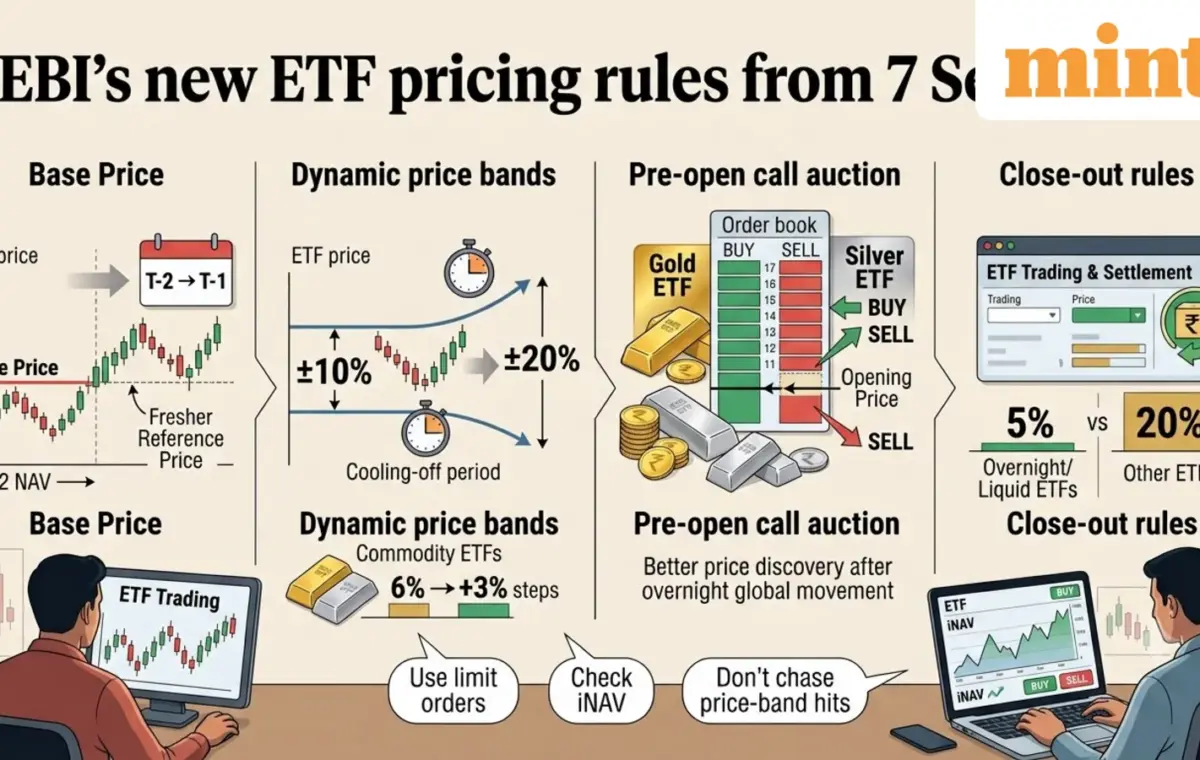
SEBI has revised the norms governing the base price, price bands, pre-open call auction, and close-out mechanism for equity, debt, and commodities ETFs.
Currently, a fixed ±20% price band applies to equity, debt, and commodity ETFs, based on the T-2 day NAV. For Overnight ETFs, the price band is ±5%, according to SEBI’s 15 June 2026 circular.
The new framework changes how ETF prices are determined. The rules originally scheduled to take effect from 1 September 2026 will now come into effect on 7 September 2026, following SEBI's circular last week.
“Every ETF is allowed to move only so far up or down in a day. That distance is measured from a reference number called the base price,” Gaurav Didwania, Partner and Fund Manager, Qode Advisors, explained.
Vaibhav Porwal, Co-founder, Dezerv added that instead of the T-2 NAV, an ETF will now use the previous day’s closing market price, based on the average trading price during the last 30 minutes. Investors should see fewer situations where an ETF’s permitted range looks out of step with its current value.
Mayank Jain, Market Analyst, Share.Market by PhonePe explained that “under the new regulations, if an ETF records no trades during the final 30 minutes of T-1 day, its base price defaults to its Last Traded Price (LTP) from earlier that day”.
He added that if the ETF did not trade at all on T-1 day, the base price reverts to its latest available closing NAV. Previously, the system applied the T-2 day NAV regardless of whether the ETF actually traded on T-1.
For illiquid ETFs, Jain said this fallback prevents unrealistic price limits caused by thin trading and keeps trading boundaries grounded in actual market value.
“SEBI has admitted this is only stage one,” said Vedant Gupte, Co-Founder and CEO of Investment platform Trackk, noted. He said using traded prices can still carry yesterday’s premium into today’s band. SEBI has asked exchanges and AMCs to resolve the operational issue and move to the T-1 closing NAV by 1 April 2027.
For equity and debt ETFs (excluding Overnight and Liquid ETFs), dynamic price bands will apply. The initial band will be ±10%, which can be expanded to ±20% after a cooling-off period.
Didwania explained that the price band is the maximum distance an ETF is allowed to travel from its reference price in a single day. A 10% band means the price cannot go more than 10% above or below that reference.
“The earlier 20% band was so wide that it rarely acted as a safeguard. The tighter 10% starting band provides protection against freak prints while retaining the ability to accommodate a genuine sell-off,” Gaurav Arora, Head of Research, SAHI explained.
This should improve price stability during volatile sessions and reduce sudden flash crashes. However, very rapid moves could result in temporary execution pauses until the band is widened, Jain said.
Sougata Basu, Founder and CEO, CashRich explained the cooling-off rule. “Say the ETF trades at 9.9% above its base. A 15-minute cooling-off period starts, or 5 minutes if it is the last half hour of the session. Trading does not stop. You can still buy and sell, just not beyond the limit. After the cooling-off, the band widens by 5%, only on the side the price is moving. The other side does not shift”.
The cooling-off therefore creates a pause before the range expands rather than allowing a 20% move at once. During this period, investors may see a one-sided order book or wider buy-sell spreads, Basu noted.