Retiring with ₹2 crore? Here’s how much you can withdraw every month — Retiring with ₹2 crore sounds reassuring, but the real question begins after retirement: how much can you withdraw every month without exhausting the corpus too early? There is no single answer because the outcome depends on your age at retirement, spending needs, investment mix, inflation, taxes and how long the money needs to last. Recent retirement guidance also stresses that a withdrawal rate is only a planning starting point, not a guarantee.
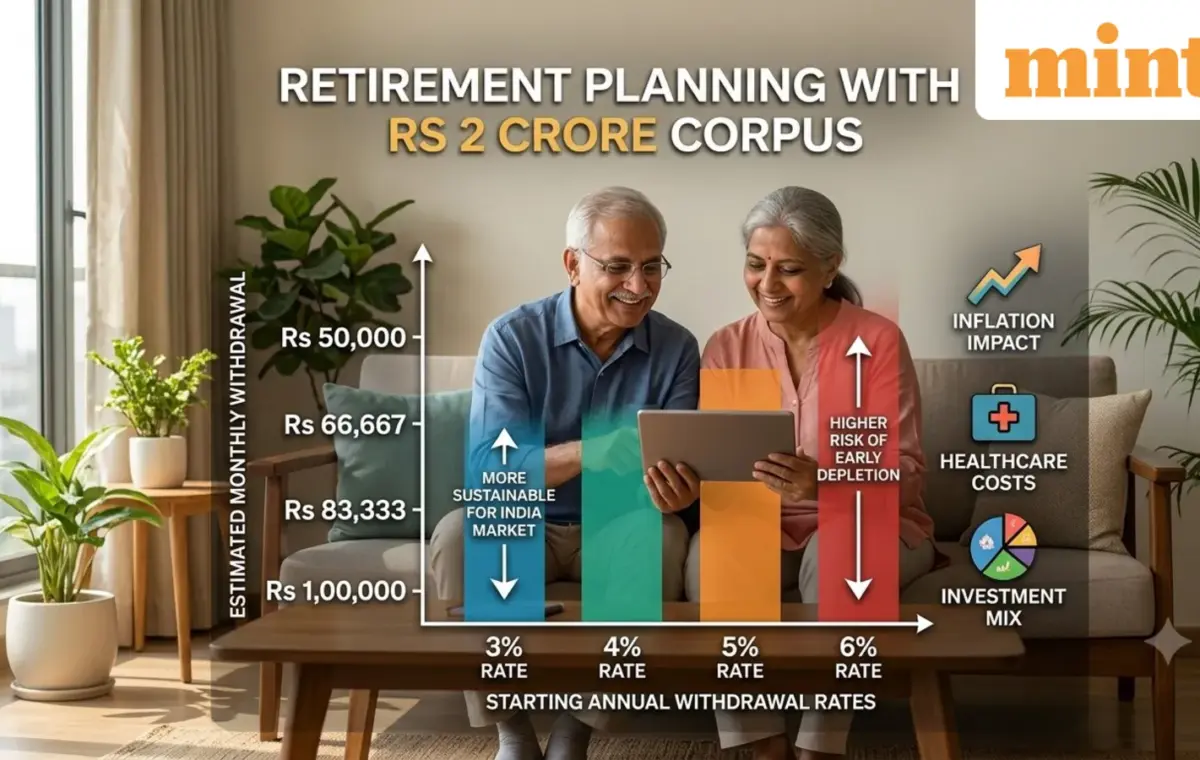
As a simple illustration, a 3 percent annual withdrawal from ₹2 crore would provide about ₹6 lakh a year, or ₹50,000 a month initially. At 4 percent, the first-year withdrawal rises to roughly ₹8 lakh, or ₹66,667 a month. A 5 percent withdrawal would mean around ₹83,333 a month, while 6 percent would provide ₹1 lakh. The higher the withdrawal, however, the greater the pressure on the corpus during a long retirement.
Recent Indian retirement analysis suggests that a 3 percent to 4 percent starting withdrawal can be a more cautious range for someone seeking long-term sustainability. An Indian study discussed by IIM Ahmedabad has argued that the widely cited 4 percent rule, developed from US market experience, may be too aggressive for India and that 3 percent to 3.5 percent can be more appropriate because of differences in inflation, market volatility and available retirement products.
Consider a ₹2 crore corpus invested to earn an average 5 percent annually, with withdrawals remaining constant. At an 8 percent withdrawal rate, or about ₹1.33 lakh a month, an illustrative calculation suggests the corpus could be exhausted in roughly 18 years. At 6 percent, or ₹1 lakh a month, it could last around 32 years under the same assumptions. These are not guaranteed outcomes because actual returns fluctuate and withdrawals made during market downturns can significantly change the result.
Inflation is the part retirees often underestimate. If your household needs ₹70,000 a month today, that amount will not buy the same basket of goods 15 or 20 years from now. Healthcare costs can also become more significant with age. That is why withdrawing a fixed amount without periodically reviewing expenses and investments can gradually reduce purchasing power, even when the nominal corpus appears healthy.
Investment strategy matters just as much. Keeping the entire ₹2 crore in low-return assets may reduce market volatility but can make it harder for the corpus to outpace inflation over a long retirement. On the other hand, taking excessive equity exposure immediately after retirement can expose withdrawals to sequence-of-returns risk if markets fall sharply during the early years.
A practical approach can be to keep a portion of the corpus in relatively stable and liquid investments for near-term expenses, while investing another portion for long-term growth. The exact allocation should reflect your age, risk tolerance, other income and financial obligations. Pension income, rental income or other guaranteed cash flows can also reduce the amount that needs to be withdrawn from the ₹2 crore corpus.
Catch all the Instant Personal Loan, Business Loan, Business News, Money news, Breaking News Events and Latest News Updates on Live Mint. Download The Mint News App to get Daily Market Updates.
Log in to our website to save your bookmarks. It'll just take a moment.
Oops! Looks like you have exceeded the limit to bookmark the image. Remove some to bookmark this image.
Retiring with ₹2 crore sounds reassuring, but the real question begins after retirement: how much can you withdraw every month without exhausting the corpus too early? There is no single answer because the outcome depends on your age at retirement, spending needs, investment mix, inflation, taxes and how long the money needs to last. Recent retirement guidance also stresses that a withdrawal rate is only a planning starting point, not a guarantee.
As a simple illustration, a 3 percent annual withdrawal from ₹2 crore would provide about ₹6 lakh a year, or ₹50,000 a month initially. At 4 percent, the first-year withdrawal rises to roughly ₹8 lakh, or ₹66,667 a month. A 5 percent withdrawal would mean around ₹83,333 a month, while 6 percent would provide ₹1 lakh. The higher the withdrawal, however, the greater the pressure on the corpus during a long retirement.
Recent Indian retirement analysis suggests that a 3 percent to 4 percent starting withdrawal can be a more cautious range for someone seeking long-term sustainability. An Indian study discussed by IIM Ahmedabad has argued that the widely cited 4 percent rule, developed from US market experience, may be too aggressive for India and that 3 percent to 3.5 percent can be more appropriate because of differences in inflation, market volatility and available retirement products.
Consider a ₹2 crore corpus invested to earn an average 5 percent annually, with withdrawals remaining constant. At an 8 percent withdrawal rate, or about ₹1.33 lakh a month, an illustrative calculation suggests the corpus could be exhausted in roughly 18 years. At 6 percent, or ₹1 lakh a month, it could last around 32 years under the same assumptions. These are not guaranteed outcomes because actual returns fluctuate and withdrawals made during market downturns can significantly change the result.
Inflation is the part retirees often underestimate. If your household needs ₹70,000 a month today, that amount will not buy the same basket of goods 15 or 20 years from now. Healthcare costs can also become more significant with age. That is why withdrawing a fixed amount without periodically reviewing expenses and investments can gradually reduce purchasing power, even when the nominal corpus appears healthy.
Investment strategy matters just as much. Keeping the entire ₹2 crore in low-return assets may reduce market volatility but can make it harder for the corpus to outpace inflation over a long retirement. On the other hand, taking excessive equity exposure immediately after retirement can expose withdrawals to sequence-of-returns risk if markets fall sharply during the early years.
A practical approach can be to keep a portion of the corpus in relatively stable and liquid investments for near-term expenses, while investing another portion for long-term growth. The exact allocation should reflect your age, risk tolerance, other income and financial obligations. Pension income, rental income or other guaranteed cash flows can also reduce the amount that needs to be withdrawn from the ₹2 crore corpus.
Catch all the Instant Personal Loan, Business Loan, Business News, Money news, Breaking News Events and Latest News Updates on Live Mint. Download The Mint News App to get Daily Market Updates.
Log in to our website to save your bookmarks. It'll just take a moment.
Oops! Looks like you have exceeded the limit to bookmark the image. Remove some to bookmark this image.
Written by https://futureknowledge.in/ | Source: www.livemint.com
Written by https://futureknowledge.in/