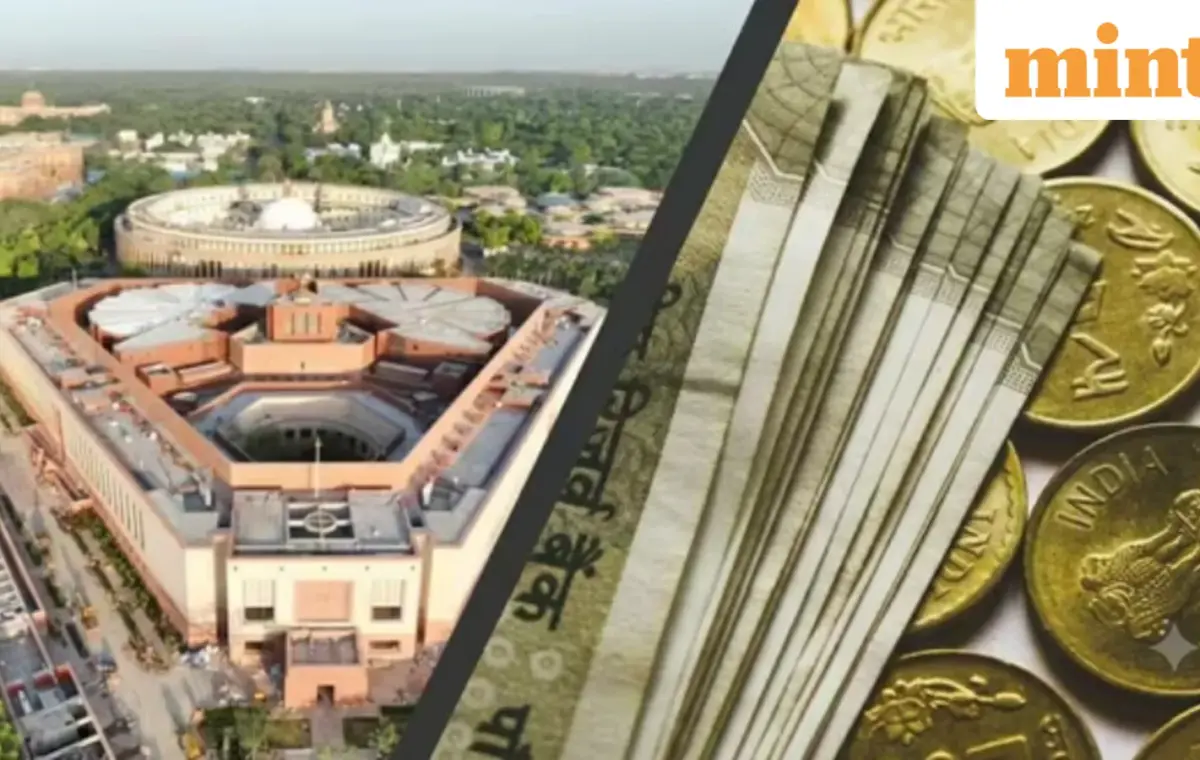
Time is money is a famous adage. But when Parliament loses roughly 80 hours of functioning in a session due to interruptions and disruptions, how much money is actually lost?
Well, there is no one answer to this question. While more often than not it is said that " ₹2.5 lakh per minute" are lost when proceedings of Parliament are disrupted. But there is no official amount wasted available as such.
In fact, the government says that the data cannot be shared with the public as it is not considered "information" under the RTI Act, 2005.
Chaos and bedlam are a common sight during Parliament sessions. Monsoon Session held last month was no exception as such. The stand-off between the ruling dispensation and opposition parties often leads to the wastage of time of the House and adversely affecting the very purpose of Parliament.
Data from the Lok Sabha Secretariat revealed that the lower house lost 330 hours and 18 minutes (13 days, 18 hours, 18 minutes) across the eight sessions (so far) of the 18th Lok Sabha, formed after the 2024 general elections. The House, however, "gained" some of this time by sitting late to complete listed business.
This further prompts many to raise concerns about the huge amount of money spent on running the Houses, which goes to waste due to the disruption of proceedings. Not just the money, but the disruptions of the House and the lower "productivity" of Parliament also impact democracy.
Mayuri Gupta, who is a Milon K Banerji Senior Resident Fellow at Charkha, Vidhi Centre for Legal Policy, explains that what the productivity of Parliament really means, what productivity trend in the past few years shows, how it may impact democracy and why loss of time in Parliamentary functions must concern common citizens.
Gupta earned her Doctorate in Law from Gujarat National Law University in 2026, and completed her LL.M. in Constitutional and Administrative Law from Gujarat National Law University in 2017. Here is what she said:
In the context of the Indian Parliament, the productivity of the House refers to the amount of time it spends conducting its scheduled business, compared to the total time allotted for the session. A session is therefore considered to have low productivity when a significant portion of the scheduled time is lost, often due to disruptions and repeated adjournments.
Thus, productivity is fundamentally an indicator of time utilisation. For instance, the Monsoon Session of Parliament this year (20 July–13 August 2026) recorded low productivity amid repeated disruptions.
Parliamentary Affairs Minister Kiren Rijiju stated that the Lok Sabha’s productivity was only 19%, while the Rajya Sabha’s stood at 39%. (See here) However, this is not an isolated instance.
Several parliamentary sessions in the past have also witnessed substantial disruptions and significant loss of scheduled working time.
A closer look at Parliament’s functioning reveals a substantial decline in the number of days it sits compared with earlier decades. During the 1950s, the Lok Sabha met for an average of 120 days a year.
This figure fell to around 70 days a year in the 2000s. The decline has continued in recent years: the 17th Lok Sabha (2019–2024) sat for an average of just 55 days a year. Fewer sitting days mean less time available for Parliament to debate legislation, scrutinise government policies and hold the executive accountable. However, if we look at the data from the recent years, the productivity of the Parliament has been quite volatile across sessions.
For instance, just like the current Monsoon Session, the 2025 Monsoon Session saw low productivity with the Lok Sabha and the Rajya Sabha functioning for 29% and 34% respectively. However, the Winter Session in the same year marked a high productivity with the Lok Sabha and the Rajya Sabha functioning for 103% and 104% respectively of its scheduled time.