Zurich Airport International AG, the main developer and concessionaire behind Noida International Airport (NIA), is bracing for a significantly slower ramp-up in air traffic than initially anticipated. Commercial domestic passenger flights commenced on June 15, but initial footfall figures reflect a modest start. The airport recorded 104 flights carrying 25,000 passengers in June, rising to 1,044 flights and 77,000 travelers in July. Due to this sluggish initial trajectory, the facility projects an H1 EBITDA core financial loss of roughly ₹28.6 crore ($3 million).
In its outlook for NIA, Zurich AG has said: “Slower ramp up expected due to challenging geopolitical environment with near-time performance remaining subject to elevated uncertainty. Route network will continue to expand with international services expected to follow. Strong confidence in the long-term growth potential and attractive fundamentals of the Indian aviation market.”
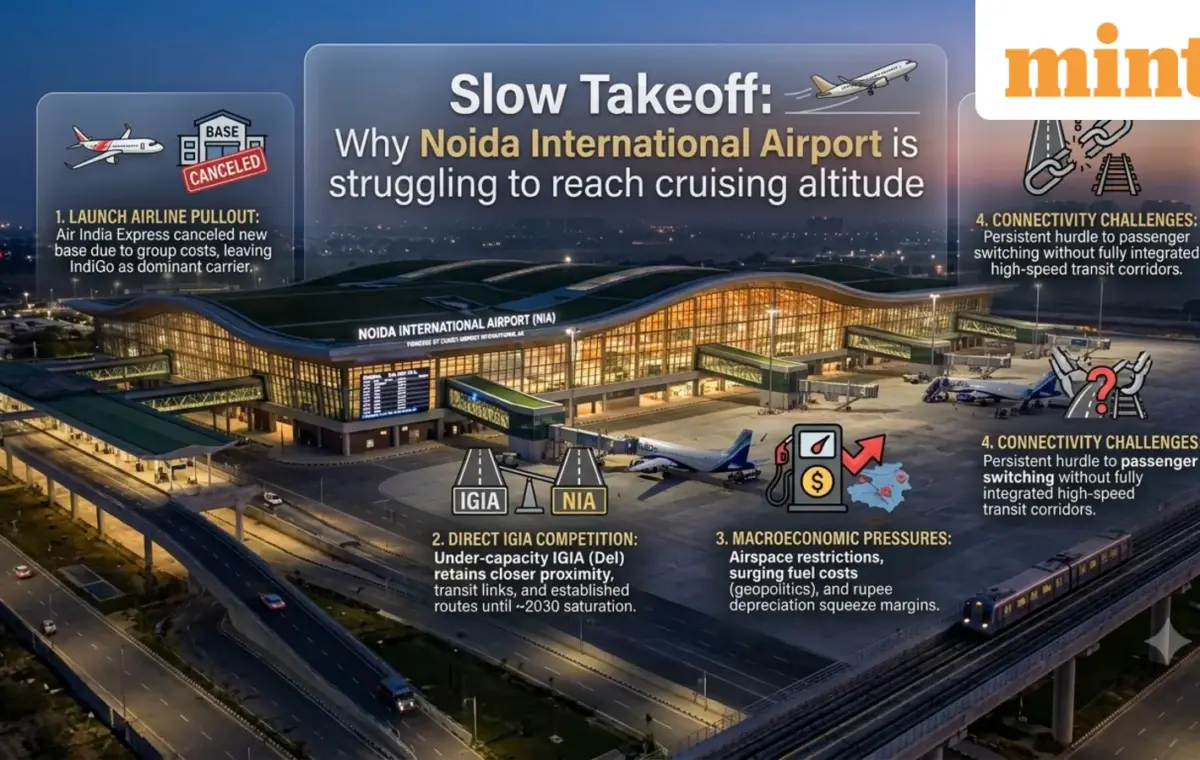
Initial forecasts pegged first-year passenger volume at 60 lakh—roughly 50% of the airport’s total capacity—which translates to an average monthly target of 5 lakh travelers. July’s turnout fell far short of these projections, largely due to a key structural setback. Air India Express, slated to be one of three launch carriers, withdrew prior to operations to curb costs amid broader financial losses across the Air India Group. Because establishing a new base involves heavy capital expenditure, the airline opted to forgo expansion at NIA. Consequently, IndiGo remains the dominant operator by a wide margin, supported by a minimal presence from Akasa Air.
Unlike previous greenfield projects in Hyderabad and Bengaluru—where travelers lacked alternative options—or cities where older hubs were retired, NIA must compete directly with Indira Gandhi International Airport (IGIA). Delhi’s primary hub is far from saturated; while holding a total annual capacity of 11 crore passengers, IGIA processed under 8 crore last year. Processing roughly 1,300 daily flights compared to its peak capacity of 1,550, IGIA offers closer proximity, superior transit links, and established multi-modal transportation options for residents across Delhi, Gurgaon, Noida, and Ghaziabad. Estimates suggest NIA may face stiff competition from IGIA until roughly 2030, when the latter is expected to approach its saturation point of 13 to 14 crore passengers annually.
External industry headwinds have further constrained airline appetite for route expansion. Indian carriers face compounded margin pressure from:
While peak-hour slot availability remains NIA's primary unique selling proposition, overall physical connectivity with the broader National Capital Region remains a persistent hurdle. Without fully integrated, high-speed transit corridors in place, distance and accessibility continue to deter passengers from switching away from the more accessible IGIA.
($3 million ≈ ₹28.6 crore at the current exchange rate.)
Catch all the Industry News, Banking News and Updates on Live Mint. Download The Mint News App to get Daily Market Updates.
Log in to our website to save your bookmarks. It'll just take a moment.
Oops! Looks like you have exceeded the limit to bookmark the image. Remove some to bookmark this image.