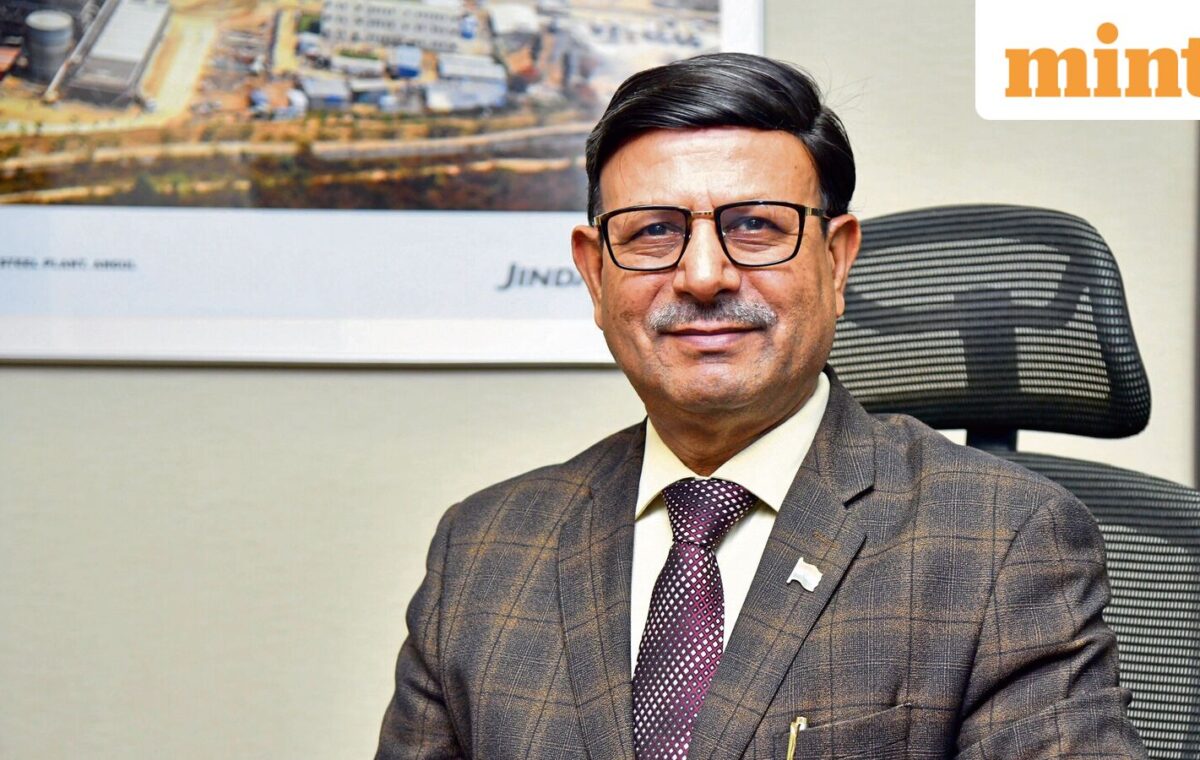
Jindal Steel, led by billionaire Naveen Jindal, plans to expand its steelmaking capacity to about 21 million tonnes (mt) by 2032 as newly appointed managing director V.R. Sharma looks to bring greater leadership stability at the company and focus its expansion on specialised steel.
Currently, the Jindal brothers—Naveen Jindal and Sajjan Jindal—hold 51 million tonnes (mt) of installed capacity, giving them just under a fourth of India’s 220 mt installed capacity. By 2030, the two brothers aim to reach a combined annual capacity of at least 100 mt, accounting for a third of the country's planned 300 mt target. Sajjan Jindal-led JSW Steel is targeting 80 mt within this timeframe, while Jindal Steel is eyeing a more measured 20-21 mt expansion. Sharma emphasized that the company is not looking to chase volume for its own sake, considering 20–21 mt an adequate scale for its operations.
“We are targeting 20-21 mt, but we intend to pursue this growth in a measured and sustainable manner. Achieving this scale will depend on several factors, including the availability of iron ore and coal, logistics, market conditions, and other operational considerations,” Sharma told Mint on the sidelines of the Metalogic 9th Annual Conference on Steel in New Delhi on Thursday.
Jindal Steel has 15.6 million tonnes per annum (mtpa) of total steelmaking capacity, of which around 12 mt is currently operational. Sharma said the company does not intend to compete purely on volumes, and will instead use the additional capacity for specialised steel.
“We are not in a race to add millions and millions of tonnes of capacity. Our focus is on profitable, sustainable and responsible growth, while ensuring that every expansion creates value for the company,” Sharma said. He added that the company is looking at specialised steel used in sectors such as nuclear power plants and shipping.
The company has already been working on developing these specialised grades for about a year, engaging with IITs, research scientists and overseas professionals to build the required capabilities. The specialised steel capacity will come up at the company’s Angul plant in Odisha, Sharma said.
Sharma, who has returned to the company as managing director, is also looking to build a more stable leadership pipeline following several senior-level changes in recent years.
Rather than relying heavily on external hires, Sharma said Jindal Steel plans to develop its leadership internally. The company has identified around 2,000 employees from AGM to vice-president level as its core leadership pool, from which it plans to develop 20 people for top leadership roles and around 200 for middle management.
“We'll give them a chance first,” Sharma said, referring to long-serving employees who have spent 17-20 years at the company.
Meanwhile, Jindal Steel is taking a cautious, flexible approach to acquiring captive mines amid steep auction premiums. The company currently relies on state-run Odisha Mining Corporation (OMC) and National Mineral Development Corporation (NMDC) for 70% of its raw materials, with the remaining 30% coming from its own mines.
Unwilling to bid aggressively if the economics don't line up, Sharma noted that Jindal Steel would even be comfortable sourcing 100% of its iron ore from the open market if needed.
This is in contrast to JSW Steel and Tata Steel, which have sought to maintain a significant captive iron ore base for raw-material security. Tata Steel currently meets its iron ore requirements entirely through captive mines. However, as some of its existing mines come up for auction from 2030, the company plans to maintain a 50:50 mix between captive mines and market purchases. JSW Steel, too, has indicated a preference for retaining at least half of its iron ore requirements through captive sources.
“We do not want to burden our balance sheet with excessive debt. Our philosophy is ‘earn & invest’. We will generate earnings, build internal accruals and use these accruals to fund our future expansion,” said Sharma.
He also said Jindal Steel is not concerned about the impact of the European Union’s Carbon Border Adjustment Mechanism (CBAM), or ‘carbon tax’, on its exports. To service export markets, the company relies on four electric arc furnaces: three in Gajapati and one in Angul, Odisha. These furnaces produce green steel by using high-current electricity to melt recycled scrap or direct-reduced iron (DRI), nearly halving carbon emissions.
"We are not worried about the business because we have electric arc furnaces," Sharma said, noting that their emissions average around 1 tonne of CO2 per tonne of steel, well below the EU benchmark of 1.3 tonnes.