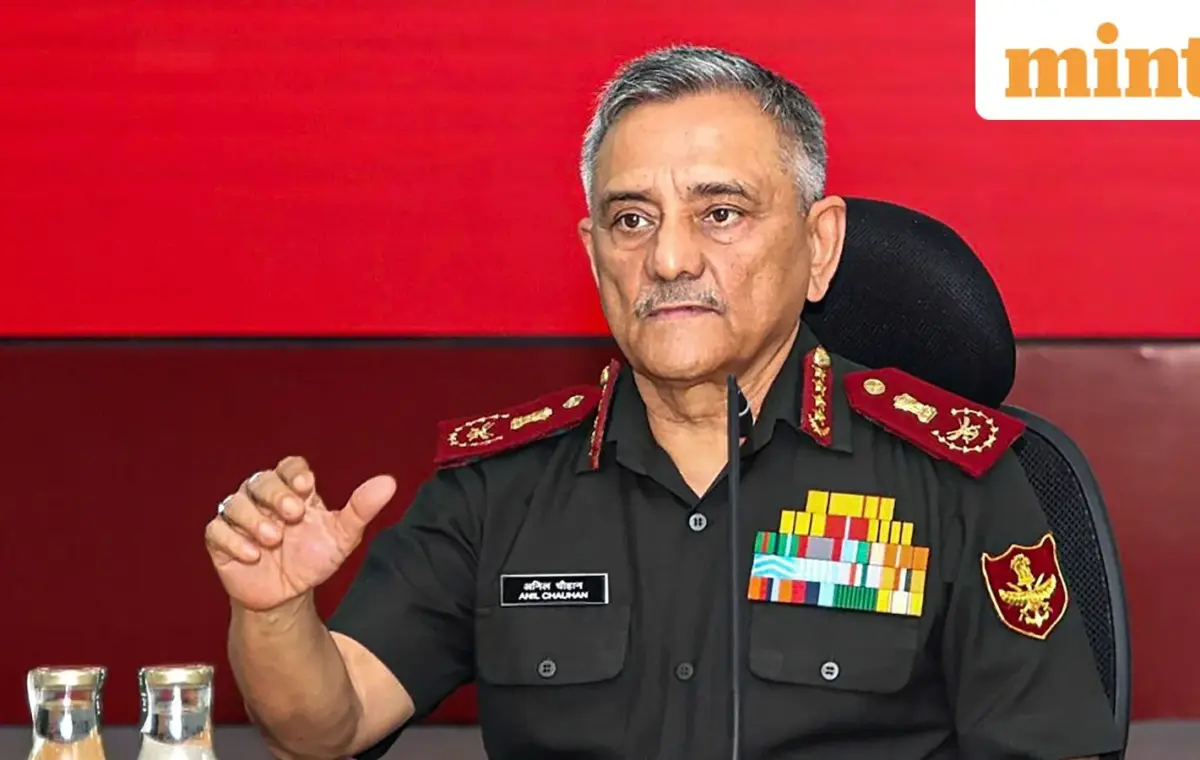
Former Chief of Defence Staff General Anil Chauhan (Retd) has warned that India’s security threats are evolving beyond conventional warfare, with cyber operations, information campaigns, technology and attempts to influence public thinking becoming increasingly important in modern conflicts.
Speaking at the 22nd Bharat Ratna Pandit Govind Ballabh Pant Memorial Lecture at the Prime Ministers' Museum and Library in New Delhi on Saturday, Chauhan identified "cognitive colonialism", Pakistan’s nuclear-backed instability and the unresolved border dispute with China among the key challenges facing India.
His lecture, titled “Threats & Challenges to India's Security”, was delivered to mark the 139th birth anniversary of Pandit Govind Ballabh Pant.
Chauhan described "cognitive colonialism" as an attempt to influence how societies understand themselves, shape their values, decide whom to trust and imagine their future.
The focus, he said, is not necessarily on controlling territory or destroying infrastructure, but on influencing the human mind.
His warning comes as geopolitical relationships become more fluid, with countries increasingly pursuing narrower strategic interests. A country can simultaneously be a trade partner and a technology rival, while military force is increasingly being used as a policy instrument.
Chauhan said Operation Sindoor demonstrated how future conflicts could stretch across several domains beyond traditional military operations.
Cyber warfare, electronic warfare, space-based capabilities, economic measures, legal tools and information campaigns are likely to play a growing role, he said.
"The old kind of warfare" is no longer the only form of conflict countries need to prepare for, Chauhan said, describing the emerging environment as "a different kind of war."
He questioned whether India should prepare for a short, intense conflict or a prolonged contest requiring national resilience. He also raised the question of how much defence investment should go towards traditional domains such as land, sea and air versus newer areas including space, cyber and information warfare.
Turning to Pakistan, Chauhan highlighted what he called "long-standing and nuclearised cross-border terrorism".
He said nuclear weapons have created a degree of stability at the highest strategic level while allowing instability to persist at the sub-conventional level.
Chauhan termed this dynamic the "stability paradox", pointing to the coexistence of nuclear deterrence and lower-level conflict.
Chauhan described China as a different and more complex security challenge for India.
The two countries continue to have an unresolved boundary dispute, while there is no mutually agreed definition of even the Line of Actual Control, he noted.