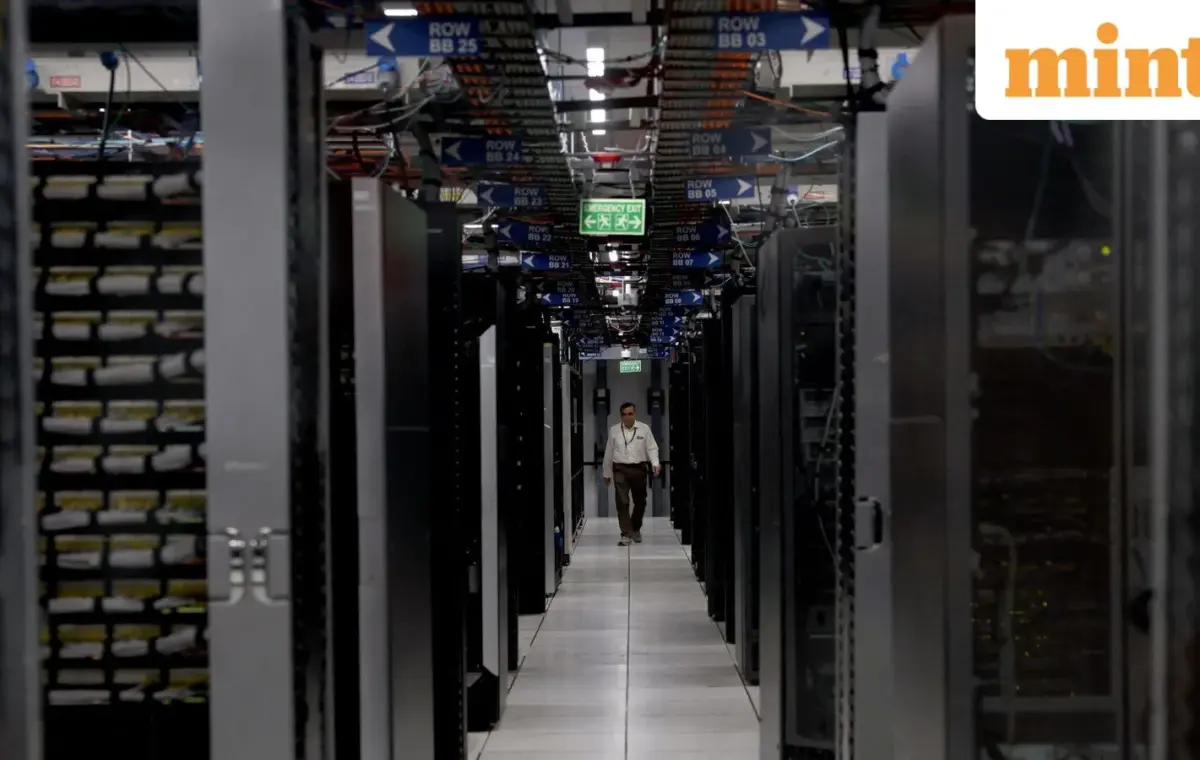
Despite billions of dollars being invested in data centres, the industry may add just 0.13% to India’s gross domestic product (GDP) by 2030, when a sizeable share of planned capacity is expected to be operational.
In a report published on Tuesday, global credit ratings agency Moody’s said data centres would have an even smaller impact on employment, projecting a meagre 0.02% increase in jobs in India over the next four years.
India would trail Malaysia, Singapore and Thailand, all of which are expected to get a greater economic boost from data centres.
To be sure, India is expected to become the world’s third-largest economy by 2030, with a projected GDP of $7.3 trillion, according to government estimates. At that scale, even a rapidly expanding data-centre industry could remain economically small. A back-of-the-envelope calculation suggests that a 0.13% contribution would amount to roughly $9.5 billion in annual GDP.
Over the past 12 months, domestic conglomerates, global Big Tech giants and smaller independent firms have together announced more than $250 billion in investments, betting on the sector’s growth. These include Google and Adani’s $15-billion, 1-gigawatt (GW) data-centre project in Visakhapatnam and Tata Consultancy Services’ $7-billion, similarly sized HyperVault project, announced in October 2025.
On 27 July, independent research firm Wood Mackenzie projected that India’s net active data-centre capacity would reach 12 GW by 2030.
The investor optimism around data centres has even drawn the Centre into the push. On 1 February, Union finance minister Nirmala Sitharaman announced a complete tax holiday until 2047 for foreign cloud service providers that use Indian data centres to host data or run workloads.
Data centres are modern-day factories that store, process and transfer vast tranches of data, the currency of modern-day artificial intelligence. Each of India’s top conglomerates, including Tata Sons, Reliance Industries, Adani Enterprises, Larsen & Toubro and Airtel’s parent Bharti Enterprises, have ventured into the sector, drawn by the prospect of large orders to store and run data in the country.
Yet, relative to the size of India’s economy, Moody’s said that the sector will remain small. “India's planned investment and construction employment are substantial in absolute terms but small relative to the size of the economy. The investment is strategically and locally important, but is not yet large enough to materially change the national growth profile,” the report by analysts Deborah Tan and others read.
Moody’s also added that the country is likely to see data centres account for less than 5% of its net national power consumption by 2030, indicating a smaller impact on resources than previously projected.
Industry stakeholders labelled the assessment fair, noting that revenue from data centres may not be commensurate with committed investments.
“The large capital investment does not translate into equally large domestic value addition. A significant share of spending goes into imported servers, graphics processing units (GPUs) and other specialized equipment, while the domestic contribution is concentrated in construction, power, connectivity and hosting revenues,” said Kashyap Kompella, chief executive of technology consultancy firm, RPA2AI Research.
Concerns around infrastructure are emerging. On 3 August, Mint reported that shortages of transmission lines and substation capacity are emerging as critical bottlenecks that could slow the country's data-centre expansion. A bigger question, as Moody’s’ report raised, is whether India can turn the massive capacity build-out into a larger economic opportunity.
“The immediate priority is utilization. Data-centre operators need enough sustained demand from hyperscalers, enterprises and cloud providers to keep expensive capacity occupied and generate recurring returns,” Kompella added.
Catch all the Industry News, Banking News and Updates on Live Mint. Download The Mint News App to get Daily Market Updates.