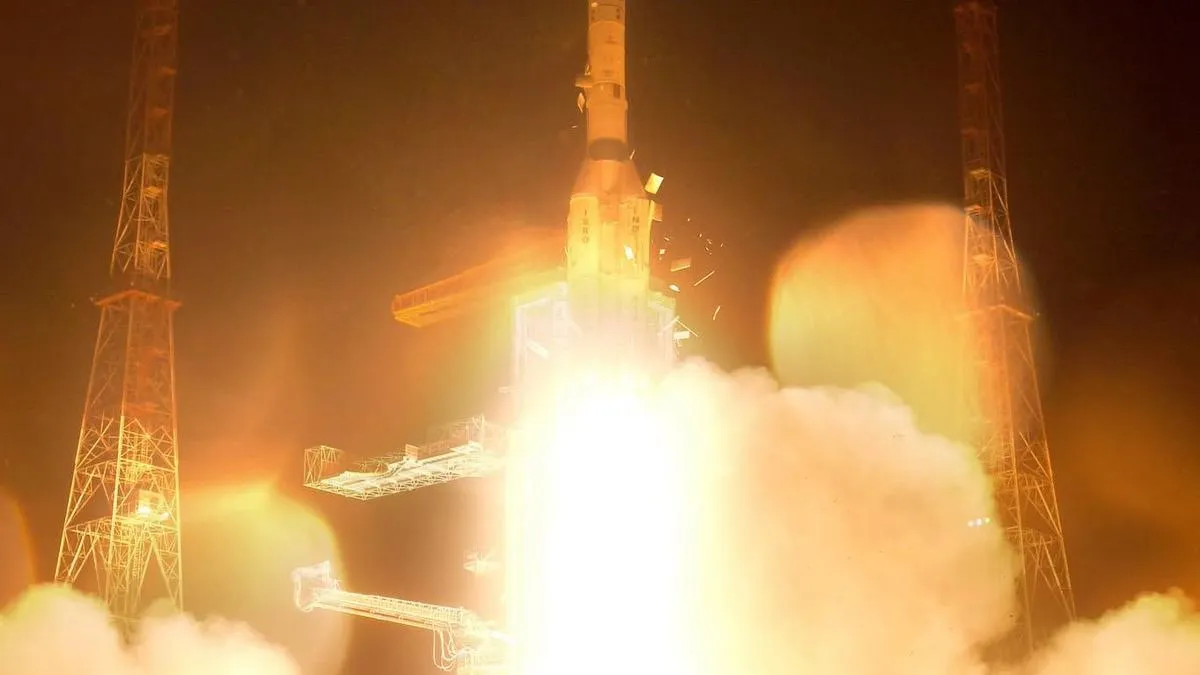
ISRO’s GSLV successfully launched EOS-05, India’s first imaging satellite headed for geosynchronous orbit, strengthening capabilities in surveillance, weather monitoring and disaster management.
A silent, pitch-black horizon. Some faint murmurs that soon faded away as the countdown reached the last few digits. ‘Liftoff’ had barely echoed from the speakers when, cutting through the spotty showers of a gloomy midnight, it soared above, leaving behind a bright golden sky to marvel at.
ISRO’s Geosynchronous Satellite Launch Vehicle (GSLV) lifted off for the nineteenth time and carried with it EOS-05 – India’s first imaging satellite headed to the Earth’s Geosynchronous Earth Orbit.
The satellite has been injected into the Geostationary Transfer Orbit (GTO) and is expected to reach GEO over the next few days using its own engines.
From 36,000 Kilometers, EOS-05 will act as India’s ‘eye-in-the-sky’ that will help monitor critical assets like remote borders and conflict zones. Unlike other imaging satellites stationed at lower altitudes, EOS-05 will match Earth’s rotation, providing continuous, real-time viewing of the same region rather than multiple snapshots captured by satellites in lower orbits.
This continuous view will bolster India’s strategic surveillance capabilities and assist with weather forecasting, cyclone and storm tracking, disaster management, agriculture, and environmental monitoring.
Interestingly, ISRO attempted to accomplish this mission once in 2021 but was unsuccessful due to a technical anomaly during the third Cryogenic Upper Stage ignition.
Speaking after the launch, V Narayanan, Chairman, ISRO, emphasised ISRO’s lessons from previous missions and the gradual improvements it made.
“The first launch of the GSLV was with a payload of 1536 KGs. Since then we have gradually improved the performance of this vehicle by optimising the structural mass and improving the propulsion system and today we have injected the heaviest satellite – 2367 KGs- launched with this vehicle,” he said.
Narayanan added that ISRO has planned six more launches this financial year, including the critical NVS-03 navigation satellite. He also mentioned that the team is working vigorously on the Gaganyaan programme with targets for the first launch this calendar year.
Returning to the launchpad for the first time after roughly seven months, the GSLV’s successful launch has brought some much-needed respite for ISRO. The space agency had previously had to contend with two consecutive failures of its ‘workhorse’ Polar Satellite Launch Vehicle, including the PSLV-C62/EOS-N1 mission in January, alongside concerns about employee attrition.
Dubbed the ‘naughty boy’ for its unpredictability and occasional failures, GSLV’s scorecard now includes 13 successes, 4 failures, and 2 partial failures.
Copyright© 2026, THG PUBLISHING PVT LTD. or its affiliated companies. All rights reserved.
Comments have to be in English, and in full sentences. They cannot be abusive or personal. Please abide by our community guidelines for posting your comments.
We have migrated to a new commenting platform. If you are already a registered user of TheHindu Businessline and logged in, you may continue to engage with our articles. If you do not have an account please register and login to post comments. Users can access their older comments by logging into their accounts on Vuukle.
Source: Read the original article on www.thehindubusinessline.com