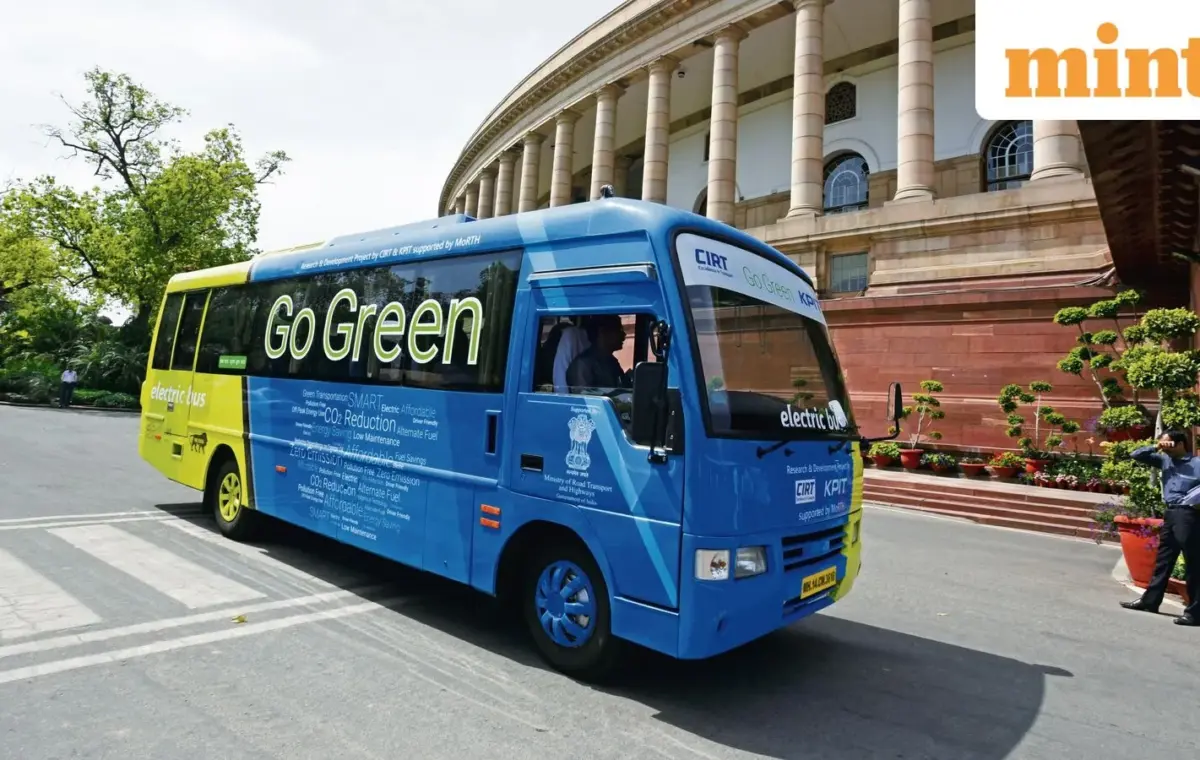
New Delhi: The ministry of heavy industries has asked e-truck and e-bus manufacturers to provide their sales estimates for upcoming years to assess demand and set targets under a new scheme to ease financing of electric commercial vehicles, according to two people aware of the development.
The new scheme will provide interest subsidy and credit guarantees to reduce financing costs for operators of e-buses and e-trucks, which cost more than twice as much as their diesel counterparts, the people said.
During stakeholder consultations in May, the government had considered a budget of ₹9,852 crore to support the financing of 50,000 e-buses and 50,000 e-trucks over five years, according to an official document reviewed by Mint.
This will be the first major government scheme for private sector intercity e-buses. Previous e-bus schemes covered state-run intracity buses.
“For this new scheme, we are still estimating how many e-buses and e-trucks will come on the roads in the next few years and how the requirement for charging infrastructure will rise. We are still in talks with the industry,” one person, a senior government official, said on condition of anonymity.
The second person, an industry executive who requested anonymity because the discussions are still underway, said the government is assessing demand for the next few years and has asked manufacturers for sales estimates and projections.
Queries emailed to the ministry of heavy industries and e-bus and e-truck makers Tata Motors, Ashok Leyland and Volvo Eicher Commercial Vehicles on 24 August remained unanswered.
India, the world’s third-largest e-bus market, according to the International Energy Agency, has recorded a sharp rise in demand in recent years, except for a dip in FY25. Following an 81% rise in e-bus sales to 3,644 units in FY24, sales dropped 6% to 3,314 in FY25 before resurging 37% to 5,356 units in FY26, according to the ministry of road transport and highways.
E-bus demand is not generated by customers, but by operators who want to transition to electric fleets for better profitability and margins.
“Broadly, demand for buses is rising because airfare is costly and railways have limited connectivity. Also, it is that much easier to board a bus compared to trains or planes,” said Sudhakar Chirra, founder and CEO of Fresh Bus, which operates 86 e-buses. “This is something that will drive the demand for buses and as more enablers such as charging solutions become widespread, the demand from operators for electric buses will also rise.”
Experts said the adoption of e-buses can help reduce more emissions than most vehicle segments.
“Buses run continuously for long periods, compared to personal cars or two-wheelers, which only run for shorter periods in the day,” said Ashim Sharma, senior partner and business unit head at Nomura Research Institute Consulting and Solutions, India. “So, with electric buses, you end up reducing a larger volume of emissions. Putting these many e-buses on roads requires thorough planning. This includes planning for depots, chargers and even designated lanes in some cases to make bus travel faster.”
The new scheme comes in the wake of low adoption of e-trucks under the ministry’s flagship PM E-Drive scheme. The 2024 PM E-Drive scheme was the country’s first to support sales of e-trucks, with a ₹500 crore budget for subsidies till FY28 and a target of 5,643 e-trucks.
According to the scheme’s dashboard, only 52 e-trucks had been incentivized as of 24 August.
Manas is a New Delhi-based journalist with Mint, where he covers the intersection of economic policy, industry, and emerging sectors shaping India’s growth. He writes on government regulation, manufacturing, and the clean energy transition, with particular depth in areas such as electric mobility, battery ecosystems, and rare-earth supply chains. He has written on India’s efforts to build domestic capacity in electric vehicles and energy storage, as well as the broader push to reduce import dependence and strengthen supply chain resilience. His reports are not limited to capturing the headline; they also aim to explain complex policy simply.<br><br>Manas has studied law in Pune, the city where he grew up, followed by a business journalism diploma from the Asian College of Journalism in Chennai. In his almost two years of being a correspondent for Mint, Manas has reported as major wars unfolded, a general election brought surprises for both the ruling party and the Opposition, and three Union Budget announcements where India has charted its economic course for the days to come.<br><br>On vacation, Manas plays bass guitar with his friends in Space & Co, their jam-rock band. He also likes cats, and occasions of late-night snacking.