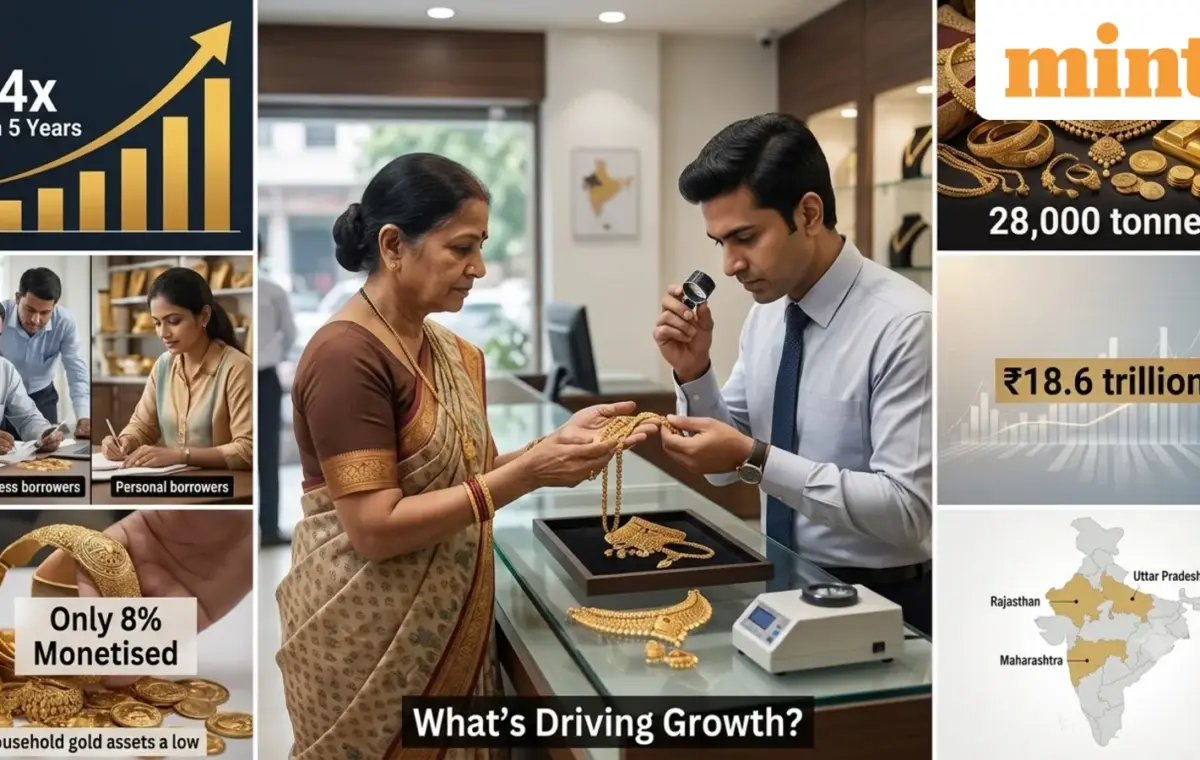
The gold loan segment has surged nearly 4x in the past five years to ₹18.6 trillion as of March 2026, becoming the second-largest asset class in the retail segment and surpassing personal loans, according to the “Morning India” report released by Motilal Oswal Financial Services on Wednesday.
However, gold loan penetration remains low, with only around 8% of the estimated gold held by Indian households currently monetised. Here's what the report reveals about the gold loan trend.
The gold loan segment has nearly quadrupled over the past five years, reaching ₹18.6 trillion as of March 2026.
The segment grew 50% year-on-year in FY26, driven by a more than 60% rise in gold prices and growing demand for gold-backed loans for personal consumption and business needs.
The report projects the gold loan market to grow at a 28% CAGR over FY26-FY28, surpassing ₹30 trillion by March 2028.
Despite the rapid growth, “penetration remains low even as household physical savings continue to rise”. Indian households are estimated to hold around 28,000 tonnes of gold worth ₹380-390 trillion.
However, only about 8% of this stock is estimated to have been monetised through the organised gold loan market, assuming an average loan-to-value ratio of around 60%, the report noted.
The opportunity is significant because physical assets continue to dominate Indian household savings. “Physical assets accounted for 64% of household savings in FY25, while savings in gold and silver ornaments rose 27% to ₹2.18 trillion”, the report mentioned.
Gold loans are gaining acceptance among micro, small and medium enterprises (MSMEs), microfinance institution (MFI) borrowers and personal-loan customers, the report noted.
For MSMEs and semi-formal borrowers, gold loans provide working capital with faster disbursal, flexible repayment options and limited documentation.
Among MFI customers who also use other retail credit products, gold loans account for the largest share at 18%. The report said gold loans offer these borrowers higher ticket sizes at lower interest rates.
“Borrowers with both gold and personal loans have witnessed moderation in outstanding personal loan balances, particularly in the sub-prime segment, indicating a gradual shift toward secured borrowing,” the report mentioned.
Southern states have historically dominated the gold loan market, accounting for around 75% of the overall market. However, the market is expanding rapidly beyond the traditional southern stronghold.
In FY26, the gold loan book in the non-southern states such as Rajasthan, Maharashtra and Uttar Pradesh grew 78%, 61% and 58%, respectively—well above the overall industry growth of 50%.
“This shift reflects the gradual evolution of gold-pledging practices and cultural acceptance of gold loans across non-southern regions,” the report stated.