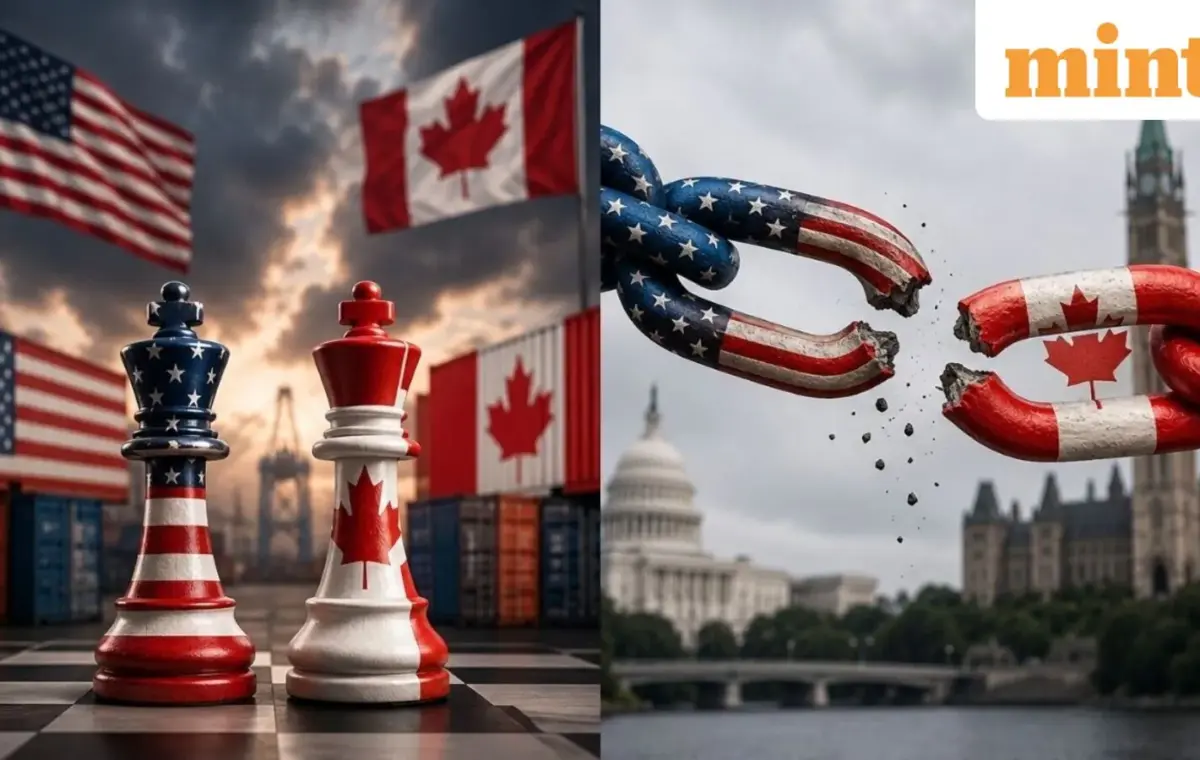
The ongoing trade war between North American neighbours of US and Canada is being driven by a widening gap between how Washington and Ottawa view their economic relationship apart from rhetoric across the border. While US President Donald Trump argues that Canada has taken advantage of the United States and that Washington holds the upper hand, Canadian Prime Minister Mark Carney has framed the dispute as a fight over sovereignty, jobs and Canada's ability to diversify its economy.
The differences came into focus after weeks of negotiations between the two countries collapsed, with both sides accusing the other of demanding too much. These key issues remain the heart of the escalating trade war.
Trump has repeatedly accused Canada of taking advantage of the United States. In an interview with right-wing radio presenter Glenn Beck, he said Ottawa had "taken advantage of the United States for many decades" and argued that Canada had benefited from access to the US market while imposing tariffs on American products.
Trump also said Canada had "taken our car industry" and "taken our agriculture industry", arguing that American farmers could not sell in Canada because of high tariffs while Canadian goods could enter the US market.
The US president has also said that America does not need Canada and that Americans could obtain Canadian products elsewhere.
Ottawa, however, has framed the dispute differently. The Canadian government said it had negotiated in good faith for a deal that would protect Canadian workers and families, strengthen the economy, provide certainty for businesses and respect Canada's sovereignty.
Carney said Canada could not accept the attitude at the negotiating table that Canada was a "subsidiary of the United States".
The sovereignty issue became particularly important during the final stages of negotiations. According to the New York Times, US officials wanted the ability to review and potentially dictate the terms of Canada's future trade agreements with other countries.
Canada had sought a "Fortress North America" arrangement with very low or zero tariffs within North America and aligned tariffs against outsiders. But Ottawa rejected a US demand that Canada match American tariffs on third countries, arguing that it would interfere with Canada's efforts to diversify trade away from dependence on the US.
Trump has presented tariffs as a way to protect American industries and workers. He has complained that Canadian tariffs have prevented American farmers from selling into Canada and accused Canada of taking away US car and agricultural industries.
The US administration also took a hard line on steel, aluminium and automobiles during the negotiations. Commerce Secretary Howard Lutnick pushed for higher protection for US companies, including seeking limits on how much Canadian aluminium could receive lower tariff rates, according to the New York Times.
Lutnick also opposed lowering tariffs on heavy trucks to the same level proposed for cars. Canada produces vehicles including the GM Silverado and Ford F-350 and F-450 in Ontario, making the issue a red line for Canadian negotiators, the report said.
Ottawa argues that tariffs and trade disruptions threaten Canadian workers and businesses.
The Canadian government said its counter-tariffs are intended to protect Canadian workers, farmers, fishers, families and businesses, while helping Canadian producers compete with US products in the domestic market.
Canada also announced additional financial support for businesses and workers affected by the trade dispute. The government said the measures include liquidity support for small and medium-sized businesses, assistance for tariff-affected industries and support for workers through income assistance, training and workforce-retention programmes.