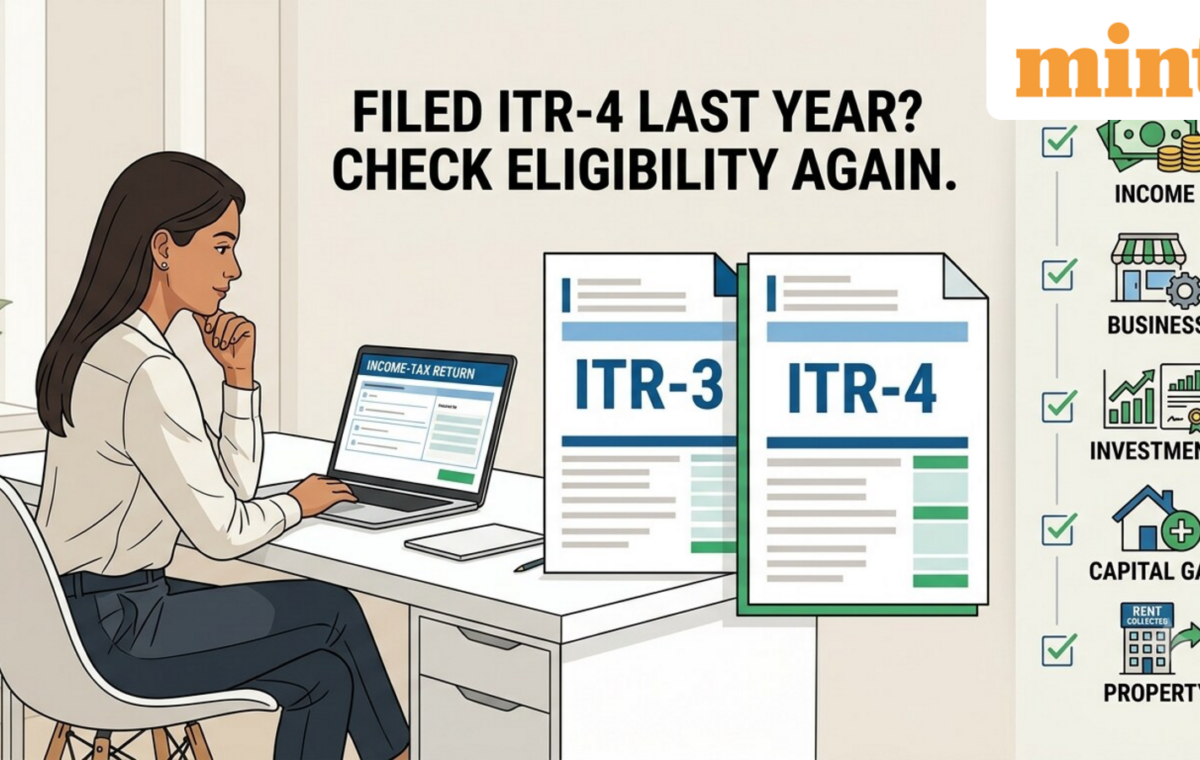
Filing ITR-4 in the previous assessment year does not automatically make a taxpayer eligible to use the same form again. Eligibility has to be assessed every year based on the taxpayer's income, business or profession, and other financial circumstances.
Siddharth Maurya, Founder and Managing Director, Vibhavangal Anukulkara, explained the key conditions taxpayers should check before filing ITR-4 for AY 2026-27.
"The eligibility for ITR-4 must be assessed every year. The form applies to resident individuals, HUFs and firms (excluding LLPs), with total income of up to ₹50 lakh and whose business or professional income is computed under the presumptive taxation provisions,” Maurya noted.
The ₹50 lakh limit for total income is separate from the turnover or gross receipts limits:
“A taxpayer will lose eligibility if they exceed these limits, if income is computed under normal provisions, if income arises from commission or brokerage, if the taxpayer carries on agency or speculative business, or if they own more than 10 goods carriers under Section 44AE,” Maurya explained.
He added that holding listed shares does not by itself make a taxpayer ineligible. However, holding unlisted shares at any time during the financial year does.
“ITR-4 is also not applicable where the taxpayer has short-term capital gains, capital losses, long-term capital gains under Section 112A exceeding ₹1.25 lakh, or gains from property, gold, debt or virtual digital assets,” he added.
Yes. "A taxpayer who does not opt for presumptive taxation may switch from ITR-4 to ITR-3 to calculate business or professional income and claim business expenses, including depreciation and other deductions, under the normal provisions,” he said.
“A taxpayer cannot use ITR-4 and earn business income in accordance with the normal provisions. However, such a taxpayer may earn business income that is more than the presumptive percentage and continue to use ITR-4, since this is a case of presumptive income,” he explained.
Maurya also highlighted the five-year rule under Section 44AD. If a taxpayer opts for the scheme and later exits it, Section 44AD may not be available for the next five assessment years.
Therefore, they cannot simply opt for the presumptive scheme again by filing ITR-4 during this period. The restriction does not apply to Sections 44ADA and 44AE in the same manner.
Maurya said taxpayers may need to shift from ITR-4 to ITR-3 if they:
Maurya said a key modification is that taxpayers can now report income from two houses, compared with one earlier. There is also a separate field for rent that could not be realised, helping in computation.
The Income Tax Department has also removed the requirement to report foreign retirement benefits. However, Maurya cautioned that this does not allow taxpayers to report foreign assets or income in ITR-4. Such holdings or income can still make a taxpayer ineligible for the form.
Disclaimer: This is only for informational and educational purposes. Please consult a qualified expert for the latest laws and regulations.