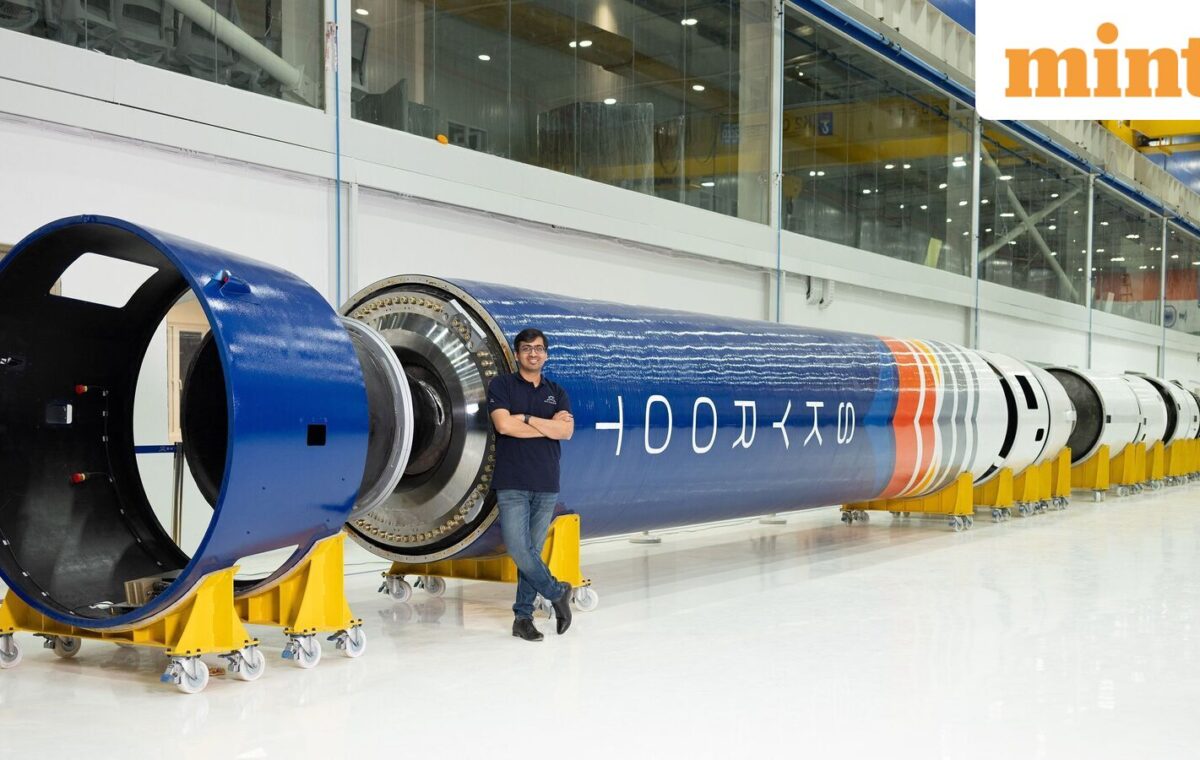
New Delhi: India’s fledgling private space industry has a steep hill to climb before it can become a competitive global launch market. Among six markets capable of launching rockets carrying satellites, India is the most expensive, according to a peer-reviewed article.
The article, written by economists Alessio Terzi of University of Cambridge, England, and Francesco Nicoli of Politecnico Institute of Turin, Italy, in the September edition of the acclaimed peer-reviewed academic journal Economics Letters, said that at the end of calendar year 2025, the cost of launching a satellite from India was $13,302 ( ₹12.7 lakh) per kilogram (kg) aboard rockets available in the country. This is more than four times the US figure of $3,225 ( ₹3.1 lakh), the lowest among the markets studied.
India, interestingly, was more expensive than the European Union, Russia, China and Japan, with Europe’s rocket launch cost being the next most expensive after India at $9,897 ( ₹9.5 lakh) per kg.
Prices were of launches coordinated by NewSpace India Ltd (Nsil), the commercial arm of government-run space agency Indian Space Research Organisation (Isro)—aboard a mix of the latter’s rockets.
The findings are significant for the country's private space industry, for one of India’s biggest selling points has been the frugality of its scientific space missions. At the same time, India hopes to poach market share from SpaceX and capture satellite clients of its own to earn up to 8% of the global space market, as per the Centre’s claim as of December 2025. For all of this, competitive rocket prices are key.
Though the first private commercial rocket launch with Skyroot Aerospace on 18 July marks a major step for India, the cost difference may not be immediate or large.
On 28 October 2025, Pawan Kumar Chandana, chief executive of Skyroot Aerospace, had told Mint that the company expects to earn at least $4 million in each launch of its first rocket–Vikram-1. At this revenue, at peak capacity of carrying 350 kg of satellites to a low-earth orbit of 500km in height or below, Skyroot Aerospace will average at least $11,000 ( ₹10.5 lakh) per kg.
Chandana and Skyroot did not immediately respond to Mint’s emails seeking comment on whether its cost estimates have changed. Emails sent to Isro and Nsil also remained unanswered.
This high cost, industry stakeholders believe, could pose a challenge to India’s near-term space ambitions.
“What India needs is an inherent, recurring customer—which in most cases is the government. Commercial clients, to be sure, would be far and few—that's true for all rocket operators worldwide,” said Chaitanya Giri, space fellow at think-tank Observer Research Foundation (ORF). “What India should work toward is to try lowering its launch costs to match the EU first, and then Japan—to levels of about $7,000 per kg. Rivalling the US is too far into the future, we don't have technical capabilities to do that.”
“To ramp up the cost reduction, a body like Isro has to start developing sustainability-focused technologies, and then pass the technology on through a tech transfer process to the private sector. That is how the industry will gain capabilities.”
In October 2023, India set a target of $3.5 billion in annual revenue from satellite launch services aboard domestic rockets by 2033, as per a ‘Decadal Vision’ document by the country’s space promotions body, Indian National Space Promotion and Authorization Centre (In-Space).
SpaceX, to be sure, uses its ‘Falcon-9’ reusable rocket for regular commercial launches. Alongside being reusable (where the main engine of the rocket lands back and is used in future missions), SpaceX’s Falcon-9 carries up to 22,800 kg of satellites to low-earth orbit. In comparison, India’s heaviest rocket until 2025, Launch Vehicle Mark-3 (LVM3), could carry up to 10,000kg of satellites to the same orbit height—and was not reusable.
The frequency of launches, too, has been vastly different. Through 2025, India launched four successful missions—two on Isro’s older Geosynchronous Satellite Launch Vehicle (GSLV)-Mark 2 (GSLV-M2) rocket, and two aboard LVM3.
In contrast, SpaceX has launched eight successful missions this August alone—two commercially, one for the US government, and five for satellite launches for its fellow Elon Musk-owned venture, Starlink.