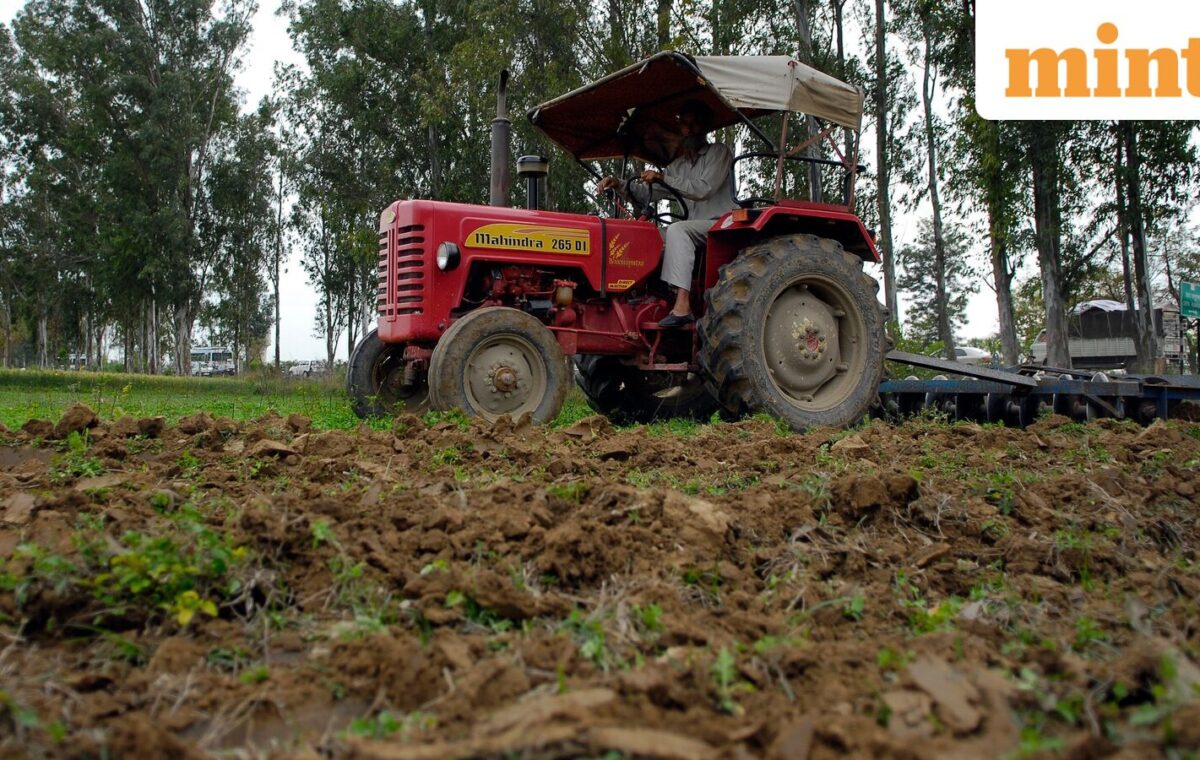
The government has asked public sector banks (PSBs) and the Indian Banks’ Association (IBA) to develop a standard loan product and uniform documentation for contract farming, including financing for farm machinery, within 6-12 months, according to two people close to the discussions and a document reviewed by Mint.
“The proposed contract-farming framework envisages an anchor buyer or processor tie-up, with buyer payments routed through an escrow account with a defined waterfall. It would include sub-limits for input finance, procurement advances, warehouse receipt finance and processing capex,” said one of the persons.
The second person said lending decisions would be based on the reliability of the buyer’s purchase agreement, rather than collateral.
At present, these exposures are documented differently by banks, increasing legal costs, slowing sanctions and making the asset class difficult to compare or aggregate.
The proposed framework would include a model tripartite agreement among the farmer, sponsor, and bank, a uniform set of loan terms, and standard rules for handling quality rejections and price changes.
Dispute resolution could be referenced to applicable state contract-farming legislation, reducing the need for a case-by-case legal exercise.
Mint's queries emailed to the IBA, 12 PSBs, National Bank for Agriculture and Rural Development (NABARD) and ministries of agriculture and farmers welfare and rural development on 18 August evening remained unanswered.
The government has also proposed that the IBA and NABARD explore Credit Guarantee Fund Trust for Micro and Small Enterprises (CGTMSE), National Credit Guarantee Trustee Co. Ltd (NCGTC) and other guarantee mechanisms for the agricultural value chain.
The focus is on aggregators and first-stage processors—businesses that collect and carry out basic processing of farm produce and may have regular cash flows but little fixed collateral.
Without such cover, banks may either decline these proposals or seek security that borrowers cannot provide, which is identified as a key reason why many value-chain financing proposals currently stall.
Another proposal is to support entrepreneurs in setting up district-level custom hiring centres (CHCs) for various types of farm equipment.
The document noted that machinery is unaffordable at the level of individual smallholdings, while much of the equipment is required only for a few weeks per season.
Financing for such centres is proposed as a micro, small, and medium enterprise term loan, appraised on projected utilization across the crop calendar rather than a single crop cycle, with available farm machinery subsidies built into the funding.
The proposals form part of a broader effort to strengthen the farm-to-fork value chain through three areas: farm production and aggregation, bridging infrastructure gaps, and value addition.
India's agricultural sector contributes approximately 18% of gross domestic product (GDP) and provides employment to around 240 million workers, or 43% of the total national labour force.