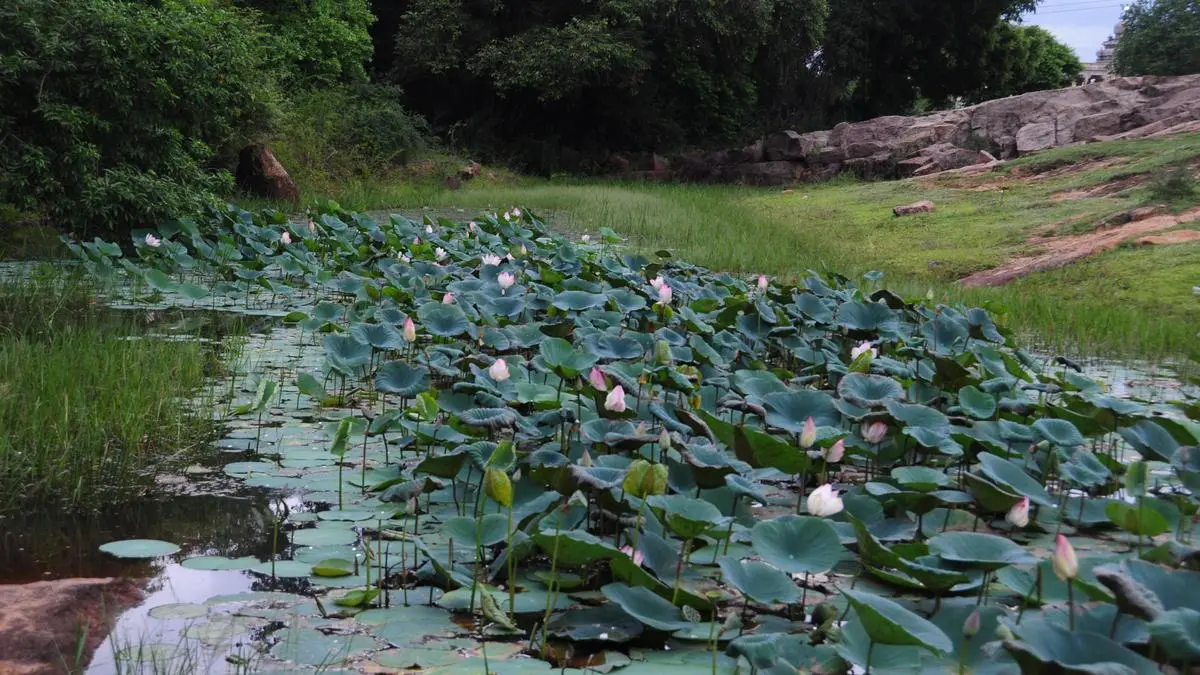
The lotus stem, locally known as nadru, is a staple of Kashmiri cuisine and was also an important source of income for families living around Wular
Ghulam Qadir gazed across Wular Lake at the lotus flowers rising above its waters, a sight he had almost forgotten after decades of watching the lake’s ecological decline.
For Qadir, a fisherman from the villages around the lake, the return of the lotus is more than a seasonal spectacle. It is a reminder of a time when the lake supported families through fishing, harvesting lotus stems and collecting water chestnuts.
The flowers began reappearing last year after being largely absent from Wular for nearly three decades. Their return has continued this year, raising hopes that the vast freshwater lake may be showing signs of ecological recovery.
“Last year, lotus flowers emerged across in parts of the Wular Lake,” said Altaf Hussain, coordinator at Wular Conservation and Management Authority (WUCMA).
The official said lotus growth had been seen again this year, although heavy rains in recent weeks triggered flooding in parts of the lake and damaged some of the emerging vegetation.
“Lotus grows in shallow waters, making it vulnerable to heavy rains and rising water levels, which can submerge or damage the plants,” said Hussain.
For residents, the comeback has revived memories of an economy once closely tied to the lake. The lotus stem, locally known as nadru, is a staple of Kashmiri cuisine and was also an important source of income for families living around Wular.
“Nadru was an essential part of our family’s economy. It disappeared for nearly three decades and that affected the livelihoods of hundreds of families,” said Javed Ahmad, a resident of the area.
He said the return of the lotus had brought renewed optimism among communities that had watched traditional sources of income decline.
The disappearance of lotus has been linked by local officials and residents to the heavy accumulation of silt in the lake following major floods in 1992. The sediment altered parts of the lake and damaged areas where lotus had traditionally grown.
Wular, spread across more than 200 square kilometres, is Asia’s second-largest freshwater lake and one of Kashmir’s most important wetland ecosystems. Its decline has affected not only biodiversity but also communities whose livelihoods have traditionally depended on its waters.
To address the deterioration, desiltation work was carried out between 2020 and 2023. Authorities said more than five square kilometres of the lakebed were successfully desilted, while efforts are continuing to restore Wular to its original wetland condition.
Villages including SK Payeen, Kolhama and Goorora have historically depended on Wular for fishing, nadru harvesting and the collection of water chestnuts.
Copyright© 2026, THG PUBLISHING PVT LTD. or its affiliated companies. All rights reserved.
Source: Read the original article on www.thehindubusinessline.com