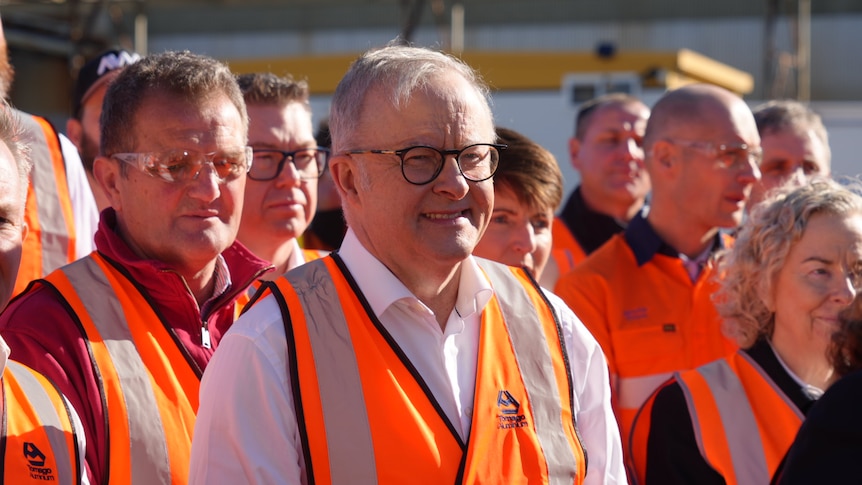
The deal, announced by Anthony Albanese and Chris Minns, comes at a taxpayer cost of $2.5 billion. (ABC Newcastle: Bridget Murphy)
A $2.5 billion taxpayer-funded deal to save Tomago Aluminium has been touted as a lifeline for Australia's aluminium industry, but its hefty price tag has left some questioning whether the deal is in taxpayers' best interests.
The Coalition has called the deal evidence of a net zero "failure", while the Greens want the government to own a stake in the smelter's operations.
The joint funding deal is expected to keep the smelter running for at least another decade.
A $2.5 billion taxpayer-funded deal to save Tomago Aluminium has been touted as a lifeline for Hunter workers and Australia's aluminium industry, but its hefty price tag has left some questioning whether the deal is in taxpayers' best interests.
Prime Minister Anthony Albanese and NSW Premier Chris Minns visited the Hunter region today to announce the deal to the workforce.
Late last year, Tomago, Australia's largest aluminium smelter, announced it would have to close its doors at the end of its current energy supply contract in 2028.
At the time, it blamed the rising cost of coal-fired power and a lack of reliable renewable energy infrastructure to power the smelter's heavy 24/7 operations.
Dan Lines has worked as an electrical engineer at Tomago for 20 years and is also a senior delegate for the Electrical Trades Union.
"There's nearly 200 trades here made up of electricians, fitters, boilermakers and plant mechanics," he told ABC Newcastle Breakfast.
"We build some really great tradesmen."
Dan Lines has worked at Tomago for more than 20 years. (ABC Newcastle: Bridget Murphy)
The business, which employs about 1,000 workers, is renowned for its apprentice program, which offers training and development across a range of trades and is heavily competitive.
Under the agreement announced overnight, the state and federal governments will step in to offer the smelter cheaper power in a 50/50 split, which will keep the smelter running for at least another decade.
At the same time, smelter owners Rio Tinto will invest at least $1.1 billion, including $100 million to introduce further decarbonisation activities at the smelter.