Peptides can be stable in concentrated sulphuric acid: study — Account subscription benefits alongside Premium Stories, Editorials,
Opinions and more. Unlock these with Subscription
The View From India
Looking at World Affairs from the Indian perspective.
First Day First Show
News and reviews from the world of cinema and streaming.
Today's Cache
Your download of the top 5 technology stories of the day.
Science For All
The weekly newsletter from science writers takes the jargon out of science and puts the fun in!
Data Point
Decoding the headlines with facts, figures, and numbers
THEdge
At the cutting edge of education and careers
Health Matters
Ramya Kannan writes to you on getting to good health, and staying there
Gender Agenda
Stories from beyond the binary.
The Hindu On Books
Books of the week, reviews, excerpts, new titles and features.
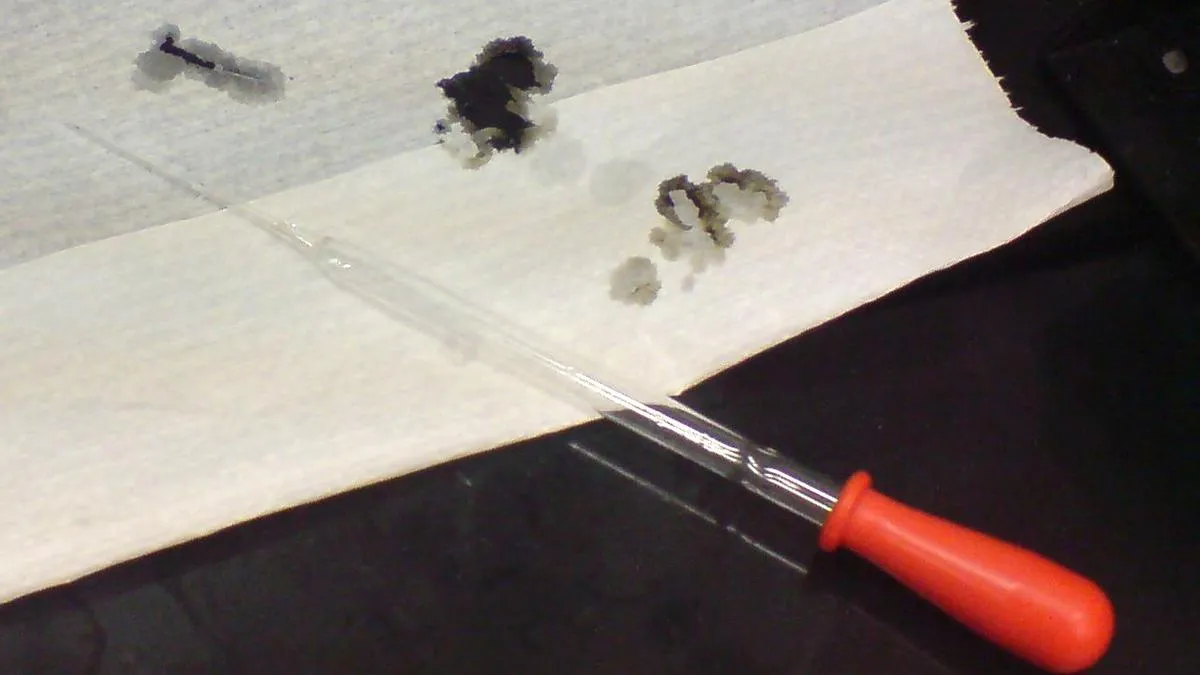
Drops of 98% concentrated sulphuric acid rapidly dehydrates tissue paper, leaving behind carbon, which stains it black.
| Photo Credit: Public domain
Researchers have found that certain peptides — short chains of amino acids that make up proteins — are not only stable in 98% concentrated sulphuric acid but also fold into the complex 3D shapes required to perform the functions central to life.
Thus, the findings, published Proceedings of the National Academy of Sciences on September 4, defy the assumption that concentrated sulphuric acid is a bane for the building blocks of life. Scientists had previously found nucleic acid bases and amino acids to be stable in the same solvent; this is the first time a macromolecule important to biology has been shown to be capable of the same feat.
Normally, strong acids break down peptides in a process called hydrolysis; as the name suggests, water molecules break down one or more important bonds. Since 98% sulphuric acid contains almost no water, the reaction that would normally shred the peptide bonds can’t happen, allowing the peptides to remain stable for several weeks at room temperature.
Using nuclear magnetic resonance spectroscopy, the researchers found that these peptides folded into a specific shape called an omega loop, using the sulphuric acid molecules themselves as a kind of scaffolding to help maintain the shape. This is however a significant departure from how proteins behave in water, where they typically form different structures like helices or sheets.
Account subscription benefits alongside Premium Stories, Editorials,
Opinions and more. Unlock these with Subscription
The View From India
Looking at World Affairs from the Indian perspective.
First Day First Show
News and reviews from the world of cinema and streaming.
Today's Cache
Your download of the top 5 technology stories of the day.
Science For All
The weekly newsletter from science writers takes the jargon out of science and puts the fun in!
Data Point
Decoding the headlines with facts, figures, and numbers
THEdge
At the cutting edge of education and careers
Health Matters
Ramya Kannan writes to you on getting to good health, and staying there
Gender Agenda
Stories from beyond the binary.
The Hindu On Books
Books of the week, reviews, excerpts, new titles and features.
Drops of 98% concentrated sulphuric acid rapidly dehydrates tissue paper, leaving behind carbon, which stains it black.
| Photo Credit: Public domain
Researchers have found that certain peptides — short chains of amino acids that make up proteins — are not only stable in 98% concentrated sulphuric acid but also fold into the complex 3D shapes required to perform the functions central to life.
Thus, the findings, published Proceedings of the National Academy of Sciences on September 4, defy the assumption that concentrated sulphuric acid is a bane for the building blocks of life. Scientists had previously found nucleic acid bases and amino acids to be stable in the same solvent; this is the first time a macromolecule important to biology has been shown to be capable of the same feat.
Normally, strong acids break down peptides in a process called hydrolysis; as the name suggests, water molecules break down one or more important bonds. Since 98% sulphuric acid contains almost no water, the reaction that would normally shred the peptide bonds can’t happen, allowing the peptides to remain stable for several weeks at room temperature.
Using nuclear magnetic resonance spectroscopy, the researchers found that these peptides folded into a specific shape called an omega loop, using the sulphuric acid molecules themselves as a kind of scaffolding to help maintain the shape. This is however a significant departure from how proteins behave in water, where they typically form different structures like helices or sheets.
Source: Read the full report on www.thehindu.com
Written by https://futureknowledge.in/