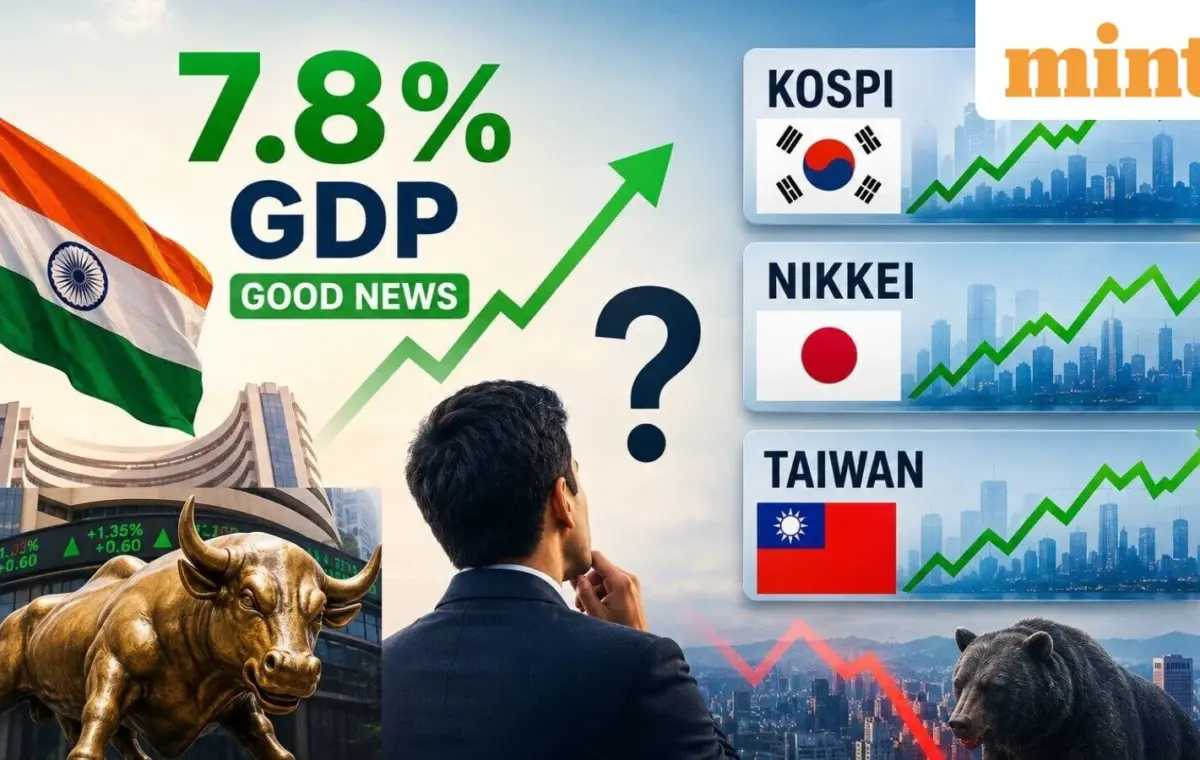
GDP growth rate of India 2026: India’s economic growth engine maintained its momentum in the April-June quarter of FY27, registering a GDP growth of 7.8%, negating any impact of the conflict in West Asia, late onset of the southwest monsoon and uncertain tariff policies, according to official data released on Monday last week. However, a smart investor correlates the stock market with the national economy; in India, the scenario is completely different.
The key benchmark indices of the Indian stock market, Nifty 50, registered an 8.60% loss in YTD, and the BSE Sensex logged over a 10% correction in YTD. The Bank Nifty index shed nearly 3.90% in 2026.
In Asian markets, the South Korean KOSPI, Japanese Nikkei 225, and South Korean Taiwan Weighted index have delivered robust gains of 55%, 25%, and 60%, respectively. They have delivered such impressive returns even when their economy failed to beat India's economic indicators, such as GDP.
Speaking on the GDP growth of India in 2026 and its impact on the Indian stock market, Avinash Gorakshkar, a SEBI-registered fundamental equity analyst, said, 'Normally, the stock market is linked to the national economy. India's GDP performed well during the April to June 2026 quarter, as reflected in the Q1 2026 results. The market is expecting a similar result in the next quarter; hence, Q2 2026 results are also expected to boost the market."
On why the Indian stock market is unable to reflect the GDP growth of India 2026, Anuj Gupta, a SEBI-registered market expert, said, “The Indian stock market was unable to sustain the soaring crude oil prices in the wake of the US-Iran war and closure of the Strait of Hormuz. The US-Iran war began on 28th February 2026, and there are no signs of any ceasefire even after more than six months of the beginning of this war. When the war began, crude oil price was around $65 per barrel, while it is still above $90 per barrel.”
On how the Asian markets perform well, as they also had to face the same soaring crude oil price challenge, Gupta said, “These Asian market bourses performed well due to the AI-led buying in the semiconductor and chips stocks.”
Raising a warning for the Indian stock market, Sandeep Pandey, Co-founder of Basav Capital, said, “We have noticed that the Indian stock market falls when the Asian or the Global markets fall, even if there is profit-booking in the AI-stocks. Our tech, IT, and banking stocks fall when AI stocks fall in the global markets. As Asian bourses like KOSPI, Nikkei 225 and Taiwan Weighted Index are in the overbought conditions and profit-booking may trigger any time there, the outlook for Sensex, Nifty 50, and the Bank Nifty index doesn't look impressive even after the stellar GDP growth of India in Q1FY27.”
Disclaimer: This story is for educational and informational purposes only. The views and recommendations above are those of individual analysts or broking companies, not Mint. We advise investors to check with certified financial experts before making any investment decisions.
Asit Manohar has nearly two decades of experience in the mainstream media. In this period, he has served esteemed media organisations like NDTV Profit, The Economic Times, and Zee Business. He has been working at LiveMint Digital since April 2021. During these two decades of journey in mainstream media, Asit has mainly covered external affairs, markets and personal finance. However, his earliest beats include railways, SME, MSME, and politics (Congress beat). Some of his features on political, economic, and foreign policy are documented in the parliamentary records.
<br><br>
While pursuing his MA (Mass Communication, Session 2004-06), Asit began his media career as a stringer at All India Radio in Varanasi. At AIR Varanasi, Asit worked with the Gyanvani, Yuvvani and Vividh Bharti teams. After working for nearly one year at AIR Varanasi, he shifted to print journalism and started working as a stringer for the HT Media Ltd, Varanasi. At HT Media Ltd in Varanasi, he covered the BHU beat.
<br><br>
Asit has also worked with some brokerage houses. He has worked with Religare Broking and India Infoline, where he assisted the research team in developing and executing trade strategies for intraday cash, F&O, and commodities.
<br><br>
Asit is a Gold Medalist in MA (Mass Communication) from BHU, Varanasi. He did his BSc. (Hons) in Mathematics from Magadh University, Bodh Gaya. Asit was a National Talent Scholarship holder during his senior secondary studies (1988-91).
Catch all the Business News , Market News , Breaking News Events and Latest News Updates on Live Mint. Download The Mint News App to get Daily Market Updates.
Log in to our website to save your bookmarks. It'll just take a moment.
Oops! Looks like you have exceeded the limit to bookmark the image. Remove some to bookmark this image.
Source: Read the original article on www.livemint.com
Written by https://futureknowledge.in/