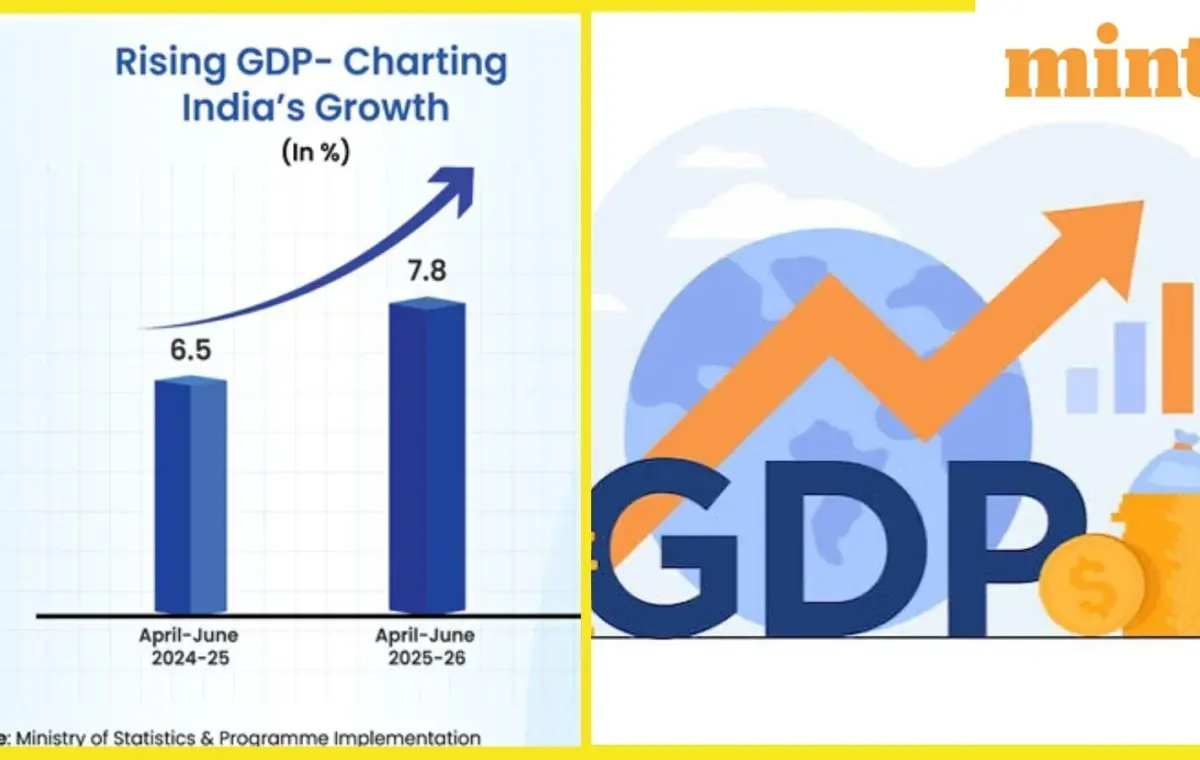
Mint Explainer: The Congress party has questioned the government’s claim that India’s economy grew by 7.8% in the April-June 2026 quarter, raising concerns over revisions to previous years’ GDP figures, inflation estimates and the performance of manufacturing and private consumption.
In a statement released on Thursday, Congress General Secretary (communications) Jairam Ramesh argued that a closer examination of the numbers raised questions about the basis of the calculation.
The real annual GDP growth for FY 2025-26 is estimated at 7.6%, higher than the 7.1% recorded in FY 2024-25, while nominal GDP, measured at current prices, is projected to grow by 8.6% during FY 2025-26, the data released by the Ministry of Statistics and Programme Implementation on 31 August said.
Ramesh, a Rajya Sabha member, who raising questions on the numbers, argued that reducing the base against which the current year’s growth is measured can make the growth rate appear significantly higher even if there has been no corresponding change in the underlying economic activity.
Citing former Finance Secretary Subhash Chandra Garg's remarks on the same, Ramesh said that if the base-year figure had not been revised down, nominal growth in the quarter would have been closer to 2.6%, rather than the 10.3% claimed by the government. He further claimed that after adjusting for inflation, real growth would be close to zero.
Prime Minister Narendra Modi called the “exemplary GDP growth of 7.8% during Q1 of FY 2026-27” a ‘herculean feat.’ Modi congratulated people for their hard work and said the country's economic growth came despite global challenges, including wars, crises and disrupted supply chains. He also took a dig at the opposition for echoing falsehoods and spreading despair.
The figure exceeded economists' projections. This is because, at the start of the quarter, the US-Iran war had led most analysts to lower their growth forecasts. The geopolitical turmoil was disrupting economies worldwide. India, in particular, was expected to see slower growth because of its heavy dependence on West Asia for energy imports, especially crude oil.
The criticism by the Congress party centres on the base-year revision. It is important to note that on 27 February this year, MoSPI unveiled a new GDP data series, changing the base year from 2011-12 to 2022-23.
So, what is a base-year revision, and why does it matter? Mint explains
Base-year revisions are a routine exercise, usually carried out every five years. India’s latest revision, however, had been long overdue, and hence, there were questions raised on the GDP data.
A base-year revision allows the government to incorporate newer data sources, improve its methodology and better capture changes in the economy, which can look very different over five years.
The latest revision also changed the size of India’s GDP. For instance, nominal GDP for 2025-26 was revised downward from ₹357 trillion under the old series, which used 2011-12 as the base year, to ₹345 trillion under the new series, which uses 2022-23 as the base year.
Rebasing is the process of updating the base year with revised, improved data to reflect the economy's current structure, the government said in a statement on 27 February when it released a new GDP data series. The new base then serves as the reference point for estimating GDP and its components, as well as key indicators such as the Consumer Price Index (CPI) and the Index of Industrial Production (IIP), going forward, it added.
In simpler terms, the base year provides an opportunity for the government to incorporate new data sources, improve methodology and capture data more accurately.
As per National Accounts Statistics, which provides data on the national income, production, and expenditure aggregates of the Indian economy, the base year is the reference year whose prices are used to calculate real growth, the government said.