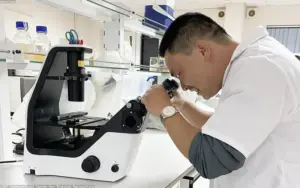
Prof Richard Bassed helped identify Boxing Day tsunami and victims of Australia’s catastrophic Black Saturday bushfires. ‘The randomness of this massive flood,’ he says. ‘That gets to you’
Get our breaking news email, free app or daily news podcast
The bodies of some of those killed in the Nepal-Tibet flood disaster may never be found, and some of those that are may never be identified, a world-renowned forensic scientist says.
Prof Richard Bassed, the head of forensic medicine at Melbourne’s Monash University, spent three months in Thailand after the 2004 Boxing Day tsunami and also helped to identify victims of Victoria’s catastrophic Black Saturday bushfires in 2009.
Now he has watched as authorities in Nepal and Tibet struggle to find and identify the dead amid the agonies of the living after last week’s devastating flash flood. More than 1,250 people have been confirmed dead, with more than 5,000 missing.
The difficult terrain, and inadequate communications and resources, would all hamper efforts, Bassed says.
“They could be washed anywhere, buried under mud. I imagine there’s a number they’ll never find. I imagine they’ll be finding bodies next year.”
Authorities are still finding bodies from the 2011 Japanese tsunami, he says.
The bodies from the 2004 tsunami were relatively easy to recover, but it still took a year to identify 5,000 people, he says.
“And there were still some we couldn’t identify.”
Asked how he copes with the horror of death on such a scale, he says he has “never found it long-term traumatising”.
“Occasionally you’ll see something that’ll hit close to home. For me, it’s kids,” he says.
“And the randomness. The randomness of a tsunami, the randomness of this massive flood. That gets to you.
“But mostly you have your clinical face on, you do the best you can and know you’re doing it to help people.”
Authorities will use rapidly improving DNA techniques to try to identify the victims. This week Nepali police urged relatives of missing tourists to provide “a fresh blood sample for DNA profiling and two passport-sized photographs” to the pathology laboratory at the police hospital in Kathmandu.