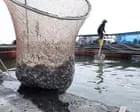
Huge rollout of fish farms could harm ecosystems and threaten vulnerable communities’ food sources, say experts
Nearly half of the world’s wild fish catch will be ground into animal feed for farmed fish if plans to expand aquaculture go ahead, a report has found.
The UN’s Food and Agriculture Organization (FAO) is aiming to increase aquaculture – where fish are farmed rather than caught in the wild – production by 75% by 2040.
The plans form part of its “blue transformation” agenda to meet growing global demand for seafood, improve food security and eradicate world hunger by 2030.
But an analysis by Changing Markets Foundation found the plans would potentially pull tens of millions of tonnes of fish from the oceans each year to feed species such as salmon and shrimp.
Aquaculture adds to the intense pressure on overexploited fisheries because food is removed from marine ecosystems and the coastal communities that rely on them.
Aquaculture supplies more than half of the aquatic animals consumed worldwide, according to the report. Carnivorous farmed species are commonly fed fishmeal and fish oil made by grinding down smaller wild fish such as anchovies and sardines.
“These fish are naturally carnivorous species, so that is what they would eat in the wild,” said Tara Ganesh, a senior campaigner at Changing Markets Foundation. “You can’t suddenly raise a salmon overnight that is vegetarian.”
Although producers had reduced the amount of wild fish used for each kilogram of farmed fish, she said this did not mean the industry’s total consumption was falling.
Modelling produced with the University of British Columbia found that, if industry trends continued, up to 34.6m tonnes of wild fish could be caught and fed to farmed species annually by 2040.
The FAO has not specified which species or farming systems should deliver the 75% increase in aquaculture. Changing Markets Foundation modelled several possible routes to the target and found that, under a scenario weighted towards feed-intensive species such as salmon and shrimp, demand for wild fish could rise to 41.4m tonnes – equivalent to 46% of the global wild-fish catch in 2020.
Muhammed Oyinlola, an aquatic ecologist at the University of British Columbia, said: “Our modelling shows that the outcome is not inevitable. A more diversified option favours growth in lower-input species, while ambiguity leaves the door open to growth that threatens communities, fisheries and the climate.”
The scale of the impact would depend heavily on which species and production systems were expanded, the research said. But neither the FAO’s roadmap nor its guidelines for sustainable aquaculture specify how its growth target should be met.
The report also says safeguards addressing the nutritional and food security effects of aquaculture trade and consumption were removed from successive drafts of the guidelines without explanation.
Changing Markets Foundation examined a December 2023 workshop in Ghana organised by the FAO in collaboration with the Global Roundtable on Marine Ingredients, an industry coalition. “Small-scale fisheries representatives instead called for sardinella to be reserved for direct human consumption and for fishmeal factory expansion to be halted,” it said.