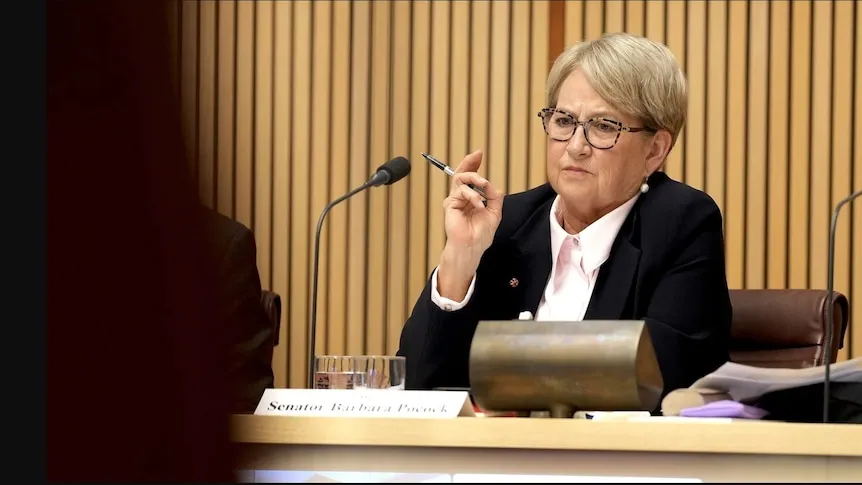
Senator Barbara Pocock at the select committee on intergenerational housing inequity. (ABC News: Callum Flinn )
NAB is forecasting a peak-to-trough decline in dwelling prices of about 7 per cent across Australia's combined capital cities.
But Sally Auld, NAB chief economist, says the price declines will not solve Australia's housing affordability issues.
Luci Ellis, Westpac chief economist, said relatively low inflation and financial deregulation had also contributed to rising house prices to household incomes in Australia in recent decades.
Australia's property price declines are forecast to be relatively large but they will not solve this country's housing affordability issues, an inquiry has heard.
Sally Auld, NAB chief economist, says Australia's housing problems have been accumulating for so long that they will take a "generation" to fix.
There has been a 20 per cent jump in Australian children growing up in rental households this century, with this group facing an average of six moves by age 14, according to a new research paper.
NAB is forecasting a peak-to-trough decline in dwelling prices of around 7 per cent across Australia's combined capital cities, equivalent to a fall of around 5 per cent during the 2026 calendar year.
"While some will welcome the drop in prices, this will not solve Australia’s housing affordability issues," Dr Auld said yesterday.
"Meaningful improvements in affordability will only be achieved through a sustained increase in housing supply over a long period of time.
Dr Auld made her comments before the Senate select committee on intergenerational housing inequity.
"House prices have risen much faster than incomes since around the turn of the century, driven by factors including lower interest rates, taxation settings and strong demand," she said.
"Housing affordability is one of Australia's most significant economic and social challenges."
Sally Auld giving evidence to the Senate select committee on intergenerational housing inequity. (ABC News: Callum Flinn)
Luci Ellis, Westpac chief economist, and former Reserve Bank assistant governor (economic), also appeared before the committee.