A leak on the Chinese social media site Weibo, 白饭炒白米饭, has posted images of what are purported to be the solder joint diagram for the A20 Pro (the diagram showing all the little contact points by which the chip is attached to the board beneath). This account has correctly leaked details of some Apple chips or products in the past.
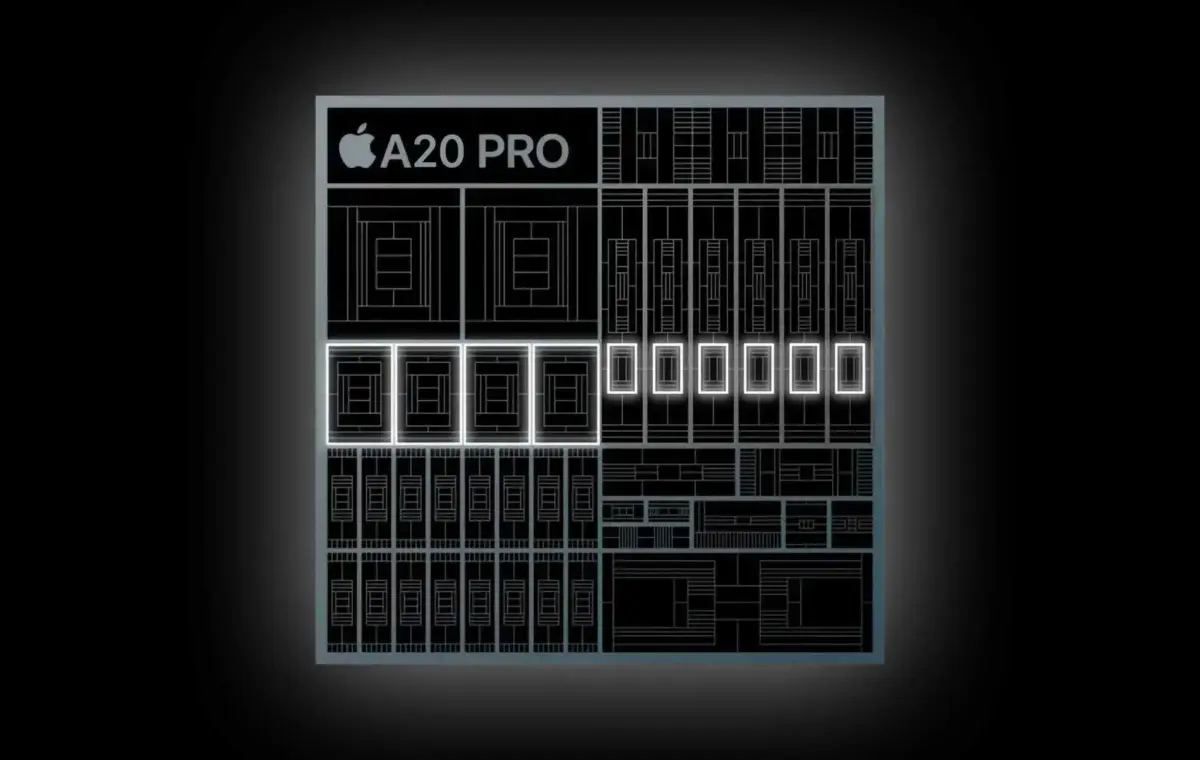
From there, the leaker has used the layout and the previous chip block diagram to estimate some of the layout of the new A20 chip—a rough diagram of some of the major components.
There are three details gleaned from this process, if you trust in its accuracy.
How does all this compare to the A19 Pro, and what could it mean? Well, the smaller efficiency cores all share a single 8MB L2 cache, which is 2MB more than before. That will speed things up a bit when the efficiency cores do bigger jobs on larger data sets. The two performance cores share a 16MB L2 cache (two 8MB blocks in the diagram), which is the same as before.
It’s not clear if any of these cores have architectural design changes or if these cores are Apple’s “Super Cores.”
Going up from 6 GPU cores to 7 is an increase of about 16 percent. We think it’s likely that the iPhone 18 Pro and Pro Max will have all GPU cores enabled, but the folding iPhone Ultra (very thin and difficult to cool) will have one core disabled, just as the iPhone Air has one A19 Pro GPU core disabled.
Graphics performance tends to be highly constrained by memory bandwidth, which is where the change to the memory interface gets interesting. Apple is not making the jump to LPDDR6 this year, sticking with LPDDR5x again, but a 50 percent wider interface means 50 percent more memory bandwidth. If Apple increases the memory clock speed, it can be even more.
So while there are “only” 16 percent more GPU cores, the increase in memory bandwidth and the potential for higher clock speeds or GPU core architectural improvements means that we can expect 20-30 percent higher GPU performance. That’s not unprecedented, but it’s more than we predicted in our A20 preview.
AI is increasingly important to Apple, and it shares many core architectural features between its A-series mobile chips and its M-series chips for Macs. So it makes sense that Apple is investing heavily in GPU performance, memory bandwidth, and GPU compute features—all of which help with running or training local AI models. Fortunately, even if you don’t care about AI performance, all of this increased GPU performance and memory bandwidth will also mean better performance for 3D games and other graphics-intensive apps and tasks.